
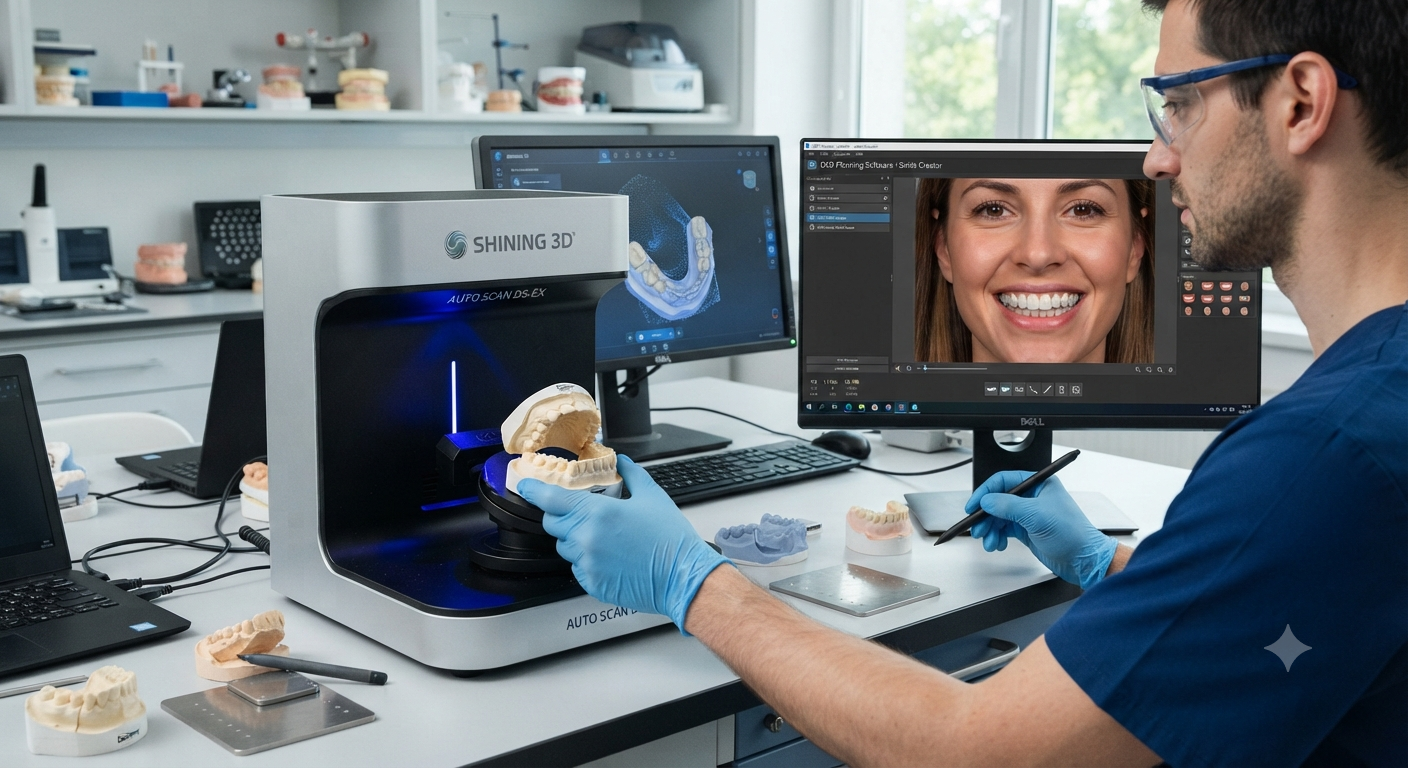
What if your dentist could show you your future smile before treatment even started?
Not through imagination. Not through a simple before-and-after photograph. But through a detailed digital model that lets you visualize how your teeth could look and fit within your overall facial appearance.
This is the exciting direction in which modern cosmetic dentistry is moving.
At the heart of this transformation is digital smile design, a technology-driven approach that is changing how dentists plan aesthetic treatments, communicate with patients, and collaborate with dental laboratories.
For more than a decade, 2D smile planning has helped dentists create visual treatment concepts using photographs and digital overlays. It was a major step forward—but dentistry is no longer limited to flat images.
Today, advanced 3D scanning, digital modeling, CAD/CAM, and 3D printing are helping dental professionals create more detailed and connected treatment workflows.
And this shift is part of a much larger technological trend.
Across engineering and manufacturing, an industrial 3d scanner can capture complex physical surfaces and convert them into highly detailed digital data for design, inspection, and quality control. Dentistry uses specialized technologies designed specifically for the oral environment, but the growing importance of accurate 3D data is influencing digital workflows across many fields.
So, what happens when this 3D mindset meets cosmetic dentistry?
The answer is a completely new way to plan a smile.
The Problem With a Smile That Exists Only in 2D
A smile might look simple when you see it in a photograph.
But behind that image is a complicated three-dimensional structure.
Every tooth has depth.
Every dental arch has curvature.
Every person’s face has unique proportions.
The lips move.
The gums create contours.
The jaw controls function.
A single photograph can show you only one part of the story.
This is why traditional 2D smile planning can become challenging in complex cases.
A design may look perfect from the front but may not have the right contours from the side.
A tooth may appear correctly proportioned but require a different three-dimensional shape to function properly.
A beautiful digital image may also be difficult to reproduce exactly in the patient’s mouth.
This is the “translation gap” between digital visualization and clinical reality.
And it’s one of the biggest reasons dentistry is moving toward 3D planning.
The Evolution of Digital Smile Design
The concept of digital smile design changed how dentists communicate with patients.
Instead of saying:
“Your teeth could be longer.”
A dentist could show the patient.
Instead of explaining:
“We can improve the symmetry of your smile.”
The patient could see a visual representation.
This made aesthetic dentistry more transparent and easier to understand.
But modern digital workflows are taking this concept further.
Rather than relying only on a frontal photograph, dentists can increasingly work with multiple sources of digital information.
These may include:
- Intraoral scans
- Facial photographs
- 3D facial scans
- Digital dental models
- Occlusal information
- Jaw movement data
- CBCT imaging when clinically appropriate
- CAD software
- 3D-printed models
When these datasets are combined, the dental team can build a more comprehensive digital picture of the patient.
The result is a shift from:
“How will the smile look?”
to:
“How will the entire smile work within the patient’s face and oral anatomy?”
That’s a much bigger question.
3D Planning Brings the Smile to Life
One of the most exciting aspects of modern digital dentistry is the ability to move from virtual design to physical testing.
A digital smile concept doesn’t have to remain on a screen.
It can be transformed into a physical mock-up.
It can be used to create temporary restorations.
It can guide preparation.
It can help the dental laboratory understand the intended result.
This creates an important bridge between technology and clinical practice.
A dentist can evaluate the proposed design.
A patient can experience the proposed smile.
A laboratory technician can work from detailed digital information.
And the entire team can make adjustments before definitive treatment.
The process becomes more collaborative.
Why Patients Are Asking for More Visualization
Today’s patients live in a highly visual world.
Before buying a car, they can explore different configurations.
Before remodeling a home, they can see digital designs.
Before purchasing furniture, they can visualize it in their room.
Naturally, patients undergoing cosmetic dental treatment also want to understand what they are getting.
They want to know:
“Will this smile suit my face?”
“Will the teeth look natural?”
“What will change?”
“Can I see the proposed result?”
This is where advanced digital smile design can improve communication.
Digital visualization doesn’t replace professional advice or guarantee an exact final result.
Instead, it gives dentists and patients a shared visual language.
The dentist can explain.
The patient can visualize.
Together, they can discuss expectations.
That’s a powerful change in the treatment experience.
Why 3D Matters More in Complex Cases
Simple cosmetic treatments may not require extensive 3D planning.
But as treatment becomes more complex, the need for detailed information increases.
Imagine a complete smile makeover involving multiple teeth.
The dentist may need to coordinate:
- Tooth length
- Tooth width
- Tooth angulation
- Tooth position
- Gingival levels
- Smile arc
- Midline
- Occlusal plane
- Facial proportions
Changing one factor can affect another.
A small alteration in tooth length may influence the smile arc.
A change in tooth position may affect the bite.
A modification to gingival levels may change perceived tooth proportions.
This interconnected relationship is difficult to fully understand from a single photograph.
3D planning can provide a broader perspective.
It allows the dental team to examine the proposed treatment as a complete system rather than as a collection of individual teeth.
What 3D Scanning Has to Do With It
The growth of 3D scanning is one of the most important developments behind modern digital workflows.
In manufacturing, 3D scanners are used to capture physical objects and create digital representations.
An industrial 3d scanner may help engineers inspect components, compare dimensions, analyze surfaces, or recreate physical objects digitally.
In dentistry, specialized intraoral and facial scanning systems perform a different job, but the underlying digital concept is similar.
Physical reality becomes digital data.
Digital data becomes a digital model.
The digital model becomes a design.
The design can then be translated back into the physical world.
This creates a powerful digital loop.
Scan → Plan → Design → Simulate → Manufacture → Treat
That workflow is helping dentistry become increasingly data-driven.
Digital Smile Design Meets 3D Printing
The relationship between digital planning and 3D printing is another major development.
Once a digital design has been created, it can potentially be converted into a physical object.
Depending on the case, this could include:
- Diagnostic models
- Mock-ups
- Temporary restorations
- Surgical guides
- Preparation guides
- Prototypes
This can help the dental team evaluate the design before completing the final treatment.
It also gives patients an opportunity to participate more actively in the process.
Instead of seeing only a computer-generated image, they may be able to experience a physical representation of the proposed changes.
This can make the treatment process more understandable and interactive.
Better Collaboration Between Dentists and Laboratories
The digital revolution isn’t only changing the patient experience.
It’s also transforming how dental professionals work together.
Traditional communication between dentists and laboratories often relied on physical impressions, photographs, written instructions, and phone calls.
Digital workflows can add another layer of information.
A laboratory can receive digital scans and treatment designs.
The dentist can communicate aesthetic goals more clearly.
The technician can better understand the intended contours and proportions.
This can make the workflow more connected.
For complex aesthetic cases, better communication can be extremely valuable.
Does This Mean 2D Smile Design Is Outdated?
Not necessarily.
2D smile design still has a place in modern dentistry.
It’s simple.
It’s accessible.
It’s easy to explain.
It’s useful for initial patient consultations.
It can help communicate an overall aesthetic vision quickly.
The real evolution isn’t about completely eliminating 2D planning.
It’s about adding another dimension when the case requires it.
Think of it this way:
2D helps tell the story.
3D helps understand the complete picture.
Digital manufacturing helps turn the plan into reality.
Together, they create a more comprehensive workflow.
The Future Could Be Smarter Than Ever
The next generation of digital smile design may become even more intelligent.
Artificial intelligence could help analyze facial proportions.
Automated systems may assist with treatment simulations.
Cloud platforms could improve collaboration between dentists and laboratories.
3D printing could make physical prototypes faster and more accessible.
Virtual reality and augmented reality could eventually provide even more immersive ways for patients to experience proposed treatments.
The possibilities are expanding rapidly.
But technology alone won’t create a beautiful smile.
The final result will still depend on clinical expertise, diagnosis, experience, materials, and careful execution.
Technology is the tool.
The dentist remains the decision-maker.
https://freeseobacklinks.online/the-growing-role-of-3d-scanning-and-3d-printing-in-modern-dentistry/
https://shopnets.com/how-3d-scanning-and-3d-printing-are-creating-a-smarter-future-for-dentistry/
https://newsgrow.blogspot.com/2026/07/how-3d-scanning-and-3d-printing-are.html
https://newsgrow.blogspot.com/2026/07/from-flat-photos-to-3d-precision-how.html
https://blogstream.net/your-next-smile-could-be-designed-before-you-ever-sit-in-the-dentists-chair/
https://freeseobacklinks.info/how-3d-technology-is-changing-the-future-of-digital-smile-design/