
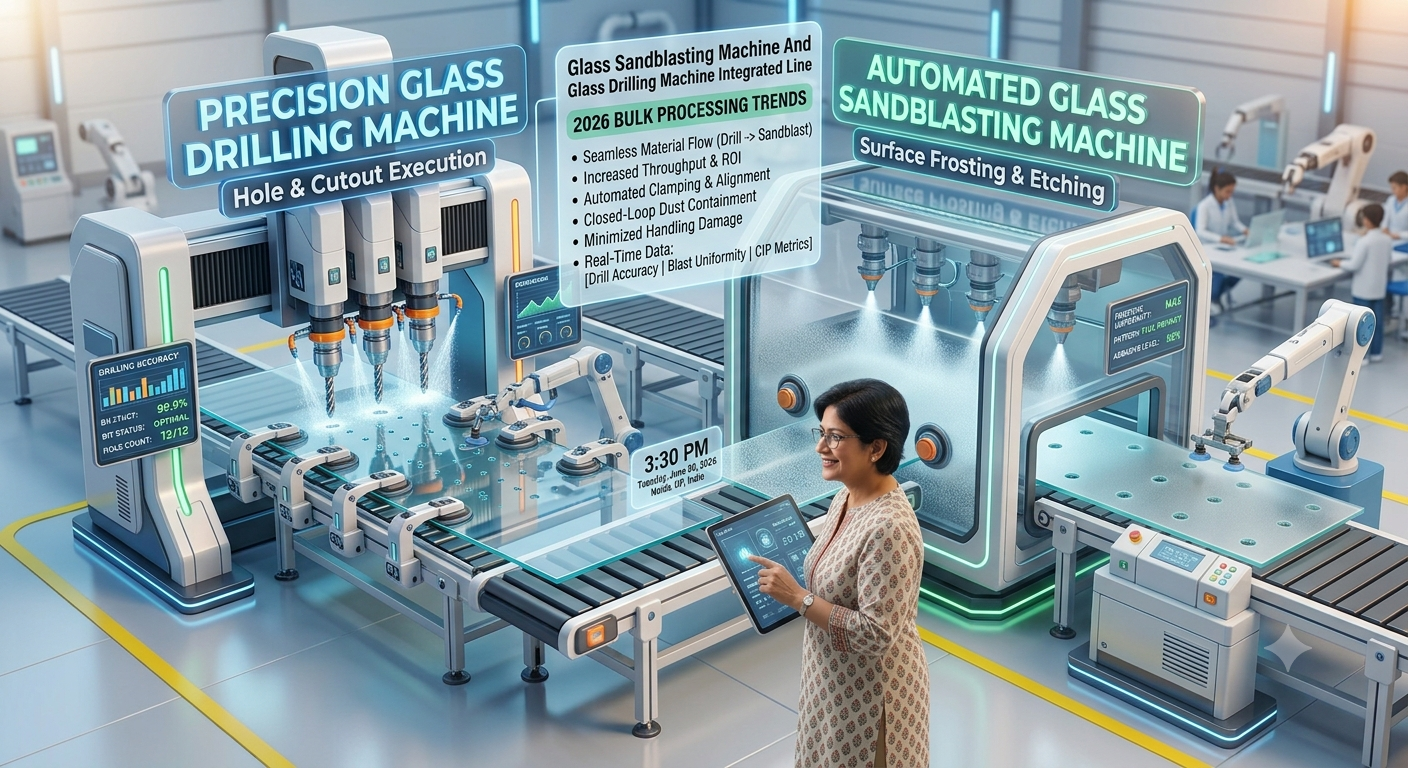
The glass processing industry is entering a new phase as manufacturers increasingly adopt advanced equipment to improve precision, productivity, and product quality. Among the technologies gaining attention are the Glass Sandblasting Machine and Glass Drilling Machine, two solutions that are helping businesses handle demanding architectural, interior, furniture, automotive, and decorative glass applications.
As customers seek more customized glass designs, processors need machinery capable of delivering consistent results while reducing manual effort. Modern equipment is responding to this demand with automated controls, improved accuracy, and flexible processing capabilities. Together, these machines are becoming important tools for companies looking to modernize production and compete in a rapidly evolving market.
Growing Demand for Advanced Glass Processing
Glass is no longer used only as a basic construction material. Today, it plays a major role in façades, shower enclosures, partitions, doors, furniture, signage, railings, and decorative interiors. This growing range of applications requires specialized processing techniques.
A Glass Sandblasting Machine is primarily used to create frosted, matte, textured, or decorative surfaces, while a Glass Drilling Machine produces accurate holes required for fittings, handles, hinges, connectors, and installation systems.
The growing adoption of these machines is being driven by several factors:
- Rising demand for customized architectural glass
- Increasing use of decorative and privacy glass
- Need for higher production efficiency
- Demand for consistent finishing quality
- Reduced dependence on manual processing
- Growing preference for digitally controlled machinery
Manufacturers are therefore investing in equipment that can combine speed, precision, reliability, and operational flexibility.
How Glass Sandblasting Machines Are Transforming Surface Finishing
A Glass Sandblasting Machine uses abrasive media to treat the glass surface and create a controlled frosted or textured appearance. Depending on the equipment configuration and processing requirements, manufacturers can produce different patterns, levels of opacity, and decorative effects.
Modern machines are increasingly designed to provide greater control over blasting pressure, movement, and processing consistency. This is particularly valuable when working on large production orders where uniformity is essential.
Key Applications of Glass Sandblasting
The technology is widely used for:
- Decorative glass panels
- Office partitions
- Shower doors
- Interior design elements
- Signage and branding
- Privacy windows
- Furniture glass
- Architectural installations
A major advantage is the ability to transform standard glass into a visually distinctive product without changing its fundamental structure.
Why Automation Matters
Automated sandblasting systems can help operators achieve more consistent results while reducing repetitive manual work. Advanced controls may also support programmed processing patterns, helping businesses manage customized designs more efficiently.
Glass Drilling Machines Bring Precision to Manufacturing
The Glass Drilling Machine is another essential technology for modern glass processors. Drilling glass requires careful control because excessive pressure, incorrect speed, or poor alignment can lead to cracks, chips, or breakage.
Modern drilling systems are designed to improve hole accuracy and repeatability. Depending on the machine type, they can be used for different glass thicknesses and hole sizes, making them suitable for a wide range of industrial and commercial applications.
Where Glass Drilling Is Used
Common applications include:
- Glass doors and shower enclosures
- Furniture and display units
- Architectural façades
- Railings and balustrades
- Industrial glass components
- Hardware installation
- Commercial interiors
For manufacturers handling high volumes, automated drilling can improve production consistency while reducing material waste caused by processing errors.
Glass Sandblasting Machine vs. Glass Drilling Machine
Although both machines serve the glass processing industry, their functions are significantly different.
| Feature | Glass Sandblasting Machine | Glass Drilling Machine |
| Primary function | Surface treatment | Hole creation |
| Main result | Frosted or textured finish | Accurate drilled holes |
| Typical use | Decorative and privacy applications | Hardware and installation |
| Processing focus | Surface appearance | Dimensional precision |
| Common industries | Architecture, interiors, décor | Construction, furniture, manufacturing |
| Key benefit | Custom visual effects | Accurate functional processing |
For many modern glass businesses, these machines are complementary rather than competing technologies. A manufacturer may use drilling equipment to prepare a panel for installation and sandblasting equipment to create its desired decorative finish.
Choosing the Right Glass Processing Equipment
Selecting the right machinery requires careful consideration of production requirements. Businesses should evaluate several factors before investing.
Important Selection Criteria
1. Production volume: High-volume manufacturers may benefit from automated systems designed for continuous operation.
2. Glass dimensions: The machine should accommodate the size and thickness of the glass being processed.
3. Accuracy requirements: Applications involving precision fittings require reliable dimensional control.
4. Automation level: Automated controls can reduce operator workload and improve repeatability.
5. Maintenance: Easy access to critical components can simplify routine servicing.
6. Safety features: Glass processing equipment should incorporate appropriate safeguards and operational controls.
Industry Trends Driving Machine Innovation
The glass machinery sector is evolving alongside broader manufacturing trends. Automation, digital controls, and customized production are influencing how processors approach their operations.
Manufacturers are increasingly looking for equipment that can support shorter production cycles without compromising quality. At the same time, the demand for personalized glass products is encouraging machinery suppliers to develop more flexible solutions.
The integration of advanced control systems is also helping operators monitor processes more effectively. As competition increases, companies that invest in efficient and accurate glass processing technologies may be better positioned to respond to changing customer expectations.
Benefits for Modern Glass Manufacturers
Investing in a Glass Sandblasting Machine or Glass Drilling Machine can offer several operational advantages when the equipment is properly matched to production needs.
Major Benefits
- Improved processing consistency
- Higher production efficiency
- Greater design flexibility
- Reduced manual intervention
- Better repeatability
- Lower risk of processing errors
- Support for customized products
- Improved production planning
However, machinery alone does not guarantee better results. Operator training, correct maintenance, suitable tooling, and appropriate process settings remain essential for achieving reliable performance.
What the Future Holds for Glass Processing
The future of glass manufacturing is likely to be shaped by increasing automation and demand for customization. As architectural designs become more sophisticated, glass processors will need technologies capable of handling complex requirements efficiently.
The combination of surface finishing and precision drilling is expected to remain important across multiple sectors. From premium residential interiors to large commercial developments, manufacturers are increasingly seeking equipment that delivers dependable performance at scale.
For businesses considering new machinery, the focus should be on long-term productivity rather than simply selecting the lowest-cost option. Equipment reliability, technical support, ease of operation, and compatibility with existing production workflows can all influence the overall return on investment.
Frequently Asked Questions
1. What is a Glass Sandblasting Machine?
A Glass Sandblasting Machine is specialized equipment used to create frosted, matte, textured, or decorative finishes on glass surfaces through controlled abrasive treatment.
2. What does a Glass Drilling Machine do?
A Glass Drilling Machine creates precise holes in glass for applications such as handles, hinges, fittings, connectors, and mounting hardware.
3. Can sandblasting be used for decorative glass?
Yes. Sandblasting is commonly used to create decorative patterns, privacy effects, logos, textures, and frosted designs.
4. Is glass drilling difficult?
Glass drilling requires precision because improper pressure, speed, or alignment can cause cracking or breakage. Specialized machinery helps improve accuracy.
5. Which industries use glass sandblasting?
Architecture, interior design, furniture, construction, signage, and decorative glass manufacturing are among the major application areas.
6. Where are glass drilling machines commonly used?
They are widely used in architectural glass, furniture manufacturing, shower enclosures, façades, railings, doors, and commercial interiors.
7. Are automated glass machines better than manual systems?
Automation can improve consistency, productivity, and repeatability, particularly for manufacturers handling larger production volumes.
8. How should businesses choose glass processing equipment?
Businesses should consider production volume, glass dimensions, thickness, required accuracy, automation, maintenance, safety, and after-sales technical support.
9. Can one machine perform both sandblasting and drilling?
Typically, these are separate processing technologies designed for different purposes. Some production facilities use both machines as part of an integrated workflow.
10. Why is precision important in glass processing?
Precision helps reduce breakage, improve product quality, ensure accurate fitting, and minimize material waste during manufacturing.