
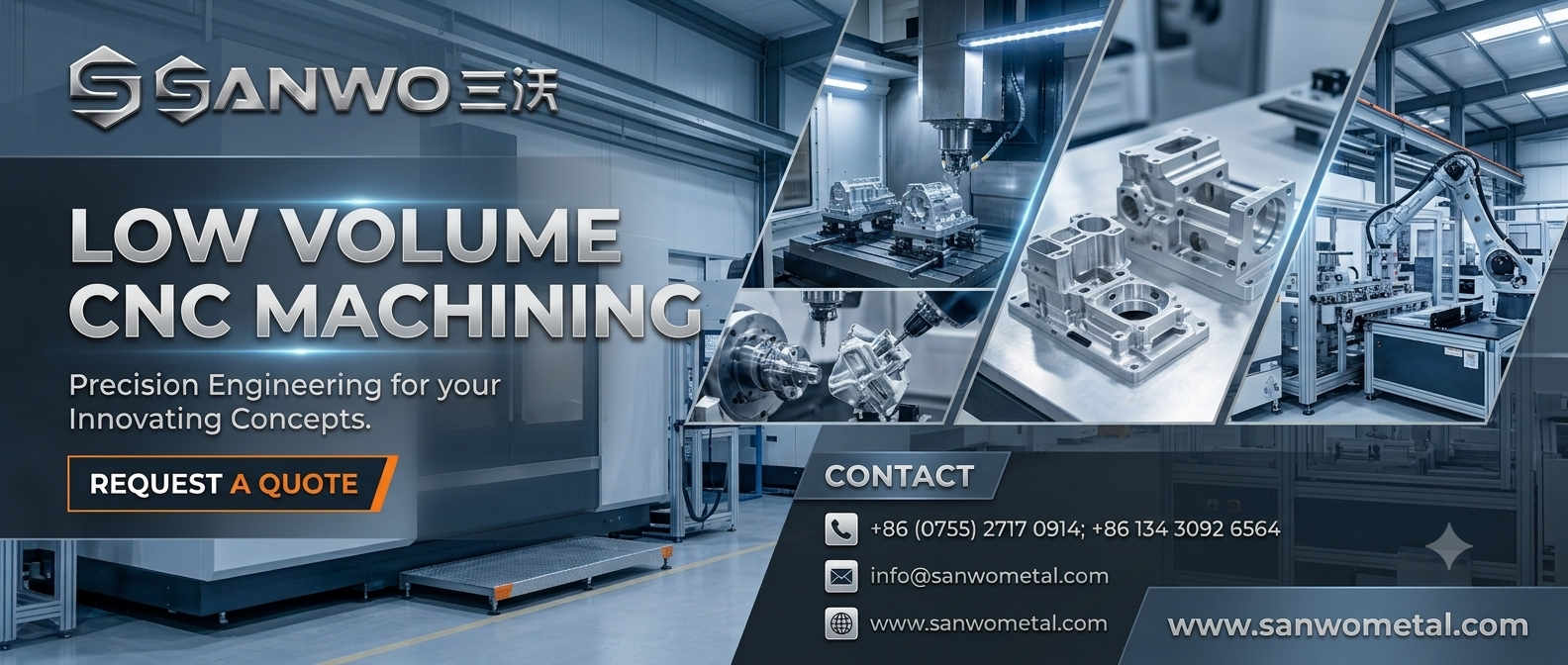
In today’s competitive manufacturing landscape, speed and flexibility often determine whether a product succeeds or falls behind. Businesses no longer want to invest in expensive tooling before validating a design. Instead, they are turning to low volume CNC machining to produce high-quality parts quickly while keeping development costs under control.
For startups, OEMs, automotive suppliers, robotics companies, and medical device manufacturers, low-volume production has become a strategic advantage rather than simply a manufacturing option.
Companies like Sanwo Metal help businesses bridge the gap between prototyping and mass production by delivering precision-machined components with consistent quality, shorter lead times, and scalable manufacturing solutions.
What Is Low Volume CNC Machining?
Low volume CNC machining is the process of manufacturing a limited number of precision parts using computer-controlled CNC equipment. Production quantities typically range from a single prototype to several thousand units, depending on project requirements.
Unlike traditional manufacturing methods that require expensive molds or tooling, CNC machining directly converts CAD files into finished components.
This makes the process ideal for:
- Product development
- Engineering validation
- Functional testing
- Bridge production
- Custom industrial equipment
- Replacement components
- Market launch preparation
Manufacturers can quickly move from design to production without the delays associated with tooling.
Why Manufacturers Are Choosing Low Volume Production
Global manufacturing trends are changing rapidly.
Product life cycles are becoming shorter.
Customer expectations continue to increase.
Companies need faster design improvements.
These changes have made low volume CNC machining an essential manufacturing strategy.
Instead of waiting months for tooling, engineers can receive production-quality components within days, allowing faster design validation and quicker market entry.
Key Benefits of Low Volume CNC Machining
Faster Time to Market
One of the biggest advantages is speed.
Without tooling requirements, production begins almost immediately after design approval.
This helps companies:
- Launch products earlier
- Meet customer deadlines
- Respond quickly to market changes
Lower Initial Investment
Traditional manufacturing often requires significant tooling costs before production begins.
Low-volume machining eliminates these upfront expenses.
This is especially valuable for:
- Startups
- Research projects
- Product redesigns
- Pilot production
Excellent Precision
Modern CNC machining delivers exceptional dimensional accuracy.
Complex geometries can be produced repeatedly with minimal variation.
Industries such as aerospace, medical, robotics, and automotive rely heavily on this precision.
Design Flexibility
Engineering changes happen frequently during product development.
With low volume CNC machining, modifications can be implemented directly from updated CAD files without replacing expensive tooling.
This dramatically reduces development costs.
Practical Example
Consider an electric vehicle startup developing a new battery cooling system.
The engineering team initially requires 80 aluminum housings.
After performance testing, they discover airflow improvements are needed.
With CNC machining:
- Engineers modify the CAD model.
- The next production batch reflects the design update.
- No tooling investment is lost.
- Development continues without major delays.
If injection molding had been used, the tooling would require costly modifications.
Industries That Benefit Most
Many industries depend on low volume CNC machining for rapid production.
These include:
- Aerospace
- Automotive
- Medical devices
- Industrial automation
- Consumer electronics
- Semiconductor equipment
- Robotics
- Defense manufacturing
- Renewable energy
- Laboratory instruments
Each sector values speed, precision, and manufacturing flexibility.
Materials Commonly Used
A professional machining supplier should support a wide variety of engineering materials.
Common options include:
- Aluminum
- Stainless Steel
- Carbon Steel
- Brass
- Copper
- Titanium
- ABS
- POM
- Nylon
- Polycarbonate
- PTFE
- Acrylic
Material selection depends on strength, corrosion resistance, weight, and application requirements.
Low Volume CNC Machining vs Traditional Manufacturing
| Feature | Low Volume CNC Machining | Traditional Tooling |
| Initial Cost | Low | High |
| Tooling Required | No | Yes |
| Lead Time | Days | Weeks or Months |
| Design Changes | Easy | Expensive |
| Best Production Quantity | 1–5,000 Parts | High Volume |
| Precision | Excellent | Excellent |
| Product Development | Ideal | Less Flexible |
| Customization | High | Limited |
How to Reduce Manufacturing Costs
Experienced engineers know that smart design can significantly reduce machining expenses.
Here are several proven methods:
- Avoid unnecessary tight tolerances.
- Use standard material sizes.
- Simplify internal pocket geometry.
- Minimize deep cavities.
- Standardize hole dimensions.
- Choose suitable surface finishes.
- Consolidate multiple components where possible.
These small improvements can lower machining time and improve production efficiency.
Why Quality Control Matters
Precision machining extends beyond cutting metal.
Reliable manufacturers perform quality inspections throughout production.
A strong quality system typically includes:
- Material certification
- First article inspection
- In-process measurement
- Coordinate Measuring Machine (CMM) inspection
- Surface finish verification
- Final dimensional inspection
Consistent quality minimizes assembly issues and reduces production delays.
Why Choose Sanwo Metal
Choosing the right manufacturing partner can significantly impact product success.
Sanwo Metal combines advanced CNC machining technology with experienced engineering support to deliver reliable low-volume manufacturing solutions.
Key strengths include:
- Precision CNC milling and turning
- Fast prototype production
- Low volume manufacturing expertise
- Multiple engineering materials
- Strict quality management
- Competitive pricing
- Global shipping support
- Experienced technical team
Whether producing functional prototypes or bridge-production components, Sanwo Metal focuses on accuracy, consistency, and timely delivery.
Best Practices Before Ordering Low Volume CNC Parts
Before submitting your design, consider these recommendations:
- Review your CAD model carefully.
- Confirm tolerance requirements.
- Select the appropriate material.
- Specify surface finishing needs.
- Discuss assembly requirements with your machining partner.
- Request design-for-manufacturing (DFM) feedback.
- Plan future production scalability.
Early collaboration often reduces costs while improving manufacturability.
The Future of Low Volume CNC Machining
Manufacturing continues to evolve through automation, digital engineering, and smart factories.
As companies seek greater agility, low volume CNC machining will become even more important for:
- Rapid innovation
- Product customization
- Shorter development cycles
- Sustainable manufacturing
- Supply chain resilience
Businesses that embrace flexible production methods are better positioned to respond to changing customer demands and technological advancements.
Frequently Asked Questions
What is considered low volume CNC machining?
Low-volume CNC machining generally refers to production runs ranging from one part to several thousand pieces, depending on the project and industry requirements.
Is low volume CNC machining cost-effective?
Yes. It eliminates tooling expenses, shortens lead times, and allows manufacturers to validate designs before investing in mass production.
Which industries benefit the most?
Aerospace, automotive, medical, robotics, industrial automation, consumer electronics, and research organizations frequently use low-volume machining.
Which materials can be machined?
Most CNC manufacturers work with aluminum, stainless steel, brass, copper, titanium, engineering plastics, and other specialized materials.
Can low volume CNC machining produce production-quality parts?
Absolutely. CNC machining produces end-use components with excellent dimensional accuracy, making it suitable for both prototypes and production applications.
How does Sanwo Metal support low-volume manufacturing?
Sanwo Metal provides precision CNC milling and turning, engineering support, strict quality inspections, fast turnaround, and scalable manufacturing solutions that help businesses move efficiently from prototype to production.
Conclusion
For companies developing new products, improving existing designs, or managing fluctuating demand, low volume CNC machining offers an ideal balance of speed, precision, flexibility, and cost efficiency. It enables manufacturers to test, refine, and launch products with confidence while avoiding the risks of large upfront tooling investments.
By partnering with an experienced manufacturer like Sanwo Metal, businesses gain access to advanced machining capabilities, engineering expertise, and dependable quality that supports every stage of the product lifecycle. As industries continue to prioritize agility and innovation, low-volume CNC machining will remain a cornerstone of modern manufacturing strategies.
Contact – +86 (0755) 2717 0914; +86 134 3092 6564
Email ID – info@sanwometal.com
Official Website – https://www.sanwometal.com/