
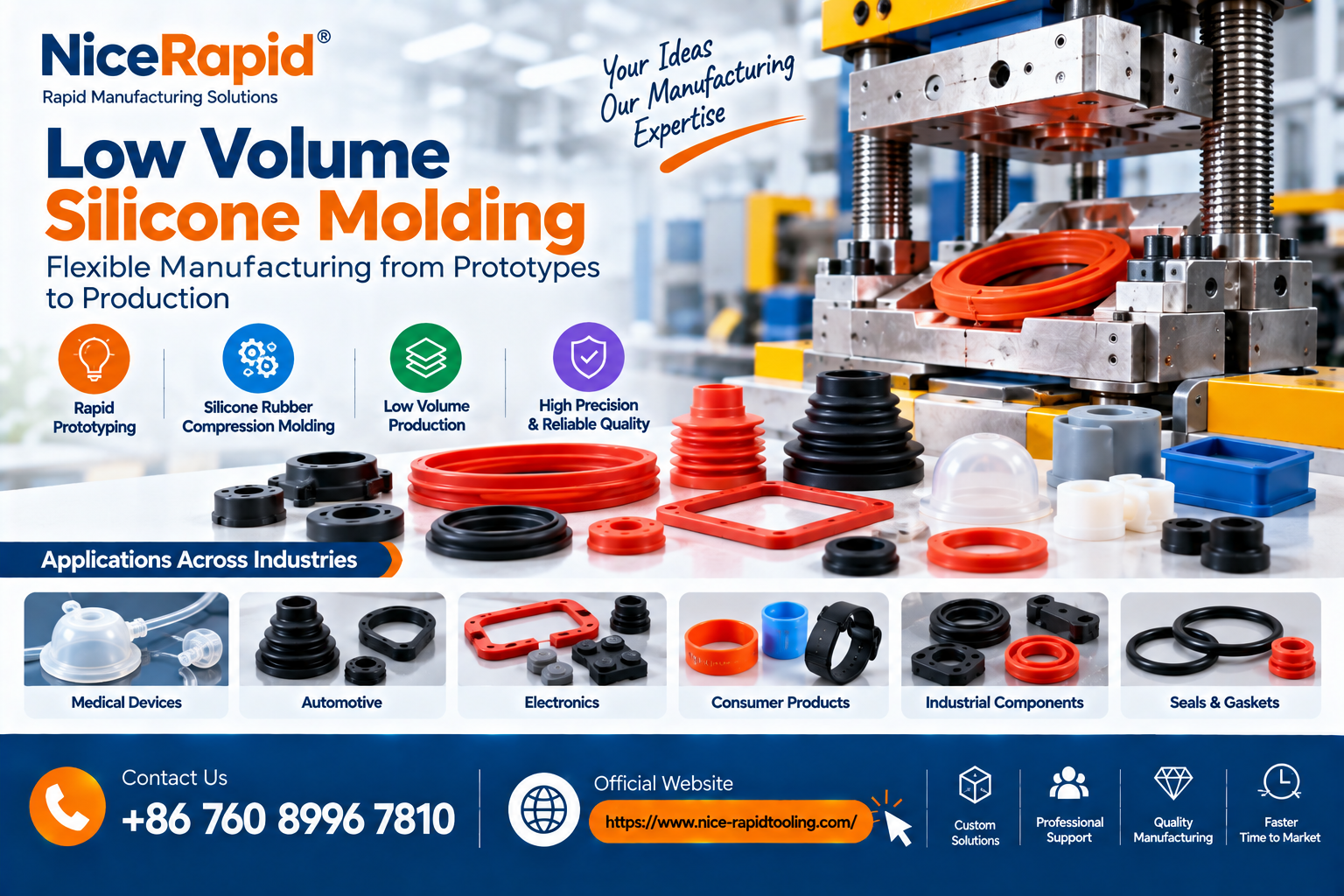
Product developers in medical devices, automotive systems, electronics, consumer products, industrial equipment, and wearable technology are increasingly looking for manufacturing methods that offer flexibility without requiring immediate commitment to large production volumes. Two approaches gaining attention are low volume silicone molding and silicone rubber compression molding, both of which can support prototyping, engineering validation, bridge production, and specialized manufacturing.
Silicone is widely used because it can provide flexibility, sealing performance, temperature resistance, electrical insulation, and durability. However, producing reliable silicone components requires careful attention to material selection, mold design, curing conditions, part geometry, tolerances, and production volume.
What Is Low Volume Silicone Molding?
Low volume silicone molding refers to manufacturing silicone parts in relatively small production quantities compared with traditional high-volume manufacturing.
It is commonly used for:
- Functional prototypes
- Engineering samples
- Pilot production
- Product validation
- Bridge manufacturing
- Custom components
- Replacement parts
- Limited market launches
This approach allows companies to manufacture real parts, test them under practical conditions, and make changes before investing in larger-scale production.
Why Low Volume Silicone Molding Matters
Modern product development often involves several design iterations.
A company may move through a process such as:
CAD Design → Prototype → Functional Testing → Design Revision → Low-Volume Production → Market Validation → Scale-Up
Using low volume silicone molding during this stage can provide several advantages.
These may include:
- Lower initial production commitment
- Greater design flexibility
- Faster product testing
- Reduced inventory risk
- Easier engineering changes
- Practical bridge production
- Better market validation
For startups and engineering teams, this can be especially valuable because product improvements can be made before manufacturing thousands of parts.
Understanding Silicone Rubber Compression Molding
Silicone rubber compression molding is a manufacturing process in which a measured amount of silicone rubber is placed inside a heated mold cavity.
The mold closes under pressure, forcing the material to fill the required shape. Heat and pressure are maintained while the silicone cures.
After curing, the mold opens and the finished part is removed.
A typical process may include:
- Preparing the silicone material
- Measuring the required amount
- Placing material into the mold
- Closing the mold under pressure
- Curing the silicone
- Removing the molded component
- Trimming excess material
- Inspecting the finished part
The process is relatively straightforward and can be suitable for many silicone geometries.
Common Applications
Silicone rubber compression molding can be used to manufacture components such as:
- Gaskets
- Seals
- Keypads
- Protective covers
- Diaphragms
- Boots
- Electronic insulation parts
- Wearable components
- Industrial rubber parts
The correct material and mold design depend on the final application.
Why Silicone Rubber Is Popular
Silicone rubber offers a useful combination of physical and environmental properties.
Depending on formulation, potential benefits include:
- High flexibility
- Heat resistance
- Low-temperature performance
- Weather resistance
- Electrical insulation
- Sealing capability
- Durability
Different silicone grades behave differently, so engineers should evaluate real service conditions before choosing a formulation.
“Silicone selection should begin with the environment in which the finished component will operate, not simply with the molding process.”
Low Volume Silicone Molding vs High-Volume Production
The main difference is not simply quantity.
Low-volume manufacturing is usually optimized for flexibility and speed, while high-volume production focuses heavily on automation and unit-cost efficiency.
| FactorLow Volume Silicone MoldingHigh-Volume Silicone Production | ||
| Typical purpose | Validation, bridge production, specialized parts | Large-scale production |
| Tooling strategy | Often simplified or optimized for lower quantities | Designed for long production life |
| Design revisions | Easier to accommodate | More expensive after tooling completion |
| Production speed | Moderate | High |
| Initial investment | Often lower | Typically higher |
| Inventory risk | Lower | Higher |
The best approach depends on product maturity and demand.
Why Compression Molding Works Well for Lower Volumes
Silicone rubber compression molding can be attractive for lower production quantities because tooling may be less complex than some highly automated molding systems.
For suitable part designs, this can provide a practical balance between tooling cost and production quality.
However, total cost depends on:
- Component size
- Geometry
- Number of cavities
- Material grade
- Mold construction
- Required tolerance
- Finishing
- Quantity
A detailed manufacturing review is still important.
Part Design and Manufacturability
The best silicone components are designed with the molding process in mind.
Important design considerations include:
Wall Thickness
Consistent wall thickness can help improve material flow and curing behaviour.
Parting Lines
Every compression mold separates along one or more parting surfaces.
Designers should consider where these marks will appear.
Draft and Demolding
Although silicone is flexible, difficult geometry can still complicate part removal.
Undercuts
Silicone can accommodate certain undercuts because of its flexibility, but excessive complexity can increase tooling difficulty.
Tolerances
Very tight tolerances can increase both tool cost and manufacturing complexity.
An early design-for-manufacturing review can help reduce later revisions.
Managing Flash
One characteristic of compression molding is the potential for thin excess material to appear around parting lines.
This is known as flash.
Flash may be removed using:
- Manual trimming
- Mechanical finishing
- Cryogenic or specialized deflashing where applicable
The required cosmetic and dimensional standard should be agreed before production because finishing can affect both cost and lead time.
Silicone Hardness and Material Selection
Silicone is available in different hardness levels.
A softer silicone may work well for:
- Sealing
- Cushioning
- Wearable comfort
A harder silicone may be more suitable when additional structural support is needed.
Material selection should consider:
- Flexibility
- Compression behaviour
- Temperature exposure
- Chemical contact
- Sealing requirements
- Expected service life
Physical samples are often useful when tactile feel matters.
Quality Control in Silicone Manufacturing
Quality requirements vary by industry and component function.
Typical inspection may include:
- Dimensional measurement
- Visual inspection
- Hardness testing
- Surface review
- Flash inspection
- Functional testing
- Material verification
For regulated or safety-critical products, additional documentation and validation may be required.
In low volume silicone molding, quality control remains just as important as in mass production because the parts are often used for engineering testing or market validation.
Prototype-to-Production Advantages
One of the greatest benefits of low volume silicone molding is that it creates a bridge between early prototypes and full-scale manufacturing.
A company can test:
- Fit
- Function
- Assembly
- Sealing
- Flexibility
- User experience
- Material behaviour
Real production parts provide insights that digital models alone cannot always reveal.
This can help reduce risks before moving into larger manufacturing volumes.
Choosing Between Compression and Injection Molding
Compression molding is not the only option for silicone parts.
Another common method is liquid silicone rubber injection molding.
Compression molding may be attractive when:
- Production quantities are limited
- Tooling simplicity matters
- Part geometry is appropriate
- Manual handling is acceptable
Injection molding may be preferable when:
- Large production volumes are required
- Automation is important
- Complex repeatability is needed
- Faster cycle control is critical
The final decision should be based on the product rather than choosing a process by habit.
Frequently Asked Questions
What is low volume silicone molding?
Low volume silicone molding is the production of silicone components in smaller quantities for prototyping, validation, bridge production, and specialized manufacturing.
What is silicone rubber compression molding?
Silicone rubber compression molding is a process where silicone rubber is placed into a heated mold and compressed under pressure until it cures into the required shape.
Is compression molding suitable for prototypes?
Yes. It can be suitable for functional prototypes and small production runs depending on part design and tooling.
What products can be made with silicone compression molding?
Common examples include seals, gaskets, keypads, covers, diaphragms, boots, and industrial components.
Why choose low-volume production?
It allows companies to test products, revise designs, reduce inventory risk, and validate demand before mass manufacturing.
Can silicone hardness be customized?
Yes. Different silicone formulations are available with different hardness levels and performance characteristics.
What affects molding cost?
Tooling, component size, geometry, material, cavities, tolerance, quantity, curing time, and finishing all affect cost.
Does silicone compression molding produce flash?
It can. Flash may appear along parting lines and may require trimming or other finishing methods.
Can low-volume molding become full production later?
Yes. It is often used as a bridge between prototyping and mass production.
What information is needed for a quotation?
Useful information includes CAD files, drawings, material requirements, quantity, tolerance, surface finish, application, and operating conditions.
Media Contact
Sales & Media Enquiries
Contact: +86 760 8996 7810
Official Website: https://www.nice-rapidtooling.com/