
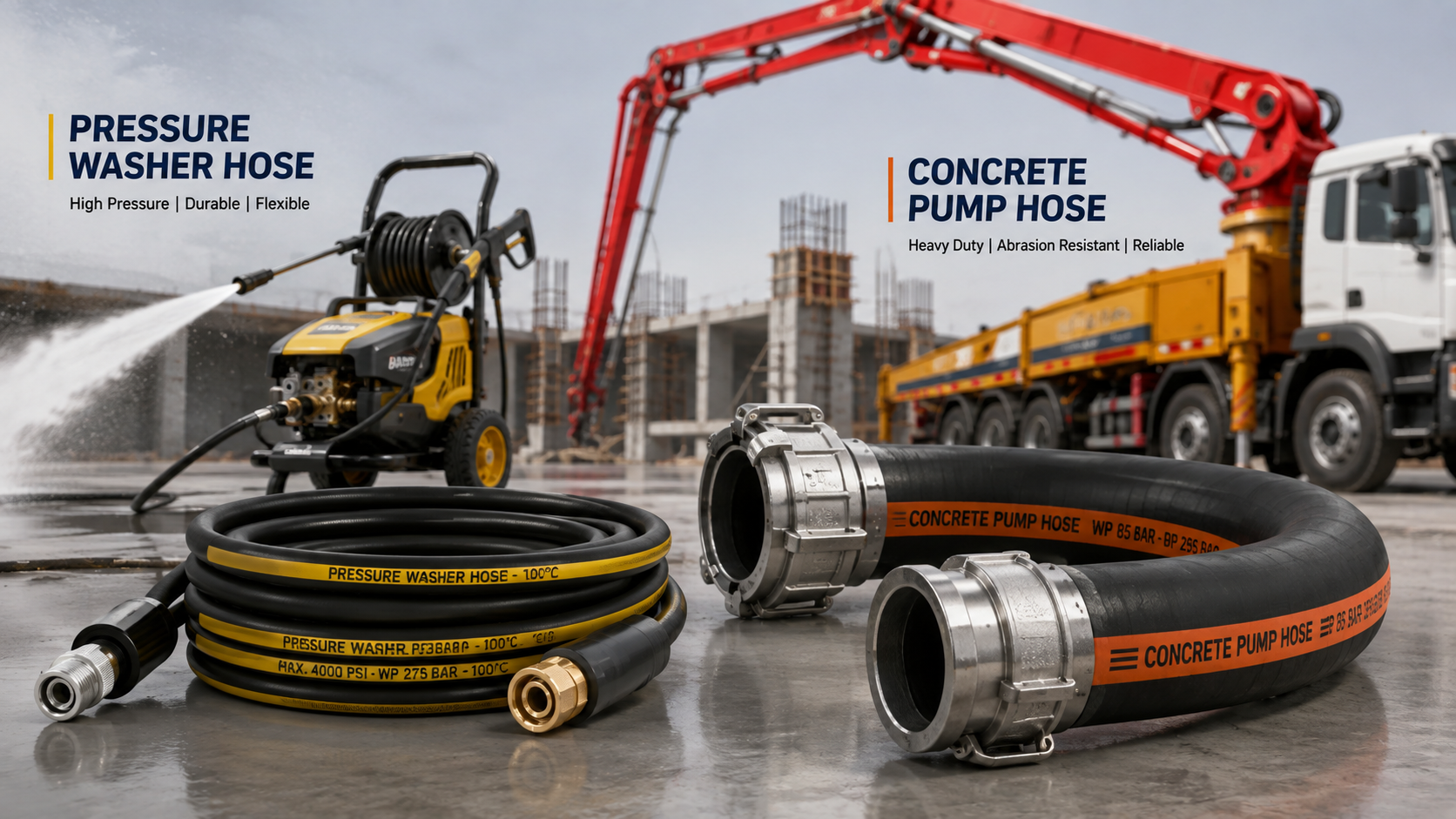
Industrial hoses may appear simple, but choosing the wrong hose can reduce equipment performance, increase downtime and create serious safety risks. Two important products used in demanding environments are the Pressure Washer Hose and Concrete Pump Hose. Although both transport material under pressure, their construction, working conditions and applications are completely different.
Understanding these differences helps contractors, equipment operators and purchasing teams select hoses that provide dependable performance, longer service life and safer operation.
What Is a Pressure Washer Hose?
A Pressure Washer Hose is specifically designed to transport high-pressure water from a pressure washer pump to a spray gun or cleaning attachment. It is widely used for commercial cleaning, vehicle washing, industrial maintenance, construction equipment cleaning and surface preparation.
Unlike an ordinary water hose, it must tolerate significantly greater operating pressure while remaining flexible enough for convenient handling.
Quality pressure washer hoses typically include an oil-resistant inner tube, reinforcement layers and an abrasion-resistant outer cover. Depending on the application, reinforcement may consist of textile braid, steel wire braid or multiple reinforcement layers.
Important Pressure Washer Hose Features
The most important characteristics include working pressure, burst pressure, temperature resistance, flexibility and compatibility with fittings.
A well-selected hose should provide smooth water delivery without excessive pressure loss while resisting abrasion from concrete floors, workshops and outdoor surfaces.
Applications of Pressure Washer Hoses
Common applications include:
- Vehicle and fleet washing
- Industrial machinery cleaning
- Building and pavement cleaning
- Agricultural equipment washing
- Construction-site maintenance
- Drain and sewer cleaning
- Professional car-wash systems
Choosing the correct hose diameter and length is particularly important because unnecessarily long or undersized hoses can affect water flow and cleaning efficiency.
What Is a Concrete Pump Hose?
A Concrete Pump Hose is a heavy-duty hose engineered to transfer wet concrete from pumping equipment to the required placement location. It is commonly installed at the end of concrete delivery pipelines where flexibility is required for accurate placement.
Concrete contains cement, water, sand and aggregates, creating a highly abrasive mixture. Therefore, the hose requires a specially engineered inner lining capable of resisting continuous wear.
A Concrete Pump Hose must also withstand pumping pressure, bending, dragging and challenging construction-site conditions.
Construction and Reinforcement
These hoses usually contain a highly abrasion-resistant synthetic rubber inner tube combined with multiple layers of high-tensile reinforcement. The exterior cover protects the reinforcement against weather, abrasion and physical damage.
Heavy-duty couplings are attached securely because fitting integrity is critical during concrete pumping.
Typical Concrete Pump Hose Applications
Concrete delivery hoses are commonly used for foundations, columns, slabs, bridges, tunnels, high-rise buildings and infrastructure projects.
Operators can manoeuvre the flexible hose around reinforcement bars, formwork and confined placement areas where rigid concrete pipelines would be impractical.
Pressure Washer Hose vs Concrete Pump Hose
Although both products operate under pressure, they cannot be substituted for one another.
| Feature | Pressure Washer Hose | Concrete Pump Hose |
| Transported Material | High-pressure water | Wet concrete |
| Main Application | Cleaning | Concrete placement |
| Abrasion Requirement | Moderate to high | Extremely high |
| Construction | Textile or wire reinforced | Heavy multi-layer reinforcement |
| Flexibility | High | Heavy-duty flexibility |
| Typical Environment | Workshops, homes, industries | Construction sites |
| Primary Concern | Pressure and temperature | Pressure and severe abrasion |
A pressure cleaning hose is engineered primarily for water pressure, while a concrete pumping hose must handle both pressure and aggressive internal abrasion.
How to Choose the Right Pressure Washer Hose
Selection should never be based on price alone. First determine the maximum working pressure generated by the equipment. The hose’s rated working pressure must safely accommodate the intended operating conditions.
Consider:
- Working pressure: Match the hose specification with the pressure washer.
- Inner diameter: Correct diameter supports adequate water flow.
- Length: Select sufficient reach without unnecessary pressure loss.
- Temperature: Hot-water machines require suitable temperature-rated hoses.
- Fittings: Connections must match the washer and spray equipment.
- Outer cover: Abrasion resistance matters for demanding commercial environments.
For frequent industrial use, reinforced hoses usually provide greater durability than lightweight alternatives.
How to Choose the Right Concrete Pump Hose
Selecting a Concrete Pump Hose requires careful attention because concrete pumping involves heavy materials and demanding operating conditions.
The hose should be selected according to pump specifications, concrete composition, aggregate size, hose diameter, working pressure and placement requirements.
Check Abrasion Resistance
Concrete continuously wears the inner tube as it travels through the hose. A high-quality wear-resistant lining helps extend service life and reduce unexpected replacement.
Verify Working Pressure
Never operate beyond the manufacturer’s specified working pressure. Pressure fluctuations or blockages can create additional stress within the pumping system.
Inspect Hose Connections
Couplings, clamps and hose ends should be checked regularly. Damaged fittings can create serious hazards when pumping concrete under pressure.
Maintenance Tips for Longer Hose Life
Regular inspection significantly influences hose performance and reliability. Operators should examine hoses before operation for cracks, exposed reinforcement, cuts, leaks, damaged couplings or abnormal deformation.
Avoid excessive twisting, sharp bending and dragging hoses across sharp surfaces. After pressure washing, properly drain and store the hose away from unnecessary heat or chemicals. Concrete hoses should be cleaned according to equipment procedures before material hardens internally.
A hose showing significant structural damage should be removed from service rather than temporarily repaired without manufacturer-approved procedures.
Why Hose Quality Matters
Industrial hose failure creates more than replacement costs. It may interrupt operations, damage equipment and expose workers to hazards.
A properly manufactured Pressure Washer Hose supports consistent cleaning performance and operator mobility. Similarly, a reliable Concrete Pump Hose contributes to controlled concrete placement while handling demanding abrasive material.
Purchasing teams should therefore evaluate construction quality, pressure ratings, dimensional requirements, fitting compatibility and manufacturer documentation instead of comparing products solely by price.
Frequently Asked Questions
1. What is a Pressure Washer Hose used for?
It transfers pressurised water from a pressure washer pump to a spray gun or cleaning accessory.
2. Can a normal garden hose replace it?
No. Standard garden hoses are generally not designed for pressure-washer discharge conditions.
3. What causes pressure washer hoses to fail?
Common causes include abrasion, excessive pressure, incorrect fittings, extreme temperatures, kinking and ageing.
4. Can longer hoses reduce pressure?
A longer hose can increase frictional losses, particularly when its internal diameter is too small for the required flow.
5. What is a Concrete Pump Hose?
It is a reinforced industrial hose designed specifically for transporting wet concrete during pumping and placement operations.
6. Why does a concrete hose need abrasion resistance?
Sand and aggregates continuously rub against the inner lining, causing substantial internal wear.
7. Are concrete pump hoses flexible?
Yes. Their flexibility allows operators to position concrete accurately while maintaining the heavy-duty construction required for pumping.
8. How often should industrial hoses be inspected?
They should be visually checked before use and maintained according to the hose manufacturer’s and equipment manufacturer’s recommendations.
9. Can damaged hoses continue operating?
A hose showing structural damage, exposed reinforcement, leakage or damaged connections should be evaluated and removed from service when required.
10. Are Pressure Washer Hose and Concrete Pump Hose interchangeable?
No. Their materials, reinforcement, pressure requirements and transported media are fundamentally different.