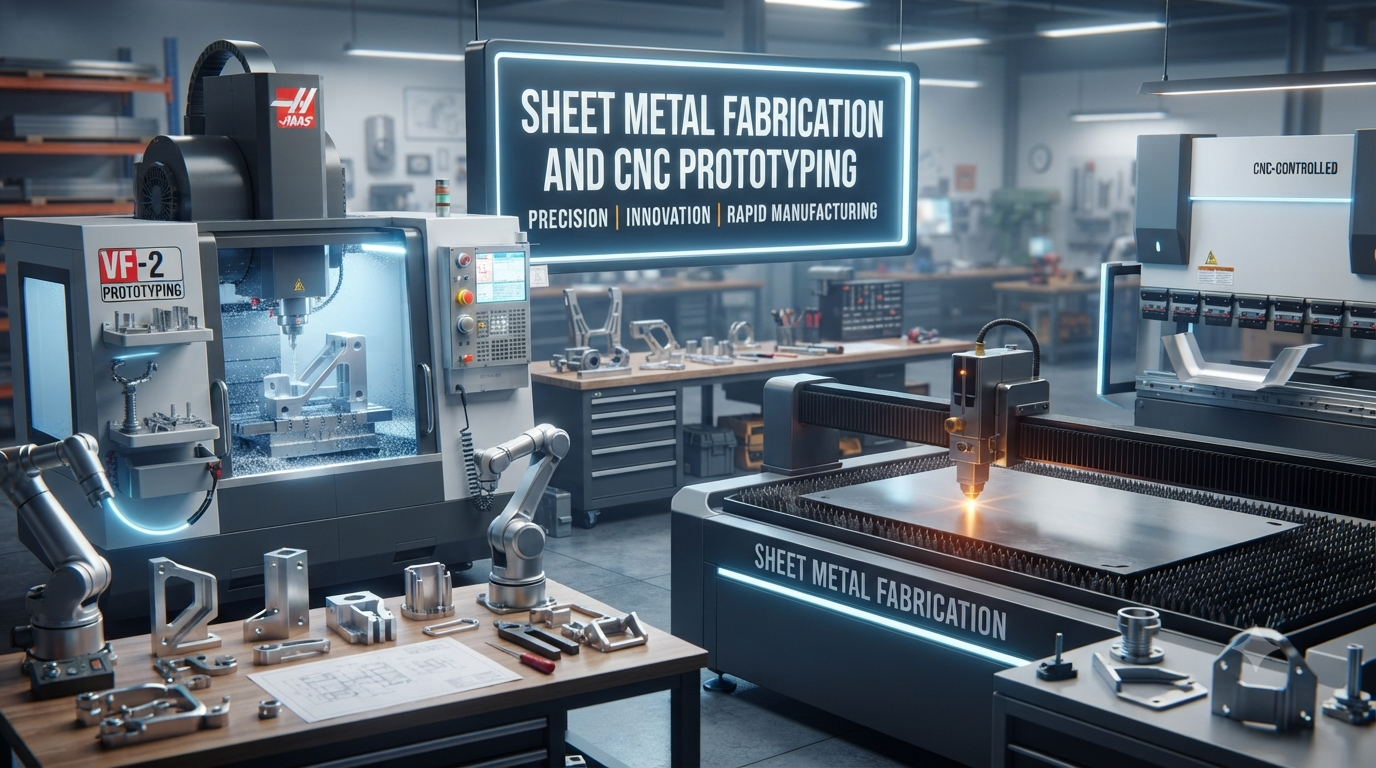
Modern product development is no longer just about having a great idea. Businesses need to turn concepts into functional products quickly, accurately, and cost-effectively. This is where sheet metal fabrication and CNC prototyping play an important role. From industrial equipment and automotive components to electronics enclosures and consumer products, these manufacturing methods help engineers transform digital designs into real-world parts.
Although each process has different strengths, combining sheet metal fabrication with CNC prototyping can create a flexible development strategy. Companies can test designs, identify potential problems, improve functionality, and prepare products for production with greater confidence.
What Is Sheet Metal Fabrication?
Sheet metal fabrication is the process of converting flat metal sheets into finished components or assemblies. Depending on the design, manufacturers may use cutting, bending, punching, forming, welding, and finishing techniques to create precise parts.
Common materials include stainless steel, aluminum, carbon steel, copper, and other specialized alloys. Material selection generally depends on factors such as strength, corrosion resistance, weight, appearance, and application requirements.
Common Sheet Metal Fabrication Processes
A typical fabrication project may involve several manufacturing steps:
- Laser cutting: Produces accurate profiles and intricate shapes from metal sheets.
- CNC punching: Creates holes, slots, and repetitive patterns efficiently.
- Press brake bending: Forms flat sheets into precise angles and geometries.
- Welding: Joins multiple fabricated components into a complete assembly.
- Deburring: Removes sharp edges and improves part safety.
- Surface finishing: Includes processes such as powder coating, painting, polishing, or brushing.
Why Businesses Choose Sheet Metal Fabrication
The versatility of fabricated metal parts makes them useful across many industries. Properly designed components can provide durability while remaining relatively lightweight and economical to manufacture.
Key benefits include:
- High structural strength
- Flexible material selection
- Scalable production
- Customizable designs
- Excellent dimensional consistency
- Compatibility with automated manufacturing
- Wide range of finishing options
For companies producing enclosures, brackets, frames, panels, cabinets, and machine components, sheet metal fabrication can be an efficient manufacturing solution.
Understanding CNC Prototyping
CNC prototyping uses computer-controlled machining equipment to manufacture physical prototypes directly from digital CAD models. CNC machines can cut, drill, mill, and turn materials with high precision, making them suitable for functional prototypes and low-volume production.
Unlike some rapid prototyping technologies that focus primarily on visual models, CNC machining can produce prototypes with material properties that closely resemble the final manufactured component. This makes it particularly useful when engineers need to evaluate strength, fit, performance, and assembly.
How CNC Prototyping Works
The CNC prototyping process generally follows these steps:
- Create a CAD design: Engineers develop a detailed 3D model or technical drawing.
- Review manufacturability: The design is checked for tooling access, tolerances, material requirements, and machining limitations.
- Generate toolpaths: CAM software converts the design into machine instructions.
- Select the material: Aluminum, stainless steel, engineering plastics, and other materials may be considered.
- Machine the prototype: CNC equipment removes material according to the programmed toolpaths.
- Inspect the part: Measurements and functional tests confirm whether the prototype meets requirements.
- Refine the design: Feedback from testing can be incorporated into the next iteration.
This iterative approach helps product teams discover issues before investing heavily in mass production tooling.
Sheet Metal Fabrication vs. CNC Prototyping
While both methods support product development, they are suited to different types of components and manufacturing needs.
| Factor | Sheet Metal Fabrication | CNC Prototyping |
| Basic process | Cutting and forming sheet material | Removing material through machining |
| Ideal parts | Panels, brackets, enclosures, frames | Complex precision components |
| Materials | Steel, aluminum, stainless steel, copper | Metals and engineering plastics |
| Typical strength | Excellent for structural applications | Depends on selected material |
| Complex geometries | Moderate | High |
| Prototype suitability | Excellent for sheet-based designs | Excellent for detailed components |
| Production scalability | Highly scalable | Suitable for prototypes and low-volume production |
| Tooling needs | Often low to moderate | Usually minimal for CNC machining |
| Design flexibility | High for formed sheet components | High for machined geometries |
The right option depends on the component’s geometry, material, tolerances, production volume, and intended application.
How CNC Prototyping Supports Sheet Metal Projects
In many product development programs, CNC prototyping and sheet metal fabrication work together rather than competing with each other.
For example, an engineer developing an industrial control cabinet may use CNC prototyping to produce precision mounting components while relying on sheet metal fabrication for the enclosure. This approach allows each manufacturing process to handle the parts it is best suited for.
Key Advantages of Combining Both Methods
Using both processes can help businesses:
- Validate product concepts earlier
- Test mechanical interfaces
- Improve dimensional accuracy
- Reduce design mistakes
- Accelerate product development
- Minimize expensive tooling changes
- Evaluate assemblies before production
- Create functional prototypes for testing
This integrated approach is especially valuable when a product contains both machined and fabricated components.
Factors to Consider Before Manufacturing
Choosing the right manufacturing method requires more than comparing prices. Several technical and commercial factors should be evaluated.
1. Material Requirements
Consider the required strength, weight, corrosion resistance, thermal performance, and appearance. The material should match the product’s operating environment.
2. Design Complexity
Simple bent components may be ideal for sheet metal fabrication, while intricate three-dimensional parts may be better suited to CNC machining.
3. Tolerance Requirements
Tight tolerances can influence manufacturing costs and process selection. Engineers should specify only the tolerances that are genuinely necessary for function.
4. Production Volume
Prototype quantities, small batches, and high-volume production may require different strategies. Discussing expected volumes with a manufacturer early can help identify the most cost-effective approach.
5. Surface Finish
The desired appearance and protection level should be considered from the beginning. Finishing requirements can affect material selection and production timelines.
Best Practices for Successful Prototyping
A well-planned prototype can save significant time and resources later. Product teams should:
- Define functional requirements before designing the part.
- Select materials based on real application conditions.
- Design components with manufacturability in mind.
- Avoid unnecessary tight tolerances.
- Request prototype feedback from manufacturing experts.
- Test prototypes under realistic operating conditions.
- Document design changes between iterations.
Early communication between designers, engineers, and manufacturers often results in better outcomes.
Frequently Asked Questions
1. What is sheet metal fabrication used for?
It is commonly used to manufacture enclosures, brackets, panels, cabinets, frames, machine components, and structural parts.
2. What is CNC prototyping?
CNC prototyping is the use of computer-controlled machining to create accurate physical prototypes from digital designs.
3. Is CNC prototyping suitable for functional testing?
Yes. CNC prototypes can be manufactured from durable metals or engineering plastics, making them suitable for fit, assembly, and functional evaluation.
4. Which is better: sheet metal fabrication or CNC machining?
Neither is universally better. The best option depends on the part’s geometry, material, tolerances, volume, and application.
5. Can sheet metal parts be used as prototypes?
Yes. Sheet metal prototypes are particularly useful when the final product will also be manufactured using sheet metal processes.
6. What materials are commonly used in sheet metal fabrication?
Common choices include aluminum, stainless steel, carbon steel, and copper, depending on application requirements.
7. How does CNC prototyping reduce development risks?
It allows teams to test physical parts and identify design, fit, or performance problems before committing to larger production investments.
8. Can CNC prototypes be customized?
Yes. CNC machining can accommodate customized dimensions, geometries, materials, and surface finishing requirements.
9. What affects the cost of sheet metal fabrication?
Material type, thickness, design complexity, cutting requirements, bending operations, finishing, labor, and order volume can all influence cost.
10. How can companies improve prototype quality?
Clear CAD files, realistic tolerances, appropriate material selection, manufacturable designs, and thorough inspection can significantly improve results.
https://newsgrow.blogspot.com/2026/07/sheet-metal-fabrication-and-cnc.html