
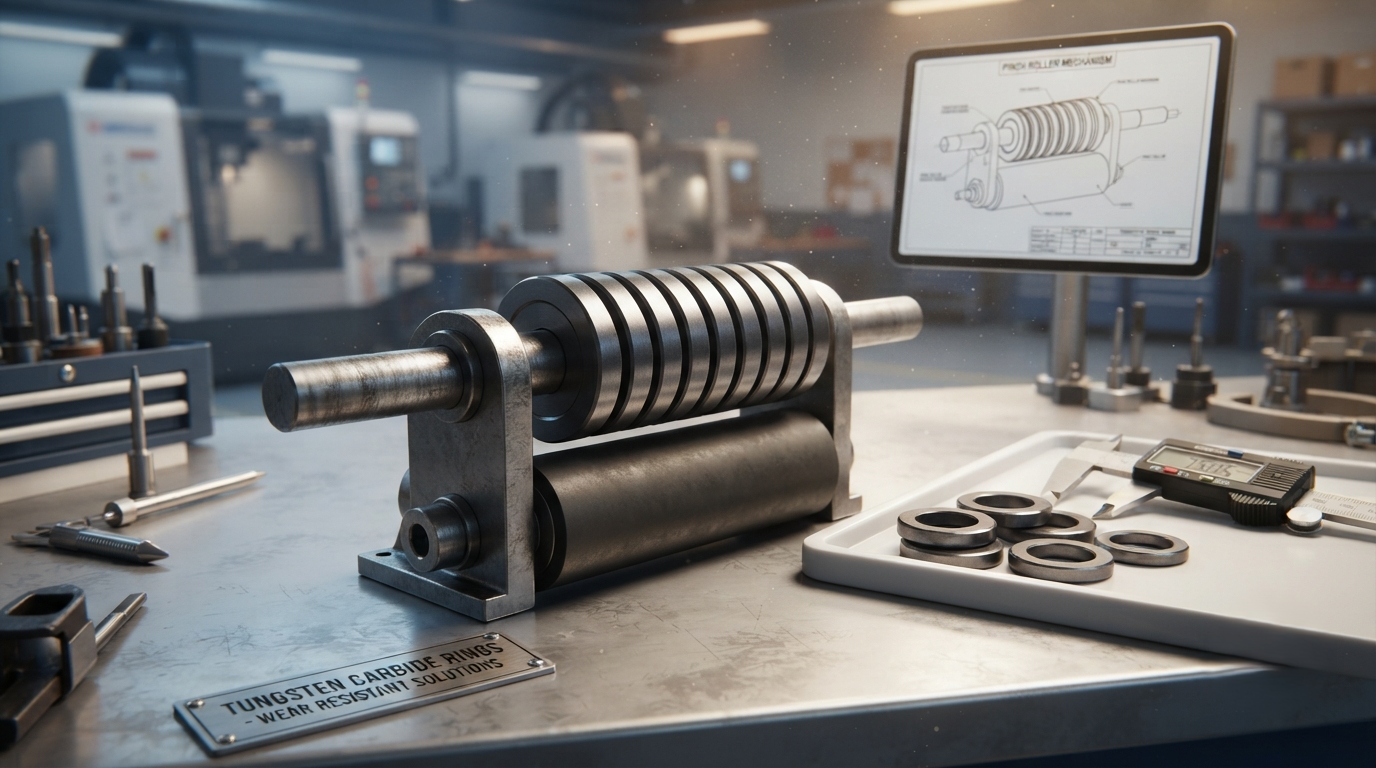
Industrial manufacturers are increasingly focused on components that can withstand demanding production environments while maintaining accuracy, consistency, and long service life. Among the components attracting attention are Tungsten Carbide Rings and Pinch Roller systems. Used across metal processing, wire production, rolling mills, tube manufacturing, and other continuous-production applications, these engineered components contribute directly to dimensional control, material handling, reduced downtime, and reliable production.
Tungsten Carbide Rings offer exceptional hardness and resistance to abrasive wear, while a precisely engineered Pinch Roller helps control, guide, feed, or tension material as it moves through a production line.
Why Tungsten Carbide Rings Matter in High-Wear Operations
Tungsten carbide is widely valued in industrial tooling because it combines high hardness with strong wear resistance. Tungsten Carbide Rings are commonly selected for applications where conventional steel rings may experience rapid surface deterioration, dimensional changes, or frequent replacement.
Performance, however, depends on more than material hardness alone. Carbide grade, binder composition, dimensional accuracy, surface finish, installation, cooling, load conditions, and application-specific design all affect service life.
Pinch Roller Technology Supports Controlled Material Movement
A Pinch Roller performs a different but equally important function. It applies controlled gripping or pressing force to moving material, helping regulate feeding, positioning, tension, or transfer between stages of production.
A properly designed Pinch Roller helps maintain smooth movement and predictable contact while accommodating the mechanical requirements of the line.
Roller diameter, surface condition, hardness, alignment, bearing arrangement, pressure settings, and drive configuration should be matched to the product being processed. Excessive force may damage the workpiece, while inadequate force may allow slipping.
How These Components Improve Production Efficiency
Although Tungsten Carbide Rings and Pinch Roller assemblies perform different tasks, both support a broader goal: reliable production with fewer avoidable interruptions.
Key operational benefits can include:
- Improved wear resistance in demanding rolling and forming zones.
- Better dimensional consistency when tooling retains its intended profile.
- More controlled feeding, gripping, and material transfer.
- Reduced frequency of component replacement when correctly specified.
- Improved process repeatability and more predictable maintenance planning.
- Potential reduction in scrap caused by worn tooling or unstable material movement.
Tungsten Carbide Rings Versus Pinch Roller: Functional Comparison
| Feature | Tungsten Carbide Rings | Pinch Roller |
| Primary role | Wear-resistant rolling or forming surface | Material gripping, feeding, guiding, or tensioning |
| Key advantage | High hardness and wear resistance | Stable, controlled material movement |
| Common applications | Rolling mills, wire and bar processing | Rolling, tube, wire, strip, and feeding lines |
| Important selection factors | Carbide grade, dimensions, finish, load | Diameter, material, pressure, alignment, drive |
| Maintenance focus | Surface condition and dimensional wear | Surface, bearings, alignment, pressure settings |
Selecting the Right Component for the Application
Successful component selection begins with operating data. Manufacturers should identify the processed material, dimensions, line speed, contact pressure, expected load, temperature, coolant conditions, required tolerances, and desired maintenance interval.
For Tungsten Carbide Rings, the appropriate carbide grade must balance hardness with toughness. Extremely hard material is not automatically the best choice if the application involves impact, vibration, or unusual loading.
Quality and Precision Are Central to Long-Term Performance
Industrial components operate as part of a complete machine system. Even premium materials can underperform if dimensions, installation, alignment, or operating settings are incorrect. Precision manufacturing and inspection therefore play a central role.
Important checks may include dimensional tolerance, concentricity, surface finish, material consistency, balance, edge condition, and compatibility with mating components. For rollers, bearing condition and alignment should also be monitored. For carbide rings, users should inspect for abnormal wear, chipping, cracking, or surface damage during scheduled maintenance.
Frequently Asked Questions
1. What are Tungsten Carbide Rings used for?
They are used in high-wear rolling, forming, sizing, and metal-processing applications where hardness, dimensional stability, and abrasion resistance are important.
2. Why choose carbide instead of conventional steel?
Carbide can provide greater wear resistance in suitable applications, potentially extending working life and reducing frequent tooling changes.
3. What does a Pinch Roller do?
It grips or presses moving material to assist feeding, guiding, tension control, positioning, or transfer through production equipment.
4. Where are pinch rollers commonly installed?
They can be found in rolling mills, wire lines, tube mills, strip-processing equipment, and other continuous material-handling systems.
5. Are all Tungsten Carbide Rings the same?
No. Carbide grade, binder content, dimensions, finish, and geometry can vary according to operating requirements.
6. Can a Pinch Roller damage material?
Yes, if pressure, alignment, surface condition, or roller design is unsuitable. Correct adjustment helps reduce marking and deformation.
7. How should carbide rings be selected?
Selection should consider load, speed, processed material, cooling, impact conditions, dimensions, tolerance, and required service performance.
8. How often should pinch rollers be inspected?
Inspection frequency depends on production intensity and operating conditions. Routine checks should cover wear, bearings, alignment, traction, and pressure.
9. Can these components be customised?
Industrial suppliers may manufacture components to specified dimensions, grades, profiles, finishes, and application requirements.
10. Do Tungsten Carbide Rings and Pinch Roller systems reduce downtime?
Correctly specified and maintained components can support longer operating intervals, stable production, and more planned maintenance, although actual results depend on the application.