Modern metal fabrication depends on accuracy, repeatability, productivity, and reliable weld quality. Manufacturers producing cylindrical tanks, pressure vessels, pipes, silos, structural components, and industrial equipment increasingly need machinery that can deliver these qualities without creating unnecessary production bottlenecks.
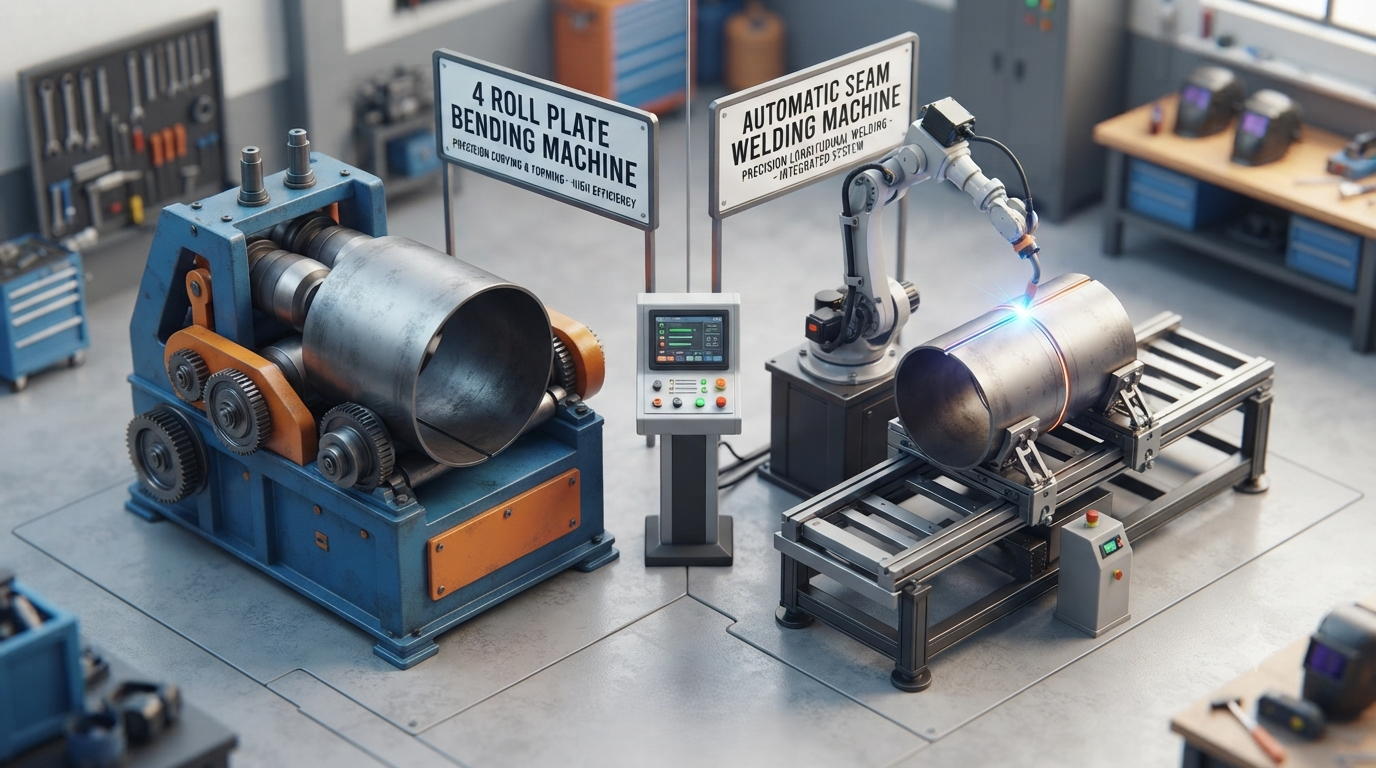
Two technologies play particularly important roles in this process: the 4 roll plate bending machine and the automatic seam welding machine. One forms flat metal plates into controlled cylindrical or curved shapes, while the other creates consistent longitudinal or circumferential welded seams. When properly integrated, these machines can establish an efficient workflow from plate preparation to finished welded components.
Understanding a 4 Roll Plate Bending Machine
A 4 roll plate bending machine is an industrial forming system designed to bend metal plates into cylinders, cones, arcs, and other curved profiles. Unlike conventional three-roll equipment, it uses four rolls to provide greater control over the plate throughout the bending operation.
The arrangement typically includes a top roll, bottom roll, and two side rolls. The plate is securely controlled between the rolls while the side rolls move into position to achieve the required curvature.
This configuration can simplify pre-bending and rolling while helping manufacturers achieve consistent results across repeated production cycles.
Important benefits include:
- Accurate plate positioning
- Efficient pre-bending of plate edges
- Controlled cylindrical forming
- Reduced material handling
- Improved repeatability
- Suitability for automated production
- Processing of different plate thicknesses and materials
For companies manufacturing tanks or cylindrical shells regularly, these capabilities can significantly streamline fabrication.
How the Four-Roll Bending Process Works
The bending cycle begins by positioning a flat plate between the upper and lower rolls. The bottom roll clamps the plate, providing stable material control.
One side roll then rises to perform edge pre-bending. After the first edge is formed, the rolls rotate and progressively bend the remaining plate until the required diameter is achieved.
The opposite edge can subsequently be pre-bent without requiring extensive plate repositioning.
Modern machines may incorporate CNC controls, programmable bending sequences, digital position monitoring, hydraulic movement, and stored production recipes. These technologies are particularly useful when manufacturers repeatedly produce components with identical dimensions.
What Is an Automatic Seam Welding Machine?
An automatic seam welding machine is designed to produce continuous, controlled welds along joints in fabricated components. Instead of relying entirely on manual torch movement, the equipment controls important variables such as travel speed, torch position, and welding sequence.
Depending on the machine configuration and application, automated seam welding may support processes such as TIG, MIG/MAG, plasma, or submerged arc welding.
Typical applications include:
- Storage tanks
- Pressure vessels
- Industrial pipes
- Cylindrical shells
- HVAC components
- Stainless-steel containers
- Process equipment
- Metal enclosures
Automation is especially valuable where long, straight, or circular seams need consistent welding conditions.
Why Automated Seam Welding Improves Production
Manual welding remains essential for many fabrication tasks, but repetitive long seams can be challenging to reproduce consistently.
An automatic seam welding machine helps maintain controlled movement along the joint. Once appropriate parameters have been established, automation can improve consistency between individual components.
Key advantages can include:
- More uniform travel speed
- Consistent torch positioning
- Reduced operator-dependent variation
- Better repeatability
- Higher production efficiency
- More predictable weld appearance
- Easier integration into production lines
Automation does not eliminate the need for skilled personnel. Operators and welding specialists are still needed for parameter development, setup, inspection, maintenance, and quality control.
4 Roll Plate Bending Machine vs Automatic Seam Welding Machine
| Factor | 4 Roll Plate Bending Machine | Automatic Seam Welding Machine |
| Primary function | Plate forming | Joint welding |
| Input | Flat metal plate | Prepared metal joint |
| Output | Curved or cylindrical component | Welded assembly |
| Main objective | Accurate geometry | Consistent weld seam |
| Automation | CNC or hydraulic control | Automated welding control |
| Common applications | Tanks, shells, cones | Tanks, pipes, vessels |
| Production stage | Forming | Joining |
Rather than competing technologies, these machines perform complementary operations.
Creating an Integrated Bending and Welding Workflow
The real production advantage becomes apparent when a 4 roll plate bending machine operates alongside an automated welding system.
Consider cylindrical tank manufacturing.
A typical workflow involves:
- Cutting the plate to specified dimensions
- Preparing edges for forming and welding
- Loading the plate into the bending machine
- Pre-bending the first edge
- Rolling the plate to the specified diameter
- Completing the second pre-bend
- Aligning the longitudinal joint
- Transferring the shell to the welding station
- Automatically welding the seam
- Inspecting dimensional and weld quality
Accurate forming can also simplify downstream welding. When plate edges are properly aligned, the welding system can operate under more stable joint conditions.
Choosing the Right Plate Bending Equipment
Buying a 4 roll plate bending machine requires more than selecting equipment based on maximum plate thickness.
Manufacturers should evaluate:
- Maximum working width
- Material type and yield strength
- Minimum and maximum required diameter
- Plate thickness range
- Pre-bending capability
- Roll diameter
- CNC functionality
- Hydraulic system
- Cone-bending requirements
- Production volume
- Loading and unloading method
- Maintenance accessibility
A machine should be selected according to actual production requirements rather than maximum capacity alone.
Selecting an Automatic Seam Welding Machine
The same principle applies when selecting an automatic seam welding machine.
Important considerations include the material being welded, joint configuration, component dimensions, welding process, penetration requirements, duty cycle, and required production speed.
Manufacturers should also examine:
- Welding power source compatibility
- Torch adjustment
- Travel-speed control
- Workpiece positioning
- Clamping system
- Seam tracking requirements
- Control interface
- Safety features
- Extraction requirements
- Automation integration
Testing representative components before finalising equipment specifications can help confirm whether the proposed system suits the actual application.
Materials Commonly Processed
Both technologies can be configured for numerous industrial metals.
Common examples include carbon steel, stainless steel, aluminium, and specialised alloys. However, machine capacity should always be evaluated according to material properties rather than thickness alone.
A plate bending machine rated for one thickness of mild steel may have different capabilities when processing higher-strength materials.
Likewise, welding parameters must account for material composition, thickness, joint design, filler material, shielding requirements, and applicable fabrication standards.
Improving Safety and Quality Control
Automation can improve process consistency, but proper safety procedures remain essential.
Operators should receive training covering machine controls, pinch points, emergency-stop systems, material handling, welding hazards, personal protective equipment, and maintenance procedures.
Quality checks should also be incorporated throughout production. These can include dimensional inspection after rolling, joint alignment verification before welding, visual weld inspection, and appropriate non-destructive testing where specified by applicable codes or customer requirements.
Frequently Asked Questions
1. What is a 4 roll plate bending machine used for?
It forms flat metal plates into cylinders, cones, arcs, and curved components used in tanks, vessels, pipes, and industrial structures.
2. Why use four rolls instead of three?
Four-roll systems provide controlled plate clamping and can simplify pre-bending and rolling operations, particularly in repetitive production.
3. Can a 4 roll plate bending machine make cones?
Many machines support cone bending, although capability depends on machine design, plate dimensions, material properties, and required geometry.
4. What does an automatic seam welding machine do?
It automatically controls welding movement along a prepared joint to create consistent longitudinal or circumferential seams.
5. Which welding processes can be automated?
Depending on system configuration, TIG, MIG/MAG, plasma, and submerged arc welding may be automated.
6. Can both machines be used for tank manufacturing?
Yes. Plate rolling creates the cylindrical shell, while automated seam welding can join its prepared edges.
7. Does automatic welding eliminate skilled welders?
No. Skilled personnel remain important for setup, procedure development, parameter control, inspection, troubleshooting, and maintenance.
8. Is CNC control useful for plate bending?
CNC control can improve repeatability and simplify production where identical or frequently repeated bending programs are required.
9. What industries use these machines?
They are commonly found in pressure-vessel, tank, energy, construction, HVAC, transportation, process-equipment, and general metal-fabrication industries.
10. How should manufacturers select machine capacity?
Capacity should be evaluated using plate thickness, width, material strength, desired diameter, production volume, forming requirements, and welding specifications.