In modern product development, businesses need manufacturing methods that balance speed, quality, flexibility, and cost. Two of the most widely used technologies for producing plastic components are vacuum casting and injection molding. While both methods can deliver high-quality parts, they serve different production needs and are best suited to different stages of product development.
Choosing the right vacuum casting and injection molding supplier can make a significant difference in product quality, development timelines, and overall manufacturing costs. A reliable supplier should offer technical expertise, consistent quality control, material knowledge, and the ability to support projects from prototype development through mass production.
This guide explains how vacuum casting and injection molding work, their key differences, and what businesses should consider when selecting a manufacturing partner.
Understanding Vacuum Casting
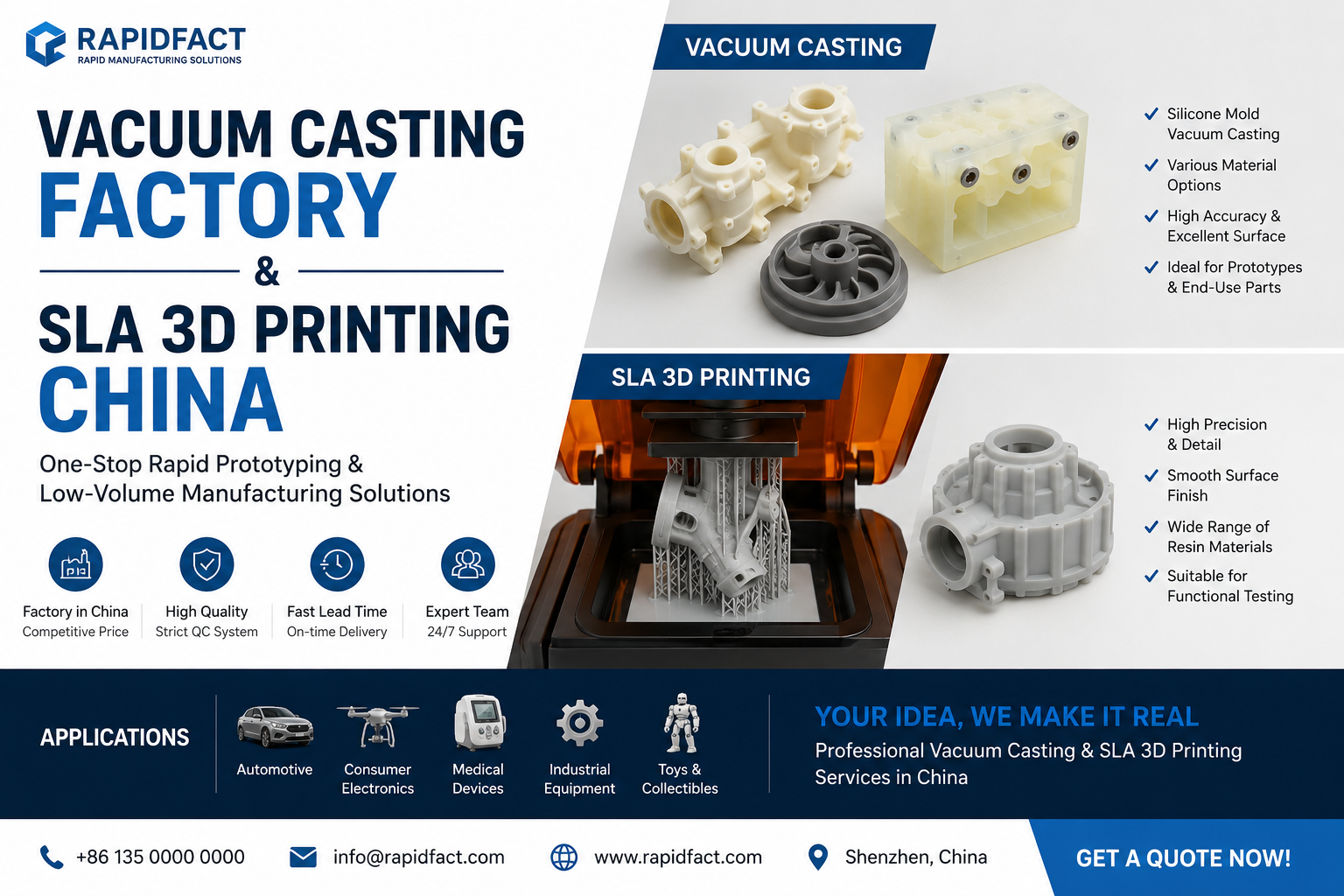
Vacuum casting is a manufacturing process commonly used to create high-quality prototypes and small batches of plastic components. The process typically begins with a master model, often produced using 3D printing or CNC machining. A silicone mold is then created around the master model.
Once the mold is prepared, polyurethane or other suitable materials are mixed and poured into the mold under vacuum conditions. Removing air during the casting process helps reduce bubbles and improves the surface finish of the finished component.
Vacuum casting is particularly useful when companies need prototypes that closely resemble the final production parts.
Common applications include:
- Product prototypes
- Functional testing components
- Consumer product housings
- Automotive interior parts
- Medical device prototypes
- Low-volume production
- Marketing and presentation models
One of the major advantages of vacuum casting is its ability to produce detailed parts without requiring expensive production tooling.
Understanding Injection Molding
Injection molding is a high-volume manufacturing process designed for producing large quantities of plastic parts with excellent repeatability. During the process, plastic pellets are heated until they become molten and are injected into a specially designed mold under pressure.
After the material cools and solidifies, the mold opens and the finished part is removed. The cycle is then repeated to produce the next component.
A professional injection molding supplier can manufacture parts in a wide variety of thermoplastics and engineering-grade materials. Injection molding is commonly used for products that require consistent dimensions and large production volumes.
Typical applications include:
- Automotive components
- Electronic enclosures
- Household products
- Medical equipment parts
- Industrial components
- Consumer electronics
- Packaging products
Although the initial tooling investment can be significant, the per-part cost becomes highly competitive when production quantities increase.
Vacuum Casting vs. Injection Molding
Understanding the difference between these technologies is essential when deciding which manufacturing method is appropriate for a particular project.
| Factor | Vacuum Casting | Injection Molding |
| Best suited for | Prototypes and low-volume production | Medium- to high-volume production |
| Tooling | Silicone molds | Metal production molds |
| Initial investment | Generally lower | Generally higher |
| Production speed | Suitable for smaller batches | Highly efficient for repeated production |
| Material options | Mainly polyurethane and similar materials | Wide range of thermoplastics |
| Part consistency | Very good for prototype quantities | Excellent for high-volume production |
| Mold lifespan | Limited | Designed for long production runs |
| Design validation | Excellent | Excellent for final production |
| Cost efficiency | Strong for small quantities | Strong for large quantities |
The right choice depends on production volume, product requirements, budget, material specifications, and development timelines.
When Should You Choose Vacuum Casting?
Vacuum casting is an excellent choice when a company needs realistic prototypes quickly. It allows product developers to evaluate a design before committing to expensive injection molding tooling.
For example, a startup developing a new electronic device may need 20 to 100 realistic housings for testing, demonstrations, or investor presentations. Creating injection molds at this early stage may not be economically practical. Vacuum casting can provide the required components faster and with lower initial investment.
It is also useful when a design is still evolving. If modifications are required, companies can update the master model and create a new silicone mold without investing in a permanent production tool.
When Is Injection Molding the Better Option?
Injection molding becomes more attractive when a product design has been finalized and production quantities are expected to increase.
The process offers:
- High repeatability
- Fast production cycles
- Excellent dimensional accuracy
- Consistent surface quality
- Broad material selection
- Cost-effective high-volume manufacturing
For companies producing thousands or millions of identical components, working with an experienced injection molding supplier can significantly reduce the cost per part.
How to Select a Vacuum Casting and Injection Molding Supplier
Selecting a manufacturing partner requires more than comparing prices. A supplier’s technical capabilities and quality management practices can directly influence the success of a project.
1. Evaluate Manufacturing Expertise
Look for a supplier with proven experience in both vacuum casting and injection molding. A capable partner should understand mold design, material selection, tolerances, surface finishes, and production requirements.
2. Review Material Capabilities
Different applications require different materials. Ask whether the supplier can provide materials with specific properties such as:
- High impact resistance
- Heat resistance
- Chemical resistance
- Flexibility
- UV stability
- Flame retardancy
Material expertise is especially important for automotive, medical, and industrial applications.
3. Check Quality Control Procedures
A reliable supplier should have clear inspection procedures throughout the manufacturing process. Quality checks may include dimensional inspection, visual inspection, material verification, and functional testing.
4. Consider Prototyping and Production Support
A supplier that can support the entire product journey—from prototype to production—can simplify communication and reduce development delays.
5. Assess Communication and Lead Times
Clear communication is essential for international manufacturing projects. Choose a supplier that provides transparent timelines, technical feedback, production updates, and responsive customer support.
Benefits of Working With an Experienced Supplier
The right manufacturing partner can provide value beyond production alone.
Key benefits include:
- Reduced development risks: Experienced engineers can identify potential manufacturing problems early.
- Better product quality: Professional processes help maintain consistent specifications.
- Improved cost control: Suppliers can recommend efficient materials and manufacturing methods.
- Faster development: Integrated prototyping and production services can shorten project timelines.
- Scalable manufacturing: Businesses can move from small prototype quantities to larger production runs more efficiently.
The Role of Design for Manufacturing
Design for Manufacturing, commonly known as DFM, is an important part of successful plastic production. Before manufacturing begins, engineers review the product design to determine whether it can be produced efficiently and reliably.
For injection molding, DFM considerations may include wall thickness, draft angles, ribs, bosses, parting lines, and gate locations. For vacuum casting, designers may focus on mold separation, undercuts, material flow, and the complexity of the master model.
Early DFM analysis can prevent expensive design changes later in the development process.
Frequently Asked Questions
What is vacuum casting used for?
Vacuum casting is primarily used for prototypes, functional models, product testing, and low-volume production where high-quality parts are required without expensive permanent tooling.
What is injection molding best for?
Injection molding is best suited to producing medium- and high-volume plastic components with consistent quality and repeatable dimensions.
Is vacuum casting cheaper than injection molding?
For small production quantities, vacuum casting is often more economical because it requires less expensive tooling. Injection molding can become more cost-effective at higher production volumes.
How long does a vacuum casting mold last?
The lifespan of a silicone mold depends on the part design, material, mold complexity, and manufacturing conditions. It is generally suitable for limited production runs.
Can vacuum casting produce functional parts?
Yes. Depending on the selected polyurethane material, vacuum casting can produce functional prototypes with properties such as flexibility, toughness, or impact resistance.
Is injection molding suitable for prototypes?
Injection molding can be used for prototypes, but the tooling investment may be difficult to justify for early-stage designs. It is generally more suitable once the product design is finalized.
What materials are used in vacuum casting?
Vacuum casting commonly uses polyurethane-based materials that can simulate different properties, including rigid, flexible, transparent, and rubber-like characteristics.
How do I find a reliable injection molding supplier?
Evaluate a supplier’s technical experience, material capabilities, quality systems, production capacity, communication practices, and previous project experience before making a decision.
Can one supplier provide both manufacturing methods?
Yes. Some experienced manufacturers offer both vacuum casting and injection molding, allowing customers to transition from prototype development to production through one manufacturing partner.
Why is DFM important for plastic parts?
DFM helps identify design features that may create manufacturing challenges. Addressing these issues early can improve product quality, reduce costs, and prevent production delays.
https://newsgrow.blogspot.com/2026/07/vacuum-casting-and-injection-molding.html
https://shopnets.com/sheet-metal-fabrication-and-cnc-prototyping-building-better-products-faster/