
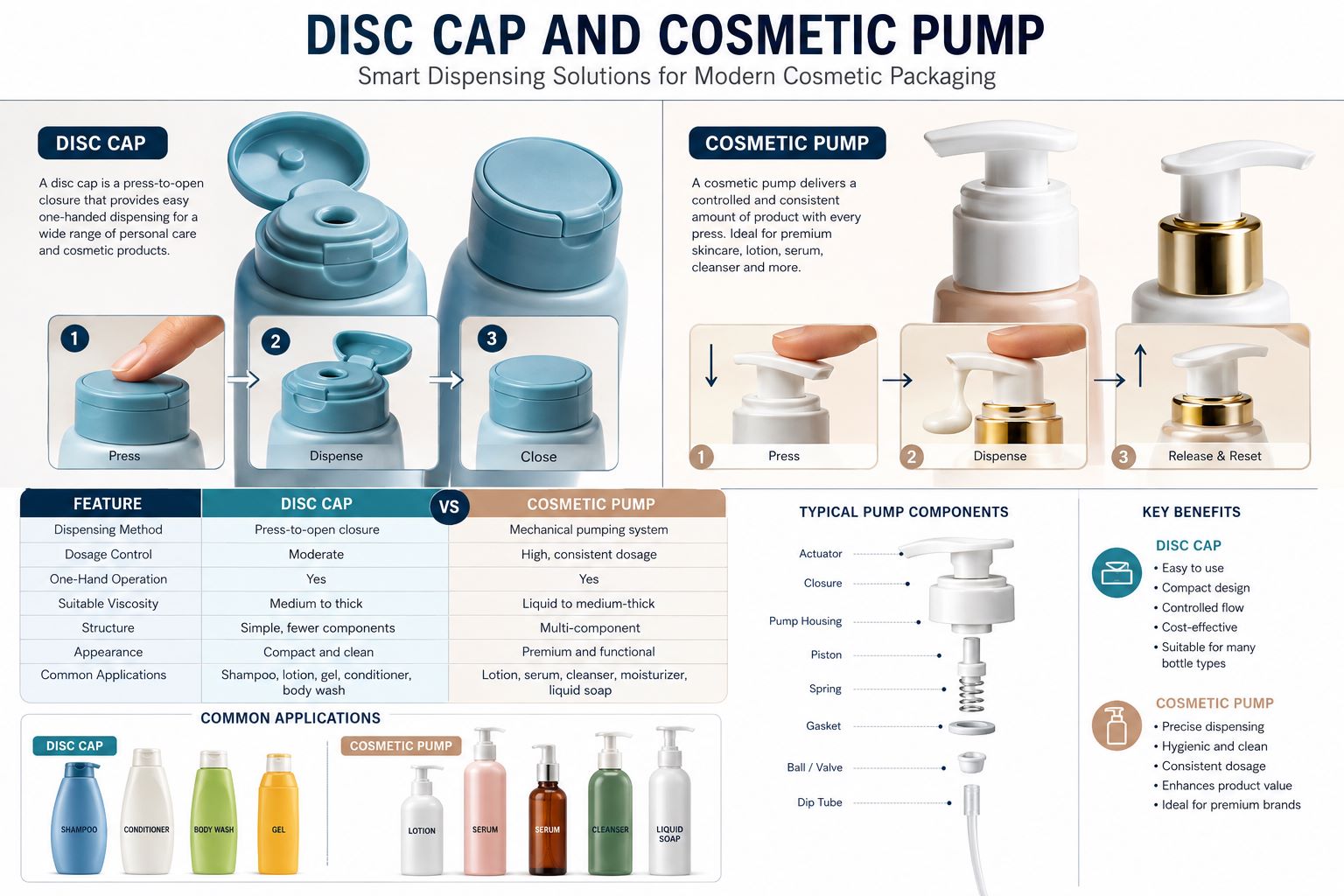
The beauty and personal care packaging sector is undergoing a noticeable shift as brands place greater importance on how products are dispensed, not simply how packages look on retail shelves. The disc cap and cosmetic pump are emerging as important components in this changing environment, supporting convenient application across skincare, haircare, body care, and personal hygiene categories.
Packaging decisions are increasingly connected with formulation compatibility, consumer convenience, controlled dispensing, sustainability, and brand positioning. As a result, closure and pump selection is becoming an earlier consideration during cosmetic product development.
For manufacturers and beauty businesses, this shift highlights an important reality: a dispenser is no longer just an accessory attached to a bottle. It is part of the product experience.
Beauty Packaging Moves Beyond Visual Appearance
For years, packaging differentiation largely focused on bottle shapes, colors, labels, decoration, and premium finishes. Those elements remain important, but functional performance has become equally significant.
Consumers expect a package to work consistently from its first use until the product is finished.
A shampoo bottle that is difficult to open or a moisturizer pump that dispenses inconsistently can negatively influence consumer perception.
This has encouraged brands to evaluate factors such as:
- Dispensing accuracy
- Ease of operation
- Leakage resistance
- Product viscosity
- Closure durability
- Bottle compatibility
- Material efficiency
- Transportation performance
The disc cap and cosmetic pump offer different approaches to meeting these expectations.
Disc Cap Continues to Support Everyday Convenience
The disc cap remains a recognizable packaging format across the personal care market.
Its operation is straightforward. Consumers press one side of the movable disc, causing the opposite side to rise and expose the dispensing opening. The bottle can then be squeezed or tilted to release the product.
After application, the raised portion can be pressed back into position.
Simple Operation Remains a Major Advantage
Unlike removable screw closures, the disc remains integrated with the bottle closure.
This feature can make the package easier to operate, particularly for products commonly used in showers, bathrooms, salons, and other environments where one-handed convenience is valuable.
Common applications include shampoos, conditioners, body lotions, shower gels, cleansers, styling products, and personal care formulations.
Disc Cap Engineering Becomes More Product-Specific
While the basic concept is straightforward, manufacturers are increasingly focusing on matching closure characteristics with individual formulations.
The dispensing opening is particularly important.
A thick conditioner requires different flow characteristics from a lightweight body lotion or cleansing product.
Viscosity Influences Dispensing Performance
If the formulation is highly viscous, an excessively small opening can make dispensing difficult.
A lower-viscosity formulation combined with an oversized opening can create the opposite problem, releasing more product than consumers expect.
This makes disc cap selection a technical decision involving formulation viscosity, orifice diameter, bottle flexibility, neck dimensions, and sealing requirements.
Cosmetic Pump Technology Supports Controlled Application
While disc closures emphasize straightforward access, the cosmetic pump addresses demand for controlled dispensing.
Pump packaging uses mechanical action to transfer the formulation from inside the container to the consumer.
The technology has become particularly relevant for moisturizers, lotions, facial cleansers, hand-care products, body-care formulations, hair treatments, and professional beauty products.
Multiple Components Work Behind Every Pump Stroke
A typical pump can contain several functional components, including:
- Actuator
- Closure
- Piston
- Pump chamber
- Valve
- Spring
- Housing
- Gasket
- Dip tube
Pressing the actuator creates movement inside the system that helps force formulation toward the dispensing outlet.
When the actuator is released, the mechanism recovers while drawing additional formulation into the chamber.
Pump Output Becomes an Important Selection Factor
One advantage associated with a cosmetic pump is the ability to specify approximate output per complete stroke.
This is important because different products require different application quantities.
A facial product may require relatively small quantities, while body lotion applications typically require more.
Controlled Dispensing Can Improve Usage
A properly selected pump can help consumers dispense a more predictable quantity.
This can support:
- More consistent application
- Cleaner dispensing
- Reduced accidental overuse
- Better product control
- Improved consumer convenience
Pump performance, however, must be tested with the actual formulation rather than assumed from specifications alone.
Disc Cap and Cosmetic Pump Target Different Packaging Needs
The growing use of both formats reflects their different strengths.
| Key Area | Disc Cap | Cosmetic Pump |
| Basic operation | Press to open | Press to dispense |
| Product movement | Gravity/squeeze | Pump mechanism |
| Construction | Simpler | Multi-component |
| Dosage | User controlled | More controlled |
| Typical application | Shampoo and conditioner | Lotion and moisturizer |
| Bottle type | Commonly squeezable | Often rigid/semi-rigid |
| User convenience | High | High |
| Packaging complexity | Lower | Higher |
| Premium positioning | Moderate | Strong |
| Formulation testing | Required | Required |
Industry specialists generally view the choice as application-specific rather than identifying one technology as superior.
Packaging Compatibility Gains Greater Attention
Compatibility has become an important subject as cosmetic formulations become more sophisticated.
Products can contain fragrances, oils, active ingredients, surfactants, solvents, and other substances capable of interacting differently with packaging materials.
For this reason, brands should evaluate the complete package.
A disc cap must maintain its sealing and opening characteristics after prolonged contact with the formulation.
A cosmetic pump must continue to prime, dispense, recover, and maintain appropriate output throughout the expected product lifecycle.
Quality Testing Moves Higher on the Development Agenda
Packaging manufacturers and beauty brands are placing greater emphasis on testing before commercial filling.
Key Tests Can Include
- Leakage evaluation
- Drop resistance
- Closure torque
- Pump output measurement
- Priming performance
- Dip-tube functionality
- Chemical compatibility
- Repeated-use testing
- Storage stability
- Transportation simulation
Why Long-Term Testing Matters
Packaging may remain in warehouses, retail stores, bathrooms, handbags, or other environments for extended periods.
Performance immediately after production does not necessarily guarantee performance several months later.
Long-term compatibility studies can therefore help brands identify potential issues before large-scale market distribution.
Consumer Experience Becomes a Competitive Factor
Beauty consumers may not know the engineering behind a dispenser, but they immediately recognize whether it feels convenient.
The opening action of a disc cap, the resistance of a pump actuator, the quantity dispensed, and the cleanliness of the nozzle all contribute to product perception.
Packaging that functions smoothly can reinforce a brand’s quality positioning.
Poor functionality can have the opposite effect.
Customization Remains Important for Brand Differentiation
Functional packaging does not mean abandoning creativity.
Manufacturers can offer customization across colors, finishes, closure profiles, actuator designs, dimensions, and dispensing characteristics.
A bold haircare range might pair colorful bottles with a matching disc cap, while a minimalist skincare brand could use a streamlined cosmetic pump to create a cleaner visual identity.
The most successful designs combine recognizable branding with dependable functionality.
Sustainability Pressures Encourage New Designs
Environmental considerations are also influencing dispensing packaging development.
Beauty companies are increasingly evaluating material reduction, packaging weight, component complexity, recyclability, refillability, and transportation efficiency.
A disc cap can offer opportunities for simplified construction because fewer functional parts may be required.
Conventional pumps present additional challenges due to their multi-component construction.
Pump Innovation Responds to Recycling Challenges
Packaging manufacturers are working on simplified pump structures, reduced material combinations, and designs intended to improve recycling compatibility.
However, sustainability should be evaluated across the complete packaging lifecycle rather than through a single feature.
Industry Focus Turns Toward Total Packaging Performance
The next stage of cosmetic packaging development is likely to involve closer integration between formulation scientists, packaging engineers, manufacturers, designers, and brands.
Rather than selecting the disc cap or cosmetic pump after the bottle has already been finalized, companies can evaluate dispensing requirements earlier.
This approach may reduce compatibility problems and create a better final consumer experience.
Frequently Asked Questions
1. Why are disc caps popular in personal care packaging?
A disc cap provides quick press-to-open operation without requiring consumers to completely remove the closure.
2. What products commonly use disc caps?
Shampoos, conditioners, lotions, shower gels, cleansers, and styling formulations are common applications.
3. Why are cosmetic pumps widely used?
A cosmetic pump provides convenient mechanical dispensing and can offer greater control over the amount released.
4. Are cosmetic pumps suitable for lotions?
Yes. Lotion is one of the most common applications, provided pump specifications match formulation viscosity.
5. What determines disc cap performance?
Orifice dimensions, formulation viscosity, bottle flexibility, neck compatibility, sealing, and closure construction all influence performance.
6. What is pump priming?
Priming is the process of drawing formulation into the pump mechanism and removing air before normal dispensing.
7. Can cosmetic pumps control dosage?
Yes. Pumps can be engineered around different output levels depending on application requirements.
8. Why is compatibility testing necessary?
It helps determine whether the formulation and packaging materials can maintain reliable performance over time.
9. Can disc caps and pumps be customized?
Yes. Colors, finishes, dimensions, designs, and dispensing characteristics can often be adapted to brand requirements.
10. What is changing in sustainable dispensing packaging?
Manufacturers are exploring lightweight components, simplified structures, material reduction, recyclability, and refill-oriented packaging concepts.
https://newsgrow.blogspot.com/2026/08/cream-jar-and-cosmetic-jar.html
https://gosarkarijobs.com/disc-cap-and-cosmetic-pump-a-deep-guide-to-modern-cosmetic-packaging/