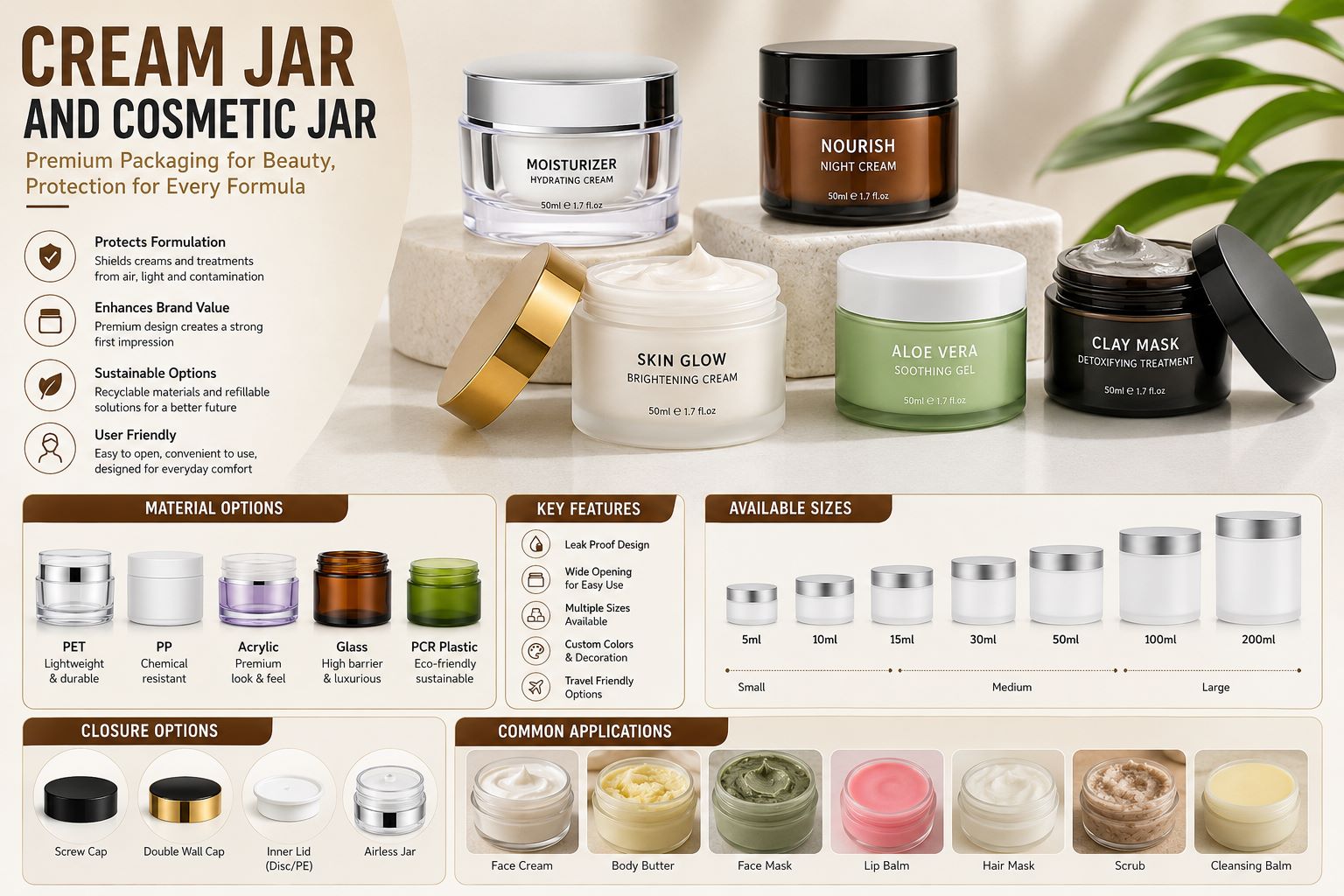
A skincare formula may take months or even years to develop, but customers often notice the packaging first. The container they see on a shelf, hold in their hands, or discover through an online store can immediately shape expectations about quality. This makes the cream jar and cosmetic jar much more than simple storage containers.
From facial moisturizers and body butter to cleansing balms and hair masks, jar packaging is used across almost every area of the beauty industry. Yet choosing a jar based only on appearance can be a costly mistake. Material compatibility, closure quality, product viscosity, decoration, shipping conditions, and customer convenience all deserve careful consideration.
So, what should a beauty brand actually look for when selecting jar packaging?
Start With the Product Inside the Jar
One of the easiest packaging mistakes is choosing the container before fully understanding the formulation.
A thick body butter behaves differently from a lightweight gel cream. An oil-rich cleansing balm has different packaging requirements from a water-based moisturizer.
The ideal cream jar should therefore be selected around the product.
Important formulation characteristics include:
- Viscosity
- Oil content
- Fragrance concentration
- Active ingredients
- Sensitivity to light
- Sensitivity to oxygen
- Recommended storage conditions
Packaging and formulation need to work as a complete system rather than as two separate elements.
Why Cosmetic Jars Work So Well for Thick Formulations
There is a practical reason jars remain common in skincare.
A wide opening makes it easy to access products that would be difficult to dispense through conventional bottles. Consumers can control how much product they remove and can usually access the contents even when the jar is nearly empty.
A cosmetic jar may be suitable for:
- Facial moisturizer
- Night cream
- Body butter
- Face mask
- Hair treatment
- Cleansing balm
- Exfoliating scrub
- Styling cream
- Hand treatment
- Lip care
This versatility allows brands to maintain similar packaging architecture across several product categories.
Your Packaging Material Tells a Story
Material selection affects far more than manufacturing cost.
The weight, transparency, texture, temperature, and appearance of a cream jar can influence what consumers expect from the product before opening it.
Comparing Popular Jar Materials
| Material | Main Strength | Best Suited For |
| Glass | Substantial premium feel | Prestige skincare |
| PET | Clarity and lightweight design | Gels and scrubs |
| PP | Chemical resistance and versatility | Creams and balms |
| Acrylic | Luxury appearance | Premium beauty ranges |
| PCR Plastic | Recycled material content | Eco-conscious packaging |
Think Beyond Luxury vs Budget
Glass is frequently associated with luxury, but plastic does not automatically mean inexpensive packaging.
Modern double-wall plastic jars, precision-molded closures, soft-touch finishes, and high-quality decoration can create a sophisticated presentation.
The right cosmetic jar is the one that delivers the required performance while matching the brand’s positioning.
What Happens When Packaging and Formula Don’t Match?
Packaging problems do not always appear immediately.
A newly filled product may look perfect during the first week. After several months, however, an incompatible formulation could potentially affect the container, closure, decoration, or seal.
That is why compatibility testing is essential.
Possible Warning Signs
Brands should watch for:
- Cracking
- Swelling
- Leakage
- Discoloration
- Surface changes
- Cap loosening
- Printing deterioration
- Unusual fragrance changes
Testing should reflect realistic storage and transportation conditions wherever possible.
The Cap Deserves Just as Much Attention
Imagine receiving an expensive moisturizer only to find cream leaking around the lid.
Customers rarely separate packaging failure from product quality. They simply remember having a bad experience with the brand.
A reliable closure is therefore an essential part of a cream jar.
Depending on the product, additional components can include liners, inner discs, seals, or tamper-evident features.
Why Closure Testing Matters
The cap should:
- Open comfortably.
- Close consistently.
- Remain secure during shipping.
- Match the jar threads correctly.
- Maintain its performance throughout repeated use.
Small closure details can have a surprisingly large impact on perceived quality.
Choosing a Jar Size That Makes Sense
Beauty brands sometimes use oversized containers to make products appear larger. But today’s consumers are increasingly attentive to unnecessary packaging.
Choosing an appropriate capacity creates a more transparent and efficient product experience.
| Capacity | Common Application |
| 5–15 ml | Eye products and samples |
| 20–30 ml | Concentrated treatments |
| 50 ml | Facial creams |
| 100–200 ml | Body creams, masks and scrubs |
| 250 ml+ | Professional products |
A 50 ml cream jar may work perfectly for a daily facial moisturizer, while a body butter used generously may require considerably more capacity.
Can Packaging Make Customers Remember Your Brand?
Absolutely.
Think about how easily consumers recognize certain beauty products from their shape or color alone.
A distinctive cosmetic jar can become a recognizable brand asset.
Ways to Customize Jar Packaging
Brands can experiment with:
- Custom colors
- Screen printing
- Foil stamping
- Matte finishes
- Frosted surfaces
- Metallization
- Embossed logos
- Premium labels
- Decorative caps
- Unique shapes
Consistency Is Often More Powerful Than Complexity
A brand does not necessarily need elaborate packaging.
Using the same cap style, typography, jar proportions, and color system across multiple products can create strong visual recognition.
Simple packaging executed consistently can be more memorable than an overly complicated design.
Packaging for Online Beauty Shoppers
E-commerce has changed the way cosmetics travel.
Products may move through fulfillment centers, delivery vehicles, sorting facilities, and last-mile transportation before reaching the customer.
A cosmetic jar designed primarily for visual appeal may struggle if transportation performance has not been considered.
Brands should test for:
- Leakage
- Impact resistance
- Cap movement
- Scratching
- Decoration damage
- Label lifting
- Glass breakage
The unboxing experience starts before the customer opens the package. A damaged jar can immediately reduce confidence in the product.
The Sustainability Question Is Getting More Complicated
Customers increasingly want beauty brands to reduce unnecessary packaging, but there is no single solution suitable for every product.
Glass, recycled plastic, refill systems, lightweight structures, and mono-material designs can each offer advantages depending on the situation.
Smarter Ways to Reduce Packaging Impact
Brands can consider:
- Reducing unnecessary material.
- Using PCR plastic where suitable.
- Designing refillable packaging.
- Eliminating excessive secondary boxes.
- Improving shipping efficiency.
- Simplifying mixed-material components.
- Providing clearer disposal instructions.
A sustainable cream jar should still protect the formulation effectively. Product waste caused by poor packaging can undermine environmental objectives.
Why Refillable Cosmetic Jars Are Getting Attention
Refillable packaging provides an interesting alternative to disposable luxury containers.
Instead of replacing the complete cosmetic jar, consumers may keep the decorative outer package and replace an inner refill.
This approach can work particularly well for premium skincare, where outer packaging may contain significant material and decorative elements.
However, refill systems should be easy to understand and convenient to use. If the refill process is complicated, customers may simply return to conventional packaging.
Is Airless Jar Packaging Worth Considering?
Airless jars combine some characteristics of traditional jars with controlled dispensing.
Rather than directly accessing the complete product surface, consumers activate a dispensing mechanism that releases a measured quantity.
Potential benefits can include:
- Cleaner dispensing
- Controlled product quantity
- Reduced direct contact
- Premium application experience
- Better evacuation for certain formulas
An airless cream jar can be valuable for selected skincare products, but it should be tested with the actual formulation.
More Technology Doesn’t Automatically Mean Better Packaging
Airless designs can involve additional components and greater complexity.
Brands should compare their practical advantages against manufacturing cost, recyclability, filling requirements, and customer expectations.
What Should You Ask a Cosmetic Jar Supplier?
Finding the lowest unit price should never be the only objective.
Packaging problems discovered after thousands of units have been produced can cost significantly more than selecting a reliable supplier from the beginning.
Ask potential suppliers about:
- Exact packaging material
- Quality standards
- Available capacities
- Minimum order quantities
- Closure options
- Decoration methods
- Color matching
- Sample availability
- Custom tooling
- Production lead times
- Quality inspection procedures
- Packaging for transportation
Request samples and test them before committing to a large production run.
Frequently Asked Questions
1. What is a cream jar mainly used for?
A cream jar is primarily used for moisturizers, masks, balms, body creams, scrubs, and other thick cosmetic formulations.
2. What is the difference between cream and cosmetic jars?
Cream jars specifically target cream-like formulations, while cosmetic jar packaging covers a wider range of beauty and personal care products.
3. Which jar material should I choose?
Choose according to formulation compatibility, barrier requirements, brand positioning, durability, transportation, sustainability, and cost.
4. Can glass cosmetic jars break during shipping?
Yes. Appropriate protective packaging and transportation testing are particularly important when distributing glass containers through e-commerce.
5. Can plastic jars look premium?
Yes. Double-wall construction, custom decoration, sophisticated closures, coatings, and precision molding can create a luxury appearance.
6. Why is packaging compatibility important?
It helps ensure the formulation and packaging materials remain suitable together throughout the intended product lifecycle.
7. Can I customize my cosmetic jars?
Yes. Depending on the supplier, brands can customize colors, shapes, caps, printing, labels, coatings, and decorative finishes.
8. Are refillable jars better for the environment?
They can reduce repeated packaging use when designed effectively and consistently reused by customers.
9. What is PCR plastic?
PCR is post-consumer recycled plastic produced using material recovered from previously used products.
10. What is an airless cream jar?
It is a jar-style package using a mechanism that dispenses product while reducing direct access to the bulk formulation.