
When consumers purchase skincare, haircare, or personal care products, they usually notice the bottle design, label, fragrance, or formulation first. Yet one of the most frequently used parts of the package often receives far less attention: the dispensing system.
Every time someone opens a shampoo bottle or applies a facial mist, the closure influences the experience. This is why solutions such as the flip top cap and cosmetic sprayer have become important elements of modern packaging development.
Choosing between them is not simply a matter of appearance. Product consistency, dosage, application method, leakage prevention, transportation, and consumer convenience all influence the decision.
Packaging Is Part of the Product Experience
A cosmetic formulation can perform exceptionally well, but inconvenient packaging can still frustrate customers.
Consider a lotion that releases far too much product or a toner that sprays unevenly. These problems can lead to waste and make the product feel less refined.
Well-planned dispensing packaging helps brands achieve several objectives:
- Easier product application
- Better dosage control
- Reduced mess and waste
- Reliable storage
- Improved portability
- Stronger product presentation
This explains why dispensing components deserve attention during the early stages of packaging development.
Why Flip Top Caps Remain a Popular Choice
The flip top cap has maintained its popularity because it combines simplicity with convenience.
Its defining feature is an integrated hinged lid. Consumers lift the top section to expose the dispensing opening and press it down again after use.
There is no separate closure to remove, hold, or potentially lose.
Where Does a Flip Top Cap Work Best?
These closures are commonly suitable for products such as:
- Shampoo
- Conditioner
- Body wash
- Face cleanser
- Lotion
- Sunscreen
- Hair gel
- Liquid soap
- Personal care oils
Products frequently used in bathrooms particularly benefit from one-handed opening and closing.
Small Design Details Can Make a Big Difference
A flip top cap may look uncomplicated, but several technical details determine whether it performs effectively.
The hinge must survive repeated movement. The locking system needs enough strength to remain closed during transportation while still being comfortable for consumers to open.
The dispensing hole must also match the formulation.
Why Product Viscosity Matters
Imagine using the same dispensing opening for a thick conditioner and a lightweight oil.
The conditioner could become difficult to squeeze through a small opening. The oil, meanwhile, could pour too quickly through a large one.
Matching the opening with product viscosity can improve dispensing control and reduce unnecessary waste.
Cosmetic Sprayers Bring Precision to Liquid Products
The cosmetic sprayer serves a different purpose.
Instead of allowing the formulation to flow directly from the container, it uses a mechanical pump and nozzle to distribute liquid over an application area.
This makes sprayers particularly useful for:
- Facial mist
- Toner
- Body mist
- Perfume
- Setting spray
- Hair mist
- Lightweight skincare products
The quality of the spray can become an important part of how consumers judge the product.
What Makes a Cosmetic Sprayer Perform Well?
Pressing the actuator activates the internal pump mechanism. Liquid travels upward through the dip tube before passing through the nozzle.
The nozzle then determines how the formulation is distributed.
Several variables influence the final result:
- Pump dosage
- Nozzle dimensions
- Spray angle
- Formulation viscosity
- Actuator pressure
- Droplet distribution
- Dip-tube configuration
A well-matched cosmetic sprayer should provide consistent dispensing without requiring excessive effort.
Which Packaging Option Should a Brand Choose?
The answer depends largely on the formulation and intended application.
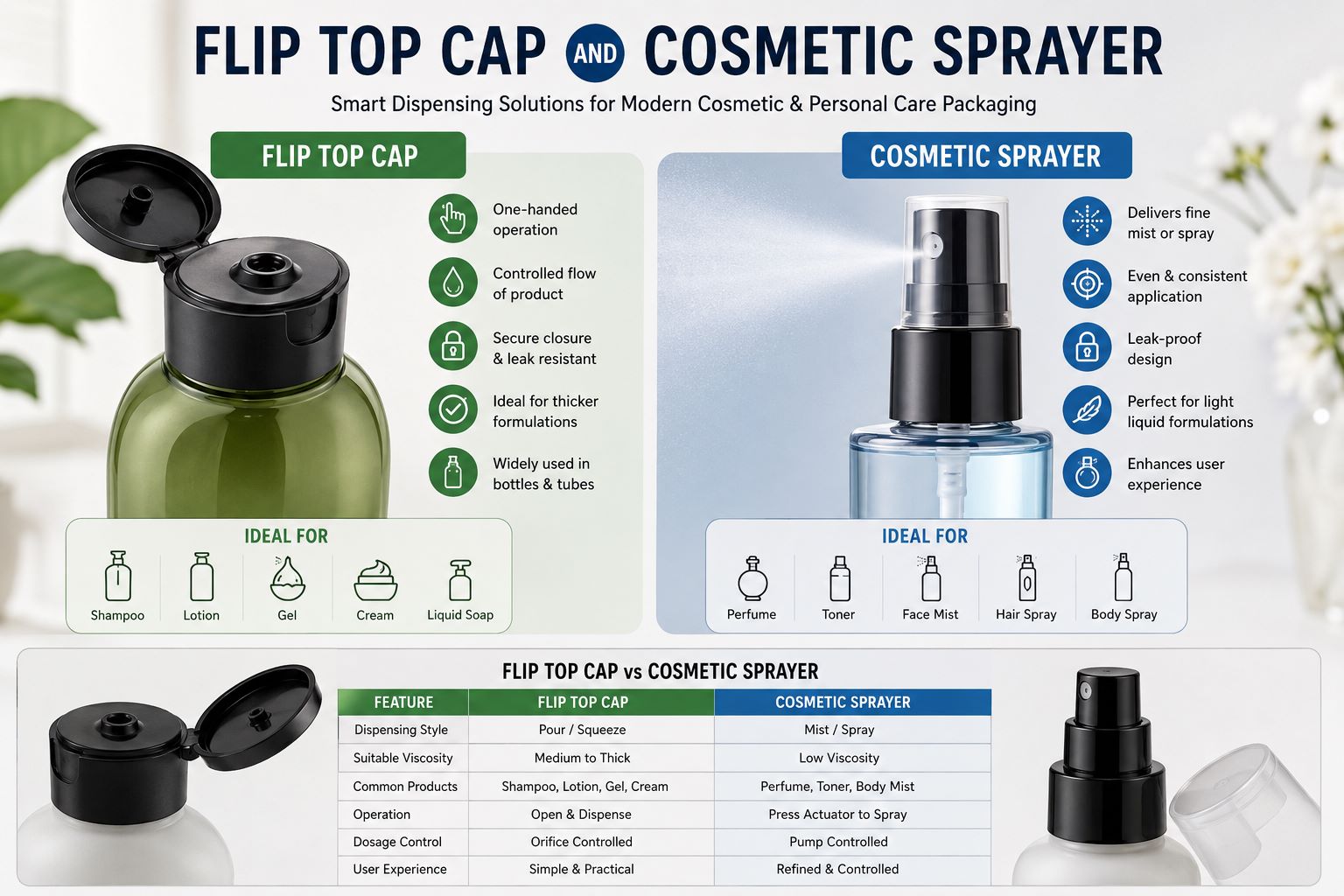
| Requirement | Flip Top Cap | Cosmetic Sprayer |
| Main dispensing style | Squeeze/pour | Spray/mist |
| Ideal product type | Gel, lotion, shampoo | Toner, mist, fragrance |
| Product consistency | Medium to thick | Mostly thin liquid |
| Mechanism | Hinged closure | Pump system |
| Application area | Direct | Wider distribution |
| Dosage control | Opening size | Pump output |
| Ease of operation | High | High |
| Technical complexity | Lower | Higher |
Neither system should be selected simply because it is popular. The packaging should support the way consumers are expected to use the product.
Compatibility Testing Can Prevent Costly Problems
One common mistake is assuming that a dispensing component will work with every cosmetic formulation.
Ingredients can interact with packaging materials during storage.
Alcohol, fragrance compounds, essential oils, preservatives, solvents, and active ingredients may affect plastics, seals, tubes, or internal components differently.
Potential problems can include cracking, swelling, leakage, discoloration, deformation, or inconsistent dispensing.
Testing a flip top cap or cosmetic sprayer with the actual formulation can reveal these problems before large-scale production begins.
Packaging Must Survive More Than the Bathroom Shelf
A package must travel through manufacturing facilities, warehouses, distribution centers, retail channels, and delivery networks before reaching consumers.
During this journey, bottles may experience vibration, pressure, temperature changes, impact, and different orientations.
This is especially important with the growth of e-commerce.
A closure that performs perfectly while standing upright may behave differently after spending hours horizontally inside a delivery box.
Important Packaging Tests
Brands should consider:
- Leakage tests
- Drop tests
- Storage evaluations
- Transportation simulations
- Repeated opening tests
- Pump cycle tests
- Compatibility studies
Testing should reflect actual distribution and usage conditions whenever possible.
Sustainability Is Changing Dispensing Design
Sustainability has become another important consideration in packaging development.
Manufacturers are exploring ways to reduce material usage without reducing performance. Lightweight closures, simplified structures, recyclable polymers, and mono-material concepts are receiving growing attention.
A flip top cap can potentially benefit from simplified construction because its functionality may be achieved using a relatively straightforward molded structure.
The cosmetic sprayer presents additional challenges because traditional pumps can contain multiple materials.
Designing for Better Material Efficiency
Reducing packaging material requires careful engineering.
A lighter component still needs to maintain sealing, durability, hinge performance, and structural integrity. Sustainability therefore works best when it is incorporated into product engineering rather than treated only as a marketing feature.
Customization Can Turn Function Into Branding
Closures and sprayers also provide opportunities for differentiation.
Brands can explore custom colors, matte or glossy finishes, embossed logos, distinctive shapes, decorative collars, and coordinated bottle combinations.
The goal should be to create a recognizable package without compromising functionality.
Consumers repeatedly touch and operate these components, making tactile experience just as important as appearance.
Frequently Asked Questions
What is the purpose of a flip top cap?
A flip top cap allows consumers to open, dispense, and securely close products without removing the entire closure.
What products work well with flip top closures?
Shampoo, conditioner, cleanser, lotion, gel, sunscreen, oil, and liquid soap are common examples.
What does a cosmetic sprayer do?
A cosmetic sprayer transforms liquid into controlled droplets or mist using a pump and nozzle mechanism.
Is a cosmetic sprayer suitable for facial products?
Yes. Properly designed fine-mist sprayers can provide even application for toners and facial mists.
Can sprayers handle thick lotions?
Standard sprayers usually suit low-viscosity liquids. Thick lotions generally require alternative dispensing pumps.
What is pump output?
Pump output is the approximate quantity of formulation released during each complete actuation.
Why should packaging be tested?
Testing helps identify leakage, durability, compatibility, transportation, and dispensing problems before products reach customers.
Can flip top closures be customized?
Yes. Manufacturers can offer customized dimensions, colors, finishes, openings, textures, and branding features.
Why is the spray pattern important?
A consistent pattern improves coverage, dosage control, application comfort, and overall consumer experience.
What makes dispensing packaging sustainable?
Material reduction, recyclability, lightweighting, simplified construction, durability, and refill compatibility can contribute to sustainability.
https://newsgrow.blogspot.com/2026/08/cream-jar-and-cosmetic-jar.html
https://gosarkarijobs.com/disc-cap-and-cosmetic-pump-a-deep-guide-to-modern-cosmetic-packaging/
https://newsgrow.blogspot.com/2026/08/disc-cap-and-cosmetic-pump-essential.html
https://tandtlawassociates.com/past-and-future-of-disc-cap-and-body-lotion-bottle-packaging/
https://newsgrow.blogspot.com/2026/08/disc-cap-and-body-lotion-bottle-designs.html