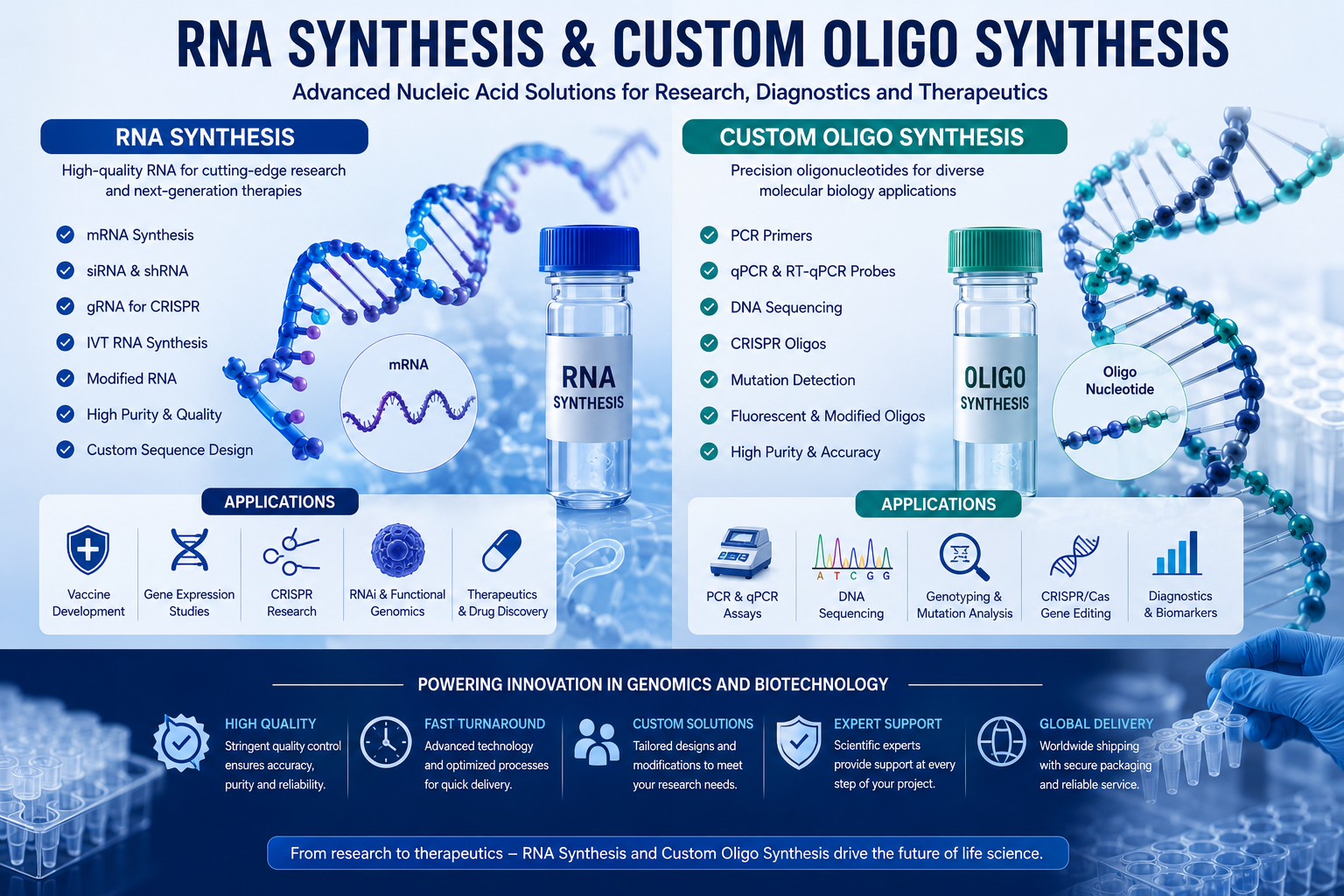
RNA synthesis is an essential service for modern molecular biology, biotechnology, drug discovery and diagnostic research. From short RNA oligonucleotides used in gene regulation studies to longer RNA molecules for functional experiments, researchers increasingly require reliable, application-specific RNA production rather than one-size-fits-all products.
Choosing the right synthesis approach depends on the RNA sequence, required length, chemical modifications, purity, quantity and intended application. For researchers working with siRNA, mRNA, guide RNA, antisense RNA or other RNA-based molecules, understanding these factors can make a significant difference to experimental performance.
This guide explains how RNA synthesis works, the main types of synthetic RNA, when to consider custom oligo synthesis, and what to look for when selecting an RNA synthesis service provider.
What Is RNA Synthesis?
RNA synthesis is the process of producing a specific RNA molecule from a defined nucleotide sequence. Depending on the application, RNA can be produced through chemical synthesis or enzymatic methods such as in vitro transcription.
The appropriate method depends largely on the RNA’s length, structure, sequence characteristics and intended use.
In practical terms, a researcher provides a target sequence and specifications, while the synthesis provider produces the requested RNA and typically performs purification and quality-control testing before delivery.
Key factors in RNA synthesis include:
- RNA sequence and length
- Required quantity
- Purity level
- Chemical modifications
- Terminal modifications
- Desired formulation
- Intended research application
- Required quality-control documentation
For straightforward short RNA molecules, chemical synthesis is commonly used. Longer RNA molecules may require enzymatic production, particularly when the application involves mRNA or other long transcripts.
How Does RNA Synthesis Work?
RNA production can involve different workflows depending on the molecule being manufactured.
1. Sequence design
The process begins with the required RNA sequence. Researchers may provide a sequence directly or work with a synthesis specialist to determine suitable design parameters.
Sequence characteristics can affect synthesis efficiency, purification and downstream performance.
2. Synthesis
For short RNA oligonucleotides, individual nucleotides are assembled chemically in a controlled sequence.
For longer RNA molecules, in vitro transcription can be used. In this approach, a DNA template is used to generate the desired RNA transcript with an RNA polymerase.
3. Deprotection and processing
After synthesis, chemical protecting groups and other synthesis-related components are removed according to the production method.
4. Purification
Purification removes unwanted by-products, truncated sequences and other impurities.
The appropriate purification strategy depends on the RNA molecule and the purity required for the application.
5. Quality control
A professional RNA synthesis service should provide appropriate quality-control information. Depending on the product, this may include analytical measurements relating to identity, purity, concentration and integrity.
6. Delivery and storage
The final RNA is supplied in an appropriate format for the intended application, together with relevant product information and handling recommendations.
Chemical RNA Synthesis vs In Vitro Transcription
There is no single RNA production method that is ideal for every project.
| Feature | Chemical RNA Synthesis | In Vitro Transcription |
| Typical use | Short RNA oligonucleotides | Longer RNA transcripts |
| Sequence flexibility | High | High, depending on template |
| Chemical modifications | Broad range available | Modification options depend on transcription system |
| Common applications | siRNA, antisense RNA, short oligos | mRNA, longer RNA transcripts |
| Production approach | Stepwise chemical assembly | Enzymatic RNA production |
| Best suited to | Defined short sequences | Longer RNA molecules |
The best approach should therefore be selected according to the actual research objective rather than simply choosing the cheapest or fastest production route.
What Types of RNA Can Be Synthesised?
Custom RNA synthesis can support a wide range of research applications.
siRNA
Small interfering RNA (siRNA) is widely used in RNA interference research to investigate gene function.
Researchers may order custom siRNA sequences designed for specific experimental targets.
Antisense RNA and ASOs
Antisense oligonucleotides can be designed to interact with complementary RNA sequences. Depending on the research objective, chemical modifications may be incorporated to influence stability and biological properties.
mRNA
Messenger RNA can be produced for research involving protein expression, RNA biology and related applications. Longer mRNA production often requires an in vitro transcription workflow followed by purification and quality assessment.
Guide RNA
Guide RNAs are used in CRISPR-based research to help direct genome-editing systems towards a selected target sequence.
Custom synthesis can be useful when researchers require specific guide sequences or customised formats.
RNA probes
RNA oligonucleotides can also be designed as probes for molecular biology and analytical applications.
Long RNA
Longer RNA molecules may require specialised synthesis, transcription, purification and quality-control workflows. The appropriate production strategy depends on the transcript length and downstream application.
What Is Custom Oligo Synthesis?
Custom oligo synthesis is the production of an oligonucleotide according to a customer’s specified nucleotide sequence and requirements.
Oligonucleotides may be DNA, RNA or chemically modified nucleic acids.
In RNA research, custom oligo synthesis allows scientists to order molecules designed specifically for their experimental requirements rather than selecting from a standard catalogue.
For example, a researcher studying the expression of a particular gene may require a sequence-specific RNA oligonucleotide that is not commercially available as a standard product.
Custom oligo synthesis may include:
- Custom RNA sequences
- Custom DNA oligonucleotides
- Modified nucleotides
- Fluorescent labels
- Terminal modifications
- Different purification levels
- Different synthesis scales
- Custom formulations
The exact options available vary between providers, so researchers should confirm technical specifications before placing an order.
When Should You Choose Custom RNA Synthesis?
Custom production is particularly useful when an off-the-shelf RNA product does not meet your requirements.
Consider custom RNA synthesis when you need:
A specific sequence:
Your target sequence is unique or unavailable as a catalogue product.
A particular modification:
Your application requires a chemical or terminal modification.
A defined purity level:
The RNA needs to meet a particular purity specification for downstream research.
A specific quantity:
Your project requires a synthesis scale that differs from standard catalogue quantities.
Application-specific specifications:
The RNA must be compatible with a particular experimental workflow.
Customisation can provide greater flexibility, but it also makes specification and quality control more important.
RNA Modifications: Why Do They Matter?
RNA molecules can be chemically modified for different research purposes.
Modifications may be used to alter characteristics such as stability, nuclease resistance, hybridisation behaviour or detection properties, depending on the specific chemistry.
Examples can include:
- 2′-modified nucleotides
- Phosphorothioate linkages
- Fluorescent labels
- 5′ modifications
- 3′ modifications
- Other application-specific chemical modifications
Not every modification is suitable for every RNA format or synthesis method. Researchers should therefore discuss the intended application with the synthesis provider before finalising the sequence.
RNA Purification and Quality Control
RNA quality can have a direct impact on downstream experimental results.
A high-quality synthesis workflow should consider both the production method and the appropriate purification strategy.
Common purification approaches for oligonucleotides may include chromatographic techniques, while longer RNA transcripts may require different purification and analytical workflows.
Depending on the product, quality-control information may address:
- Identity
- Purity
- Concentration
- Molecular characteristics
- RNA integrity
- Residual synthesis-related impurities
Researchers should ask what analytical data and documentation are supplied with their RNA product.
How Much Does Custom RNA Synthesis Cost?
The cost of custom RNA synthesis varies considerably because RNA products are highly customisable.
Important cost factors can include:
- RNA length
- Synthesis scale
- Purification method
- Required purity
- Chemical modifications
- Number of sequences
- Labelling requirements
- Formulation
- Quality-control requirements
- Production complexity
A short, unmodified RNA oligonucleotide may have very different production requirements from a longer, heavily modified or highly purified RNA molecule.
For this reason, requesting a quote based on the complete sequence and specifications is usually more useful than relying on a generic price list.
How to Choose an RNA Synthesis Service
Selecting an RNA supplier should involve more than comparing the headline price.
1. Review technical capabilities
Check whether the provider can produce the RNA length, sequence type, modifications and quantities you require.
2. Ask about purification
Confirm which purification options are available and whether they are appropriate for your intended application.
3. Understand quality control
Ask what analytical testing is performed and what documentation accompanies the final product.
4. Check modification options
If your project requires modified RNA, verify that the provider has experience with the specific chemistry.
5. Consider scalability
If your research programme may expand from a few sequences to a larger panel, choose a provider capable of supporting changing requirements.
6. Evaluate technical support
A knowledgeable technical team can be valuable when sequence design, modifications or production requirements are complex.
7. Review lead times and logistics
Production time can vary significantly depending on complexity. Confirm expected timelines before starting a time-sensitive experiment.
Custom RNA Synthesis for Research Applications
RNA synthesis supports research across several areas of life science.
Gene regulation research
Custom RNA molecules can be used to investigate how specific genes are regulated and expressed.
Molecular biology
RNA oligonucleotides are routinely incorporated into molecular biology workflows involving nucleic-acid interactions and gene expression studies.
Drug discovery research
Modified RNA molecules and antisense technologies are important areas of research in the development of new therapeutic approaches.
CRISPR research
Custom guide RNA production can support genome-editing research where sequence-specific targeting is required.
Diagnostic research
RNA oligonucleotides may be incorporated into assays and molecular detection workflows, depending on the specific test design.
RNA biology
Synthetic RNA provides researchers with controlled sequences for studying RNA structure, function, interactions and processing.
RNA Synthesis vs Custom Oligo Synthesis: What’s the Difference?
The terms are related but are not always interchangeable.
RNA synthesis specifically refers to producing RNA molecules.
Custom oligo synthesis is a broader term covering the production of custom oligonucleotides, which can include both DNA and RNA.
Therefore, if you need a custom RNA sequence, custom oligo synthesis may be the service category through which that RNA is produced.
For a project involving several nucleic-acid formats, a provider offering both custom DNA and RNA oligo synthesis can simplify procurement and project management.
Common Questions About RNA Synthesis
What is RNA synthesis used for?
RNA synthesis is used to produce defined RNA molecules for applications including gene regulation studies, RNA interference research, CRISPR experiments, molecular biology, diagnostic research and RNA-based biotechnology.
Can RNA be custom synthesised?
Yes. Researchers can order RNA based on a specific nucleotide sequence, with options for quantity, purification and certain chemical modifications depending on the synthesis provider.
What is custom oligo synthesis?
Custom oligo synthesis is the production of DNA, RNA or modified oligonucleotides according to a customer’s specified sequence and requirements.
How long does RNA synthesis take?
Production time depends on RNA length, synthesis method, modifications, purification and quality-control requirements. Simple sequences may have shorter production timelines than complex or highly modified molecules.
Can modified RNA be synthesised?
Many RNA synthesis providers offer modified nucleotides and terminal modifications. Availability depends on the specific chemistry and RNA format.
Is purification necessary for synthetic RNA?
Purification requirements depend on the intended application. Research applications with demanding performance or purity requirements may require a higher purification level than routine applications.
How do I order custom RNA?
Typically, you provide the RNA sequence, required quantity, purity, modifications and intended application to the synthesis provider. The provider can then assess feasibility and provide a quotation.
What Information Should You Provide When Requesting a Quote?
To receive an accurate quotation for custom RNA synthesis, prepare as much information as possible.
A typical enquiry should include:
- RNA sequence
- Number of sequences
- Required quantity
- Desired purity
- Chemical modifications
- Labelling requirements
- Intended application
- Preferred delivery format
- Required timeframe
Providing complete specifications at the beginning can reduce unnecessary back-and-forth and help the supplier recommend an appropriate production and purification strategy.
Practical Example: Ordering a Custom RNA Oligo
Suppose a research team needs a sequence-specific RNA oligonucleotide for a gene-expression experiment.
Instead of selecting a generic RNA product, the team can submit the required sequence and specify:
- RNA rather than DNA chemistry
- Required synthesis scale
- Purification requirements
- Any necessary modifications
- Intended research application
- Required delivery format
The synthesis provider can then review the sequence, confirm production feasibility and provide a quotation.
This approach is particularly useful when the sequence is not available as a standard catalogue product.
Why Quality Matters in Custom RNA Production
Synthetic RNA is often used as one component of a larger experimental workflow. If the RNA’s quality, concentration or identity is inconsistent with the research requirements, interpreting downstream results can become more difficult.
A reliable provider should therefore have clearly defined processes covering synthesis, purification, quality control, documentation and handling.
Researchers should not hesitate to ask technical questions before ordering, particularly for modified, long or application-critical RNA molecules.
Internal Link Opportunities
For a life-science or biotechnology website, this article can naturally link to related service and educational pages using descriptive anchor text such as:
- custom oligo synthesis services
- RNA oligonucleotide synthesis
- custom DNA oligo synthesis
- siRNA synthesis services
- modified RNA synthesis
- mRNA synthesis services
- in vitro transcription services
- oligonucleotide purification
- nucleic acid synthesis services
- custom peptide synthesis services
- recombinant antibody production
These links can help users move from educational information to relevant service pages while also strengthening the website’s topical structure.
Get a Custom RNA Synthesis Quote
If you have a specific RNA sequence, modification requirement or research application, the most practical next step is to discuss the specifications with a specialist synthesis provider.
Rather than choosing a service based solely on price, compare sequence capability, synthesis method, purification options, quality control, modification availability, technical support and delivery requirements.
For a custom RNA or oligonucleotide project, provide your sequence and specifications to the provider so the team can assess feasibility and prepare an application-specific quotation.