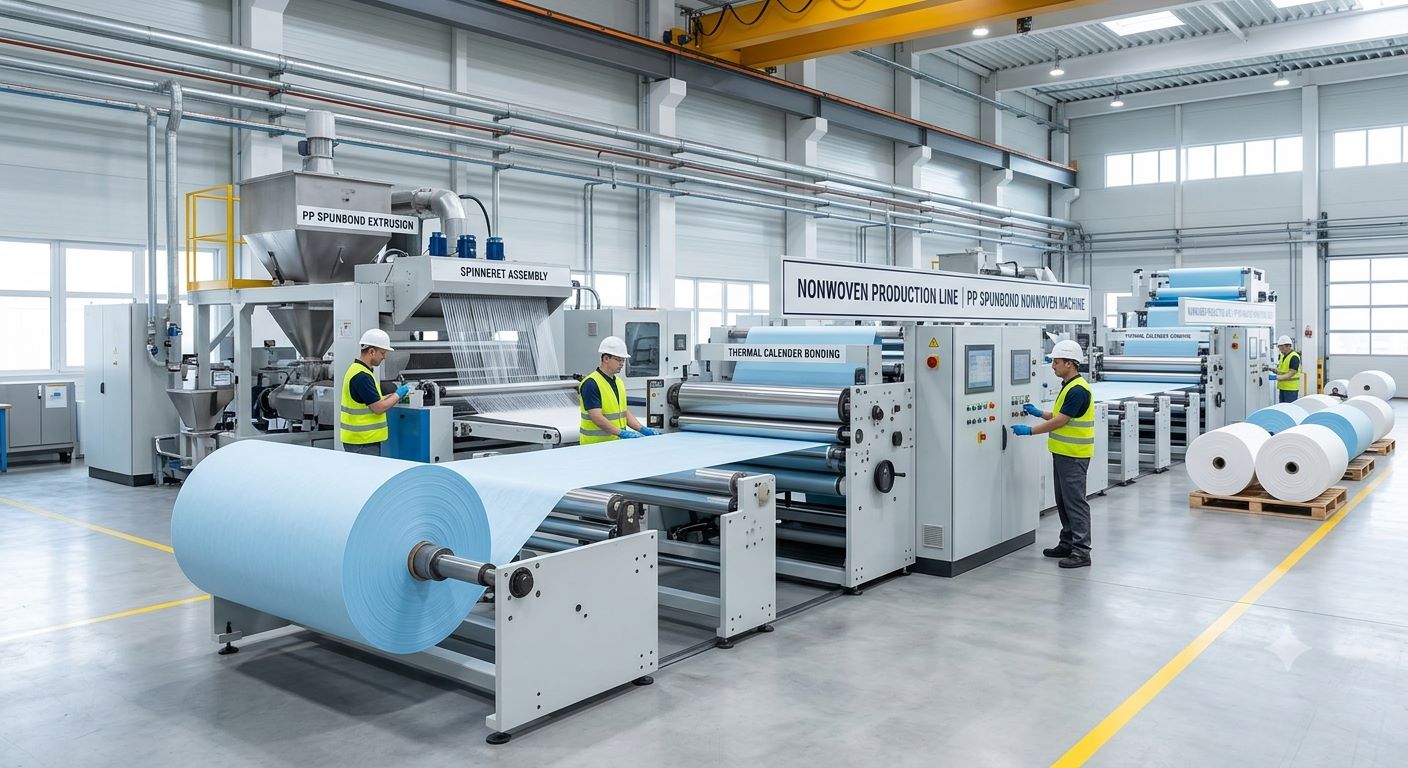
A Nonwoven Production Line is an integrated manufacturing system used to convert polymer raw materials, such as polypropylene (PP), into nonwoven fabric through processes including extrusion, spinning, web formation, bonding, winding and finishing.
For manufacturers looking to enter or expand in the nonwoven fabric industry, selecting the right production line is a significant investment decision. The equipment affects production capacity, fabric quality, energy consumption, product range and long-term operating costs.
Among the available technologies, the PP Spunbond Nonwoven Machine is widely used for producing lightweight and durable polypropylene spunbond fabrics for applications such as medical products, hygiene items, agriculture, packaging and construction.
This guide explains how a nonwoven production line works, what equipment it includes, how to choose the right configuration and what manufacturers should consider before purchasing.
What Is a Nonwoven Production Line?
A Nonwoven Production Line is a complete set of machinery designed to manufacture fabric without traditional weaving or knitting.
Instead of interlacing yarns, the process creates a web of continuous polymer filaments and bonds them together to form a fabric structure.
A typical PP spunbond line includes:
- PP raw material feeding system
- Extruder
- Polymer filtration system
- Metering pump
- Spinning or die system
- Quenching and cooling system
- Air-drawing system
- Web-forming unit
- Calender or bonding system
- Edge trimming equipment
- Fabric winding unit
- Automatic control system
The exact configuration depends on the required fabric specifications, production capacity and end-use applications.
How Does a PP Spunbond Nonwoven Machine Work?
A PP Spunbond Nonwoven Machine generally follows a continuous manufacturing process.
1. PP Material Feeding
Polypropylene granules are introduced into the feeding system. Consistent raw-material feeding is important because variations can affect extrusion stability and finished fabric quality.
2. Melting and Extrusion
The PP granules enter the extruder, where controlled heating melts the polymer.
The molten polymer is then transported under controlled pressure towards the spinning system.
3. Filtration
Before spinning, the polymer passes through a filtration system designed to remove unwanted contaminants and maintain a stable melt flow.
Effective filtration helps protect downstream components and supports consistent filament formation.
4. Filament Spinning
The molten polymer passes through a specially designed spinneret to form continuous filaments.
These filaments are subsequently attenuated and cooled under controlled conditions.
5. Web Formation
The filaments are distributed onto a moving forming surface to create a continuous web.
Uniform web formation is essential for achieving consistent fabric weight, strength and appearance.
6. Thermal Bonding
The web passes through a bonding system, commonly a heated calender, where pressure and temperature bond the filaments together.
The bonding pattern and process parameters can influence fabric properties such as tensile strength, softness, elongation and air permeability.
7. Winding and Slitting
The finished nonwoven fabric is wound into rolls. Depending on customer requirements, the rolls can then be slit into different widths.
This creates a continuous production process from polymer granules to finished nonwoven rolls.
What Are the Main Components of a Nonwoven Production Line?
Understanding the major components can help buyers compare equipment suppliers more effectively.
| Component | Primary Function |
| Extruder | Melts and transports polypropylene |
| Filter | Removes contaminants from polymer melt |
| Metering pump | Maintains controlled polymer flow |
| Spinneret | Forms continuous polymer filaments |
| Cooling system | Controls filament temperature |
| Drawing system | Attenuates and organises filaments |
| Web former | Creates the nonwoven fibre web |
| Calender | Thermally bonds the web |
| Winder | Produces finished fabric rolls |
| Slitting system | Produces required roll widths |
| Control system | Monitors and regulates production parameters |
A reliable production line is not simply a collection of individual machines. The components need to work together as a coordinated system.
What Products Can Be Made with a PP Spunbond Nonwoven Machine?
PP spunbond technology can be configured for different fabric weights, widths and applications.
Common products include:
Medical and Healthcare Nonwovens
Spunbond PP fabric can be used as a component in products such as:
- Disposable gowns
- Surgical caps
- Shoe covers
- Protective clothing
- Medical packaging
- Hygiene products
Where products are intended for regulated healthcare applications, manufacturers must ensure that the finished material and manufacturing process meet the applicable standards and customer specifications.
Hygiene Products
Spunbond nonwoven fabrics are used in various hygiene applications, including components of:
- Baby products
- Adult care products
- Feminine hygiene products
- Disposable hygiene articles
Fabric specifications depend on the product design and required performance.
Agricultural Applications
Agricultural nonwoven fabric can be used for applications such as:
- Crop covers
- Plant protection
- Nursery applications
- Weed-control products
- Soil-related applications
The required fabric properties vary according to climate, crop and intended use.
Construction and Industrial Applications
PP nonwoven fabric is also used in selected construction and industrial products, including:
- Protective layers
- Filtration-related applications
- Packaging materials
- Industrial covers
- Composite materials
Why Choose PP for Spunbond Nonwoven Fabric?
Polypropylene is widely used in spunbond manufacturing because it can be processed into continuous filaments and engineered for different nonwoven applications.
Depending on the formulation and production parameters, PP spunbond fabric can provide a combination of:
- Low weight
- Good tensile performance
- Chemical resistance
- Moisture resistance
- Process flexibility
- Consistent filament formation
- Suitability for high-volume production
However, material selection should always be based on the finished product requirements rather than simply choosing a polymer based on price.
What Should You Consider Before Buying a Nonwoven Production Line?
Buying a production line is a long-term investment. The right equipment depends on your business model, target market and required output.
1. Production Capacity
First determine the required output.
A manufacturer supplying a local market may have different requirements from a company targeting large-scale export production.
Ask suppliers for clearly defined production data based on the intended fabric specifications rather than relying only on a headline capacity figure.
2. Fabric Width
The required working width should match your target applications.
Wider equipment may provide greater production flexibility, but it can also affect the overall investment, factory layout and supporting infrastructure.
3. Fabric Weight
Determine the GSM range you need to manufacture.
For example, a producer targeting lightweight hygiene fabrics may require a different operating range from one manufacturing heavier industrial or agricultural materials.
4. Number of Beams
Depending on the machine design, multiple-beam configurations can provide additional production flexibility and may support different product requirements.
The appropriate configuration depends on the intended fabric range and production objectives.
5. Automation
Modern control systems can help operators monitor important production parameters and improve process consistency.
When comparing machines, evaluate the actual control functions, data monitoring capabilities and ease of operation rather than simply asking whether a machine is “automatic”.
6. Energy Consumption
Energy is an important operating cost in polymer processing.
Ask the equipment manufacturer for realistic energy-consumption information under defined operating conditions. This makes comparisons more meaningful than using an unspecified theoretical figure.
7. Maintenance and Spare Parts
Before purchasing, understand:
- Which components require routine replacement
- Availability of spare parts
- Recommended maintenance intervals
- Technical support arrangements
- Troubleshooting procedures
- Warranty coverage
A lower initial equipment price may not necessarily result in a lower total cost of ownership.
8. Installation and Commissioning
A production line requires more than delivery.
Clarify whether the supplier provides:
- Installation support
- Commissioning
- Operator training
- Production testing
- Technical documentation
- After-sales assistance
These services can be particularly important for manufacturers entering spunbond production for the first time.
How Much Does a Nonwoven Production Line Cost?
There is no single standard price for a Nonwoven Production Line.
The total investment depends on factors such as:
- Production capacity
- Machine width
- Fabric GSM range
- Number of beams
- Automation level
- Auxiliary equipment
- Factory requirements
- Installation and commissioning
- Shipping and import costs
- Customisation
- Supplier and technology specification
For this reason, requesting a machine quotation based only on the phrase “PP spunbond machine” may produce an inaccurate comparison.
A better approach is to provide the supplier with your required fabric width, GSM range, target production volume, raw material, intended applications and operating location.
PP Spunbond Machine vs Other Nonwoven Technologies
Not every nonwoven product requires spunbond technology.
Spunbond
Spunbond creates continuous filaments directly from polymer melt.
It is commonly selected where manufacturers require continuous filament nonwoven fabric and scalable production.
Meltblown
Meltblown uses high-speed air to attenuate polymer melt into very fine fibres.
It is commonly associated with filtration and specialised applications.
Spunbond + Meltblown
A combined configuration can produce composite structures such as SMS-type materials, where different layers provide different functional characteristics.
The best technology depends on the required performance characteristics and final application.
How to Evaluate a Nonwoven Machine Manufacturer
Choosing the machine supplier is as important as choosing the machine specification.
Before signing a purchase agreement, consider the supplier’s:
Technical experience:
Can the supplier demonstrate knowledge of polymer processing, spinning, web formation and thermal bonding?
Production references:
Can they provide verifiable examples of comparable installations?
Technical documentation:
Are machine specifications, utilities, drawings and operating requirements clearly documented?
After-sales support:
What happens if a critical component requires technical assistance?
Spare parts availability:
How quickly can important replacement parts be supplied?
Testing and acceptance:
Will the equipment be tested against agreed production parameters before final acceptance?
A supplier that communicates clearly about both capabilities and limitations is generally more valuable than one that focuses only on selling the machine.
Common Mistakes When Purchasing a Spunbond Production Line
Choosing Based Only on Purchase Price
The cheapest machine may not provide the best long-term economics.
Consider productivity, energy use, maintenance, fabric quality, downtime and technical support alongside the initial price.
Not Defining the Target Fabric
A machine should be selected around the products you intend to manufacture.
Define GSM, width, strength requirements, softness, colour requirements and other relevant properties before finalising the equipment.
Ignoring Factory Infrastructure
A production line may require specific requirements for:
- Electrical power
- Cooling water
- Compressed air
- Ventilation
- Factory space
- Material handling
- Finished-roll storage
These requirements should be assessed before installation.
Failing to Plan for Maintenance
Preventive maintenance should be part of the operating plan from the beginning.
Ask for maintenance schedules and recommended spare-parts lists before commissioning the equipment.
How to Improve Nonwoven Production Efficiency
Once a production line is installed, operational discipline becomes important.
Manufacturers can focus on:
- Maintaining stable extrusion conditions.
- Monitoring polymer quality and raw-material consistency.
- Keeping filtration systems within recommended operating conditions.
- Controlling spinning and cooling parameters.
- Monitoring web uniformity.
- Maintaining appropriate bonding temperature and pressure.
- Calibrating critical sensors and instruments.
- Following preventive-maintenance schedules.
- Recording production and quality data.
- Training operators to identify process deviations early.
Small process variations can influence fabric consistency, so systematic monitoring is preferable to relying only on visual inspection.
Frequently Asked Questions
What is a nonwoven production line?
A nonwoven production line is an integrated manufacturing system that converts polymer or other fibres into nonwoven fabric without traditional weaving or knitting. A PP spunbond line typically uses extrusion, filament spinning, web formation, thermal bonding and winding.
What is a PP spunbond nonwoven machine used for?
A PP Spunbond Nonwoven Machine is used to manufacture polypropylene spunbond fabric for applications including hygiene products, medical products, agriculture, packaging, construction and industrial materials.
Is PP suitable for spunbond manufacturing?
Yes. Polypropylene is widely processed into spunbond nonwoven fabric because it can form continuous filaments and can be engineered for a range of fabric properties and applications.
What affects the price of a nonwoven production line?
Production capacity, working width, GSM range, machine configuration, automation, auxiliary equipment, installation, customisation and technical-support requirements can all affect the overall investment.
How do I choose the right spunbond machine?
Start with the product rather than the machine. Define your target applications, fabric width, GSM range, required output, raw material, quality specifications and factory conditions. Then compare suppliers based on technical capability, lifecycle cost, support and machine performance.
Can one machine produce different GSM fabrics?
The achievable GSM range depends on the specific machine configuration, process design and operating conditions. Buyers should confirm the intended GSM range with the manufacturer and request production evidence for the required specifications.
What is the difference between spunbond and meltblown?
Spunbond generally produces continuous filaments that form a nonwoven web, while meltblown uses high-velocity air to create much finer fibres. They serve different applications and can also be combined in multilayer nonwoven structures.