
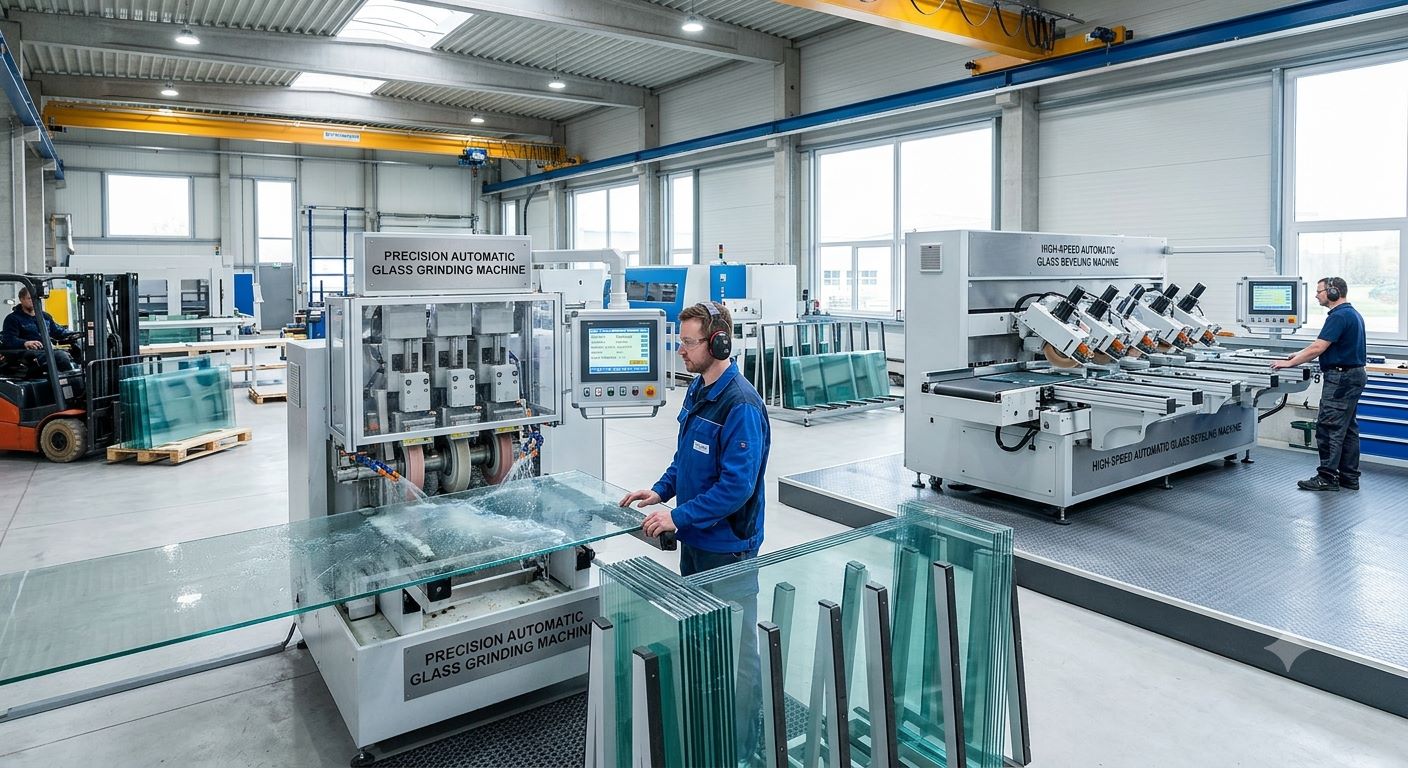
Both machines are designed to process glass edges, but their purposes are different. A glass grinding machine primarily smooths, shapes, and polishes sharp glass edges, while a glass beveling machine creates attractive angled edges commonly seen on decorative mirrors, furniture glass, doors, and architectural installations.
Choosing the right machine can help manufacturers achieve better finishing quality, reduce manual work, and increase overall production efficiency.
Understanding the Role of a Glass Grinding Machine
A glass grinding machine is used after glass has been cut into the required size. Freshly cut glass often has rough and sharp edges that may be dangerous during handling and unsuitable for installation.
Grinding machinery removes these imperfections and produces a smooth, professionally finished edge.
Depending on the machine type, manufacturers can create:
- Straight polished edges
- Flat edges
- Rounded edges
- Pencil edges
- Arris edges
- Customized edge profiles
These machines are widely used in factories producing construction glass, furniture, windows, doors, shower enclosures, appliances, and decorative products.
How Glass Grinding Machines Process Glass
Glass grinding generally involves multiple stages rather than a single grinding operation. The sheet moves through different wheels positioned inside the machine.
During processing, coarse grinding wheels remove excess glass first. Medium and fine wheels then refine the surface before polishing wheels create the final finish.
A typical process includes:
- Loading and positioning the glass.
- Rough edge grinding.
- Intermediate edge shaping.
- Fine grinding.
- Final polishing.
- Cleaning and inspection.
This progressive system improves dimensional accuracy while minimizing visible scratches.
Water is continuously supplied during operation to cool the glass and grinding wheels. It also helps remove small glass particles created during processing.
Why Cooling Is Important During Grinding
Friction between glass and high-speed grinding wheels generates heat. If the temperature becomes excessive, the glass may develop stress, chips, or cracks.
An effective cooling system provides several advantages:
- Controls processing temperature
- Protects grinding wheels
- Reduces thermal damage
- Improves edge quality
- Removes grinding residue
- Supports longer production cycles
For this reason, water pumps, tanks, filters, and circulation systems should be checked regularly.
What Is a Glass Beveling Machine?
A glass beveling machine is specifically designed to produce an angled decorative surface along the edge of glass.
Instead of creating a standard polished edge, beveling removes a controlled portion of the glass at an angle. When light passes through the finished bevel, it produces an attractive reflective effect.
Beveled edges are commonly found on:
- Wall mirrors
- Decorative glass panels
- Designer furniture
- Glass doors
- Luxury interiors
- Bathroom mirrors
- Display units
- Architectural glass features
Because beveling is highly visible, precision and polishing quality are extremely important.
How a Glass Beveling Machine Creates Decorative Edges
A glass beveling machine uses several grinding and polishing wheels positioned at carefully controlled angles.
The first wheels remove glass material and create the required bevel shape. Additional wheels refine the surface, while polishing wheels produce clarity and shine.
The process generally involves:
- Feeding the glass into the machine.
- Removing material from the selected edge.
- Establishing the required bevel angle.
- Refining the beveled surface.
- Removing fine grinding marks.
- Polishing the edge to achieve transparency.
Machine operators can adjust various settings depending on glass thickness and design requirements.
Key Beveling Settings That Affect Quality
The final appearance of beveled glass depends heavily on machine adjustment.
Important parameters include:
- Bevel angle
- Bevel width
- Glass thickness
- Conveyor speed
- Grinding-wheel pressure
- Polishing-wheel position
- Cooling-water supply
Incorrect adjustments can result in uneven bevel width, visible scratches, poor polishing, or inconsistent angles.
Modern automated machines provide digital controls that make these adjustments easier and more repeatable.
Difference Between Glass Grinding and Glass Beveling Machines
Although both machines process glass edges, their primary applications differ.
| Processing Factor | Glass Grinding Machine | Glass Beveling Machine |
| Main function | Smooths and polishes glass edges | Produces angled decorative edges |
| Primary objective | Safety and finishing | Appearance and decorative value |
| Common edge type | Flat, round, pencil or arris | Angled polished bevel |
| Typical products | Doors, windows, furniture | Mirrors and decorative panels |
| Precision requirement | High | Very high |
| Decorative effect | Moderate | Strong visual appearance |
Factories producing multiple types of glass products may benefit from installing both machines.
Main Components Used in Glass Processing Machines
Modern grinding and beveling equipment contains several important systems working together.
Grinding wheels are responsible for removing glass material. Diamond wheels are commonly used because they are strong, durable, and capable of processing glass accurately.
Polishing wheels provide the final smooth and transparent appearance.
The conveyor system moves the glass through each processing station at a controlled speed.
Motors rotate grinding and polishing wheels while providing sufficient power for continuous industrial operation.
Modern machines may also contain PLC systems, touchscreens, sensors, automatic lubrication units, and digital controls.
Advantages of Automated Glass Edge Processing
Automation has transformed the way glass factories manage production.
Using a modern glass grinding machine or glass beveling machine can provide benefits such as:
- Higher production capacity
- Consistent finishing quality
- Reduced dependence on manual labor
- Improved operator safety
- Better dimensional control
- Faster processing
- Lower rejection rates
- Consistent polishing
- Repeatable edge profiles
- Reduced production variation
Automated systems are particularly valuable for companies handling large-volume orders.
Factors to Consider Before Buying a Glass Grinding Machine
Selecting machinery only by price may lead to higher operating costs later. Manufacturers should evaluate the machine according to their actual production requirements.
Important considerations include:
- Supported glass thickness.
- Minimum glass dimensions.
- Maximum processing size.
- Number of grinding spindles.
- Required edge profiles.
- Conveyor speed.
- Motor quality.
- Water-cooling system.
- Availability of replacement parts.
- Technical support from the supplier.
A machine matched to real production needs usually provides better efficiency and reliability.
How to Choose a Suitable Glass Beveling Machine
Selecting a glass beveling machine requires additional attention because bevel quality directly affects the appearance of finished products.
Important specifications include:
- Maximum bevel width
- Adjustable bevel angle
- Number of grinding wheels
- Number of polishing wheels
- Processing speed
- Glass thickness range
- Minimum glass size
- Control-system accuracy
- Automatic lubrication
- Water circulation efficiency
Manufacturers producing premium mirrors should also evaluate polishing transparency before finalizing a machine.
Maintenance Tips for Reliable Machine Operation
Routine maintenance can improve processing accuracy and reduce unexpected downtime.
Operators should:
- Remove glass particles after every shift.
- Inspect grinding wheels for excessive wear.
- Check polishing-wheel condition.
- Maintain correct water levels.
- Clean water filters regularly.
- Lubricate chains and moving parts.
- Inspect conveyor belts.
- Check bearings and motors.
- Keep electrical components dry.
- Replace damaged components quickly.
A preventive maintenance schedule also helps extend overall machine life.
Major Applications in the Glass Industry
The glass grinding machine is widely used for architectural glass, office partitions, doors, windows, tabletops, shower panels, appliance glass, and furniture.
The glass beveling machine is more commonly selected for premium decorative products such as mirrors, designer furniture, luxury doors, wall panels, and interior decoration.
Using both technologies allows manufacturers to serve a wider range of customers and applications.
Future Development of Glass Grinding and Beveling Technology
Glass-processing machinery continues to become more intelligent and automated.
Future machines are likely to offer advanced sensors, automatic thickness recognition, digital production records, remote monitoring, energy-efficient motors, and predictive maintenance capabilities.
Smart control systems can automatically adjust processing parameters based on glass dimensions and production requirements.
Factories may also integrate grinding and beveling machines with cutting, drilling, washing, inspection, and loading systems to build fully automated production lines.
These developments can help manufacturers reduce human error while improving productivity and product consistency.
Frequently Asked Questions
1. What is a glass grinding machine used for?
A glass grinding machine is used to smooth, shape, and polish rough glass edges after cutting.
2. Why should cut glass edges be ground?
Grinding removes sharp edges, improves safety, and prepares glass for professional installation or further processing.
3. What does a glass beveling machine do?
A glass beveling machine produces a polished angled edge for decorative and premium glass products.
4. Can thick glass be processed using these machines?
Yes. Industrial machines usually support multiple glass thicknesses depending on their design and specifications.
5. What is the main difference between grinding and beveling?
Grinding mainly creates smooth functional edges, while beveling creates decorative angled surfaces.
6. Why are diamond wheels commonly used?
Diamond wheels provide excellent hardness, durability, cutting performance, and dimensional accuracy.
7. Is water necessary during glass grinding?
Yes. Water cools the glass and wheels while removing grinding particles.
8. Can bevel width be adjusted?
Yes. Most professional machines allow operators to control bevel width and angle within specified limits.
9. What causes poor glass polishing?
Worn wheels, incorrect pressure, insufficient cooling, excessive speed, and improper machine adjustment can reduce polishing quality.
10. How can machine service life be increased?
Regular cleaning, lubrication, inspection, cooling-system maintenance, and timely replacement of worn parts can improve machine lifespan.