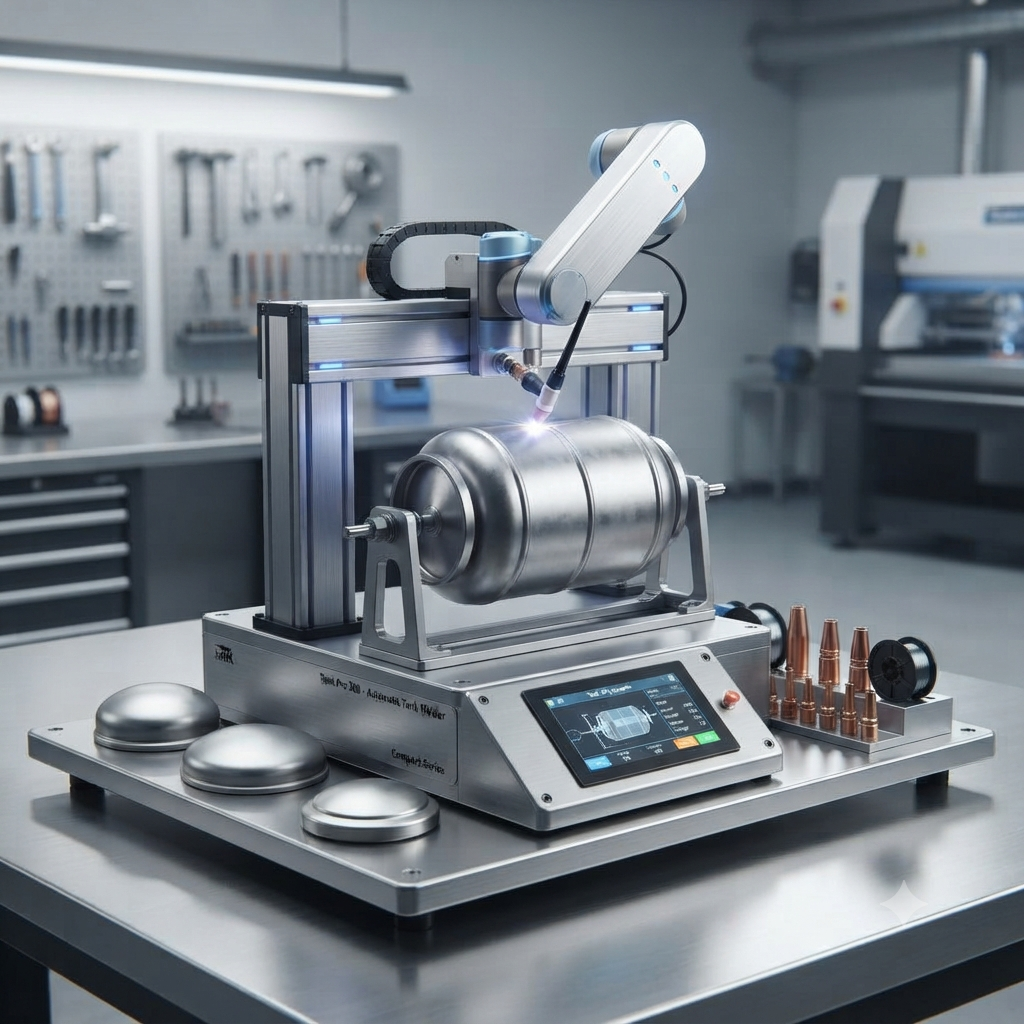
Manufacturing storage tanks for oil, water, chemicals, and food processing requires precision, consistency, and safety. An automatic welding machine for tanks is designed to automate circular and longitudinal welding operations, reducing manual effort while improving weld quality. Industries such as petrochemical, pharmaceutical, dairy, and power generation increasingly rely on automated welding systems to meet strict production and quality standards.
What Is an Automatic Welding Machine for Tanks?
An automatic tank welding machine is a specialized system that performs welding with minimal human intervention. It uses programmed controls, motorized travel mechanisms, and advanced welding processes such as:
- Submerged Arc Welding (SAW)
- MIG/MAG Welding
- TIG Welding
- Plasma Arc Welding
These machines are capable of welding tank shells, circumferential joints, vertical seams, and bottom plates with high accuracy.
Key Components
Welding Power Source
Provides stable current and voltage for consistent weld penetration.
Travel Carriage
Moves the welding head automatically along the tank seam.
Wire Feeding System
Ensures continuous and uniform wire supply during welding.
Control Panel
Allows operators to set welding speed, voltage, current, and oscillation parameters.
Benefits of Using an Automatic Welding Machine for Tanks
| Feature | Manual Welding | Automatic Welding |
| Weld consistency | Moderate | Excellent |
| Production speed | Slow | High |
| Labor requirement | High | Low |
| Rework and defects | More common | Minimal |
| Long-term cost | Higher | Lower |
Main Advantages
- Higher productivity: Continuous welding significantly reduces fabrication time.
- Improved weld quality: Automated parameter control minimizes human error.
- Better safety: Operators remain away from heat and fumes.
- Reduced material waste: Consistent welds lower the risk of defects and rework.
Applications in Tank Fabrication
Automatic welding systems are widely used for:
- Oil storage tanks
- Water treatment tanks
- Chemical processing vessels
- LPG and cryogenic tanks
- Stainless steel food-grade tanks
For large-diameter tanks, circumferential automatic welding machines are particularly effective because they maintain uniform travel speed around the entire shell.
How to Choose the Right Machine
When selecting an automatic welding machine for tanks, consider the following factors:
Tank Material
- Carbon steel
- Stainless steel
- Aluminum alloys
Tank Diameter and Thickness
Thicker plates may require SAW, while thinner stainless steel tanks often use TIG welding.
Production Volume
For high-volume manufacturing, CNC-controlled or robotic welding systems provide better efficiency and repeatability.
Compliance Standards
Ensure the machine supports fabrication according to ASME, API 650, or ISO welding standards.
Maintenance Tips
Proper maintenance extends machine life and ensures reliable performance:
- Clean the wire feeder regularly.
- Inspect cables and connections for wear.
- Calibrate welding parameters periodically.
- Lubricate moving parts of the travel carriage.
- Replace worn contact tips and nozzles on time.
Frequently Asked Questions (FAQs)
1. What is the best welding process for large storage tanks?
Submerged Arc Welding (SAW) is commonly preferred for thick plates and long seams.
2. Can automatic welding machines weld stainless steel tanks?
Yes, TIG and MIG systems are widely used for stainless steel tank fabrication.
3. How much productivity improvement can be expected?
Many manufacturers achieve 30–60% faster production compared to manual welding.
4. Are these machines suitable for field tank construction?
Yes, portable automatic welding systems are available for on-site tank erection.
5. Do operators need special training?
Basic welding knowledge and machine operation training are recommended.
6. Can the machine weld vertical seams?
Yes, dedicated vertical seam welding attachments are available.
7. What industries use tank welding automation the most?
Oil & gas, chemical, food processing, pharmaceuticals, and power plants.
8. How often should the machine be serviced?
Routine inspection should be done weekly, with full servicing based on operating hours.
9. Is robotic welding better than standard automatic welding?
Robotic systems offer greater flexibility for complex tank geometries but are more expensive.
10. What is the typical lifespan of an automatic welding machine?
With proper maintenance, industrial machines can operate effectively for 10–20 years.