
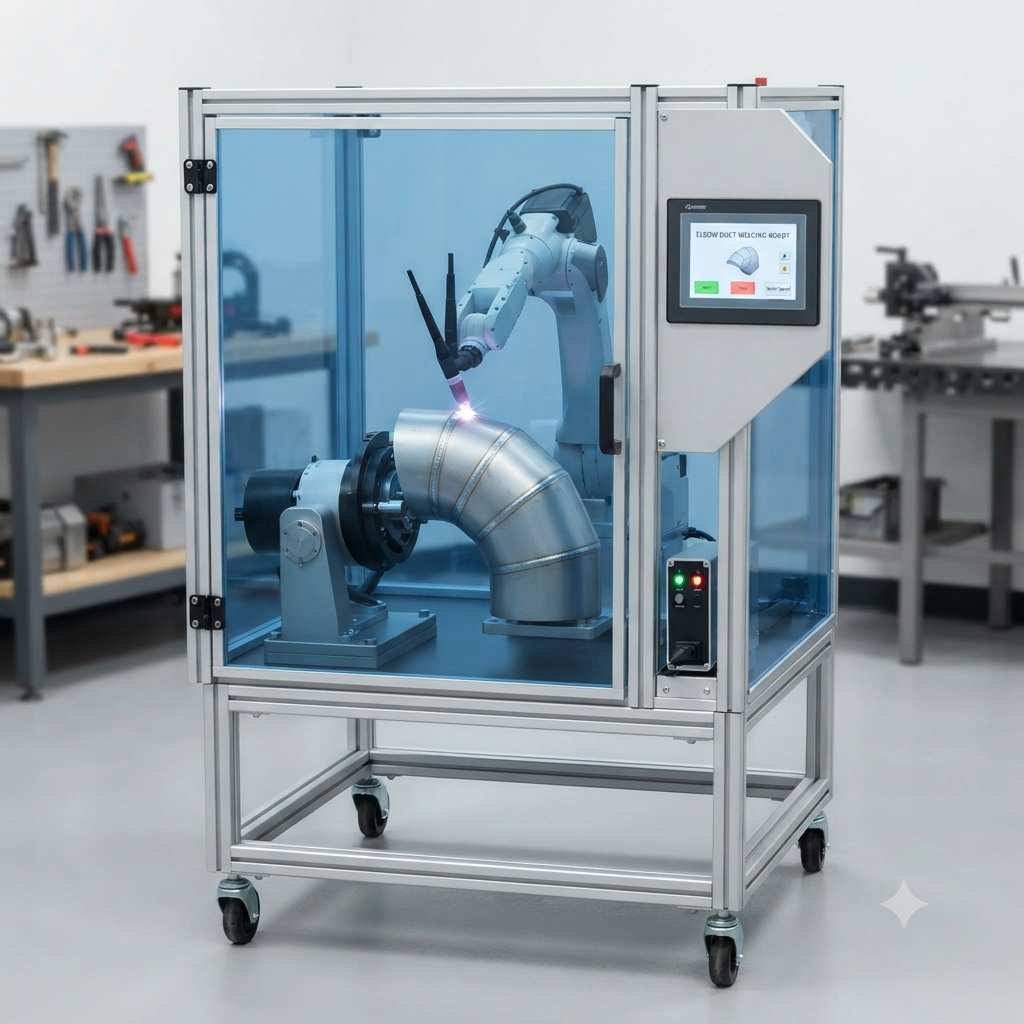
In modern HVAC and industrial ventilation manufacturing, the elbow duct welding robot has become an essential automation tool. It is designed to weld curved duct elbows with high accuracy, consistent quality, and minimal human intervention. As factories move toward Industry 4.0, robotic welding systems are helping manufacturers increase productivity while reducing labor costs and welding defects.
What Is an Elbow Duct Welding Robot?
An elbow duct welding robot is an automated welding machine specifically developed for joining elbow-shaped sheet metal ducts used in HVAC systems, exhaust systems, and industrial air pipelines. The robot uses programmed motion control and welding parameters to create uniform welds along curved seams.
Key Components
- Robotic welding arm
- Rotary positioning fixture
- Welding power source (MIG/TIG)
- Servo motor control system
- Touchscreen control panel
- Safety enclosure and sensors
Benefits of Using an Elbow Duct Welding Robot
1. Higher Welding Accuracy
The robot maintains a consistent welding path, reducing gaps, misalignment, and burn-through.
2. Faster Production
Automated welding can significantly reduce cycle time compared to manual welding, making it ideal for high-volume duct manufacturing.
3. Improved Worker Safety
Operators are protected from welding fumes, sparks, and excessive heat because the welding process is enclosed and automated.
4. Consistent Weld Quality
Every elbow receives the same welding parameters, ensuring repeatable results and reducing rework.
Manual vs Robotic Welding
| Feature | Manual Welding | Robotic Welding |
| Weld consistency | Moderate | Excellent |
| Production speed | Slower | Faster |
| Labor requirement | High | Low |
| Safety level | Lower | Higher |
| Long-term operating cost | Higher | Lower |
How the Robot Works
The welding process typically follows these steps:
- Load the elbow duct onto the rotary fixture.
- Clamp and align the workpiece automatically.
- Start the welding cycle through the control panel.
- Rotate the duct while the robotic arm follows the seam.
- Complete the weld and release the finished part.
This automated sequence ensures smooth and continuous welding around the curved elbow surface.
Applications
Elbow duct welding robots are widely used in:
- HVAC duct manufacturing
- Industrial ventilation systems
- Power plants
- Pharmaceutical facilities
- Food processing plants
- Chemical and petrochemical industries
Choosing the Right Robot
When selecting a robotic welding system, consider the following factors:
Duct Size Range
Ensure the machine can handle the minimum and maximum elbow diameters required in your production line.
Welding Method
- MIG welding: Faster and suitable for most galvanized steel ducts
- TIG welding: Better for stainless steel and high-quality finish requirements
Automation Level
Look for features such as automatic seam tracking, programmable recipes, and integration with existing production systems.
Maintenance Tips
To keep the robot operating efficiently:
- Clean welding nozzles daily
- Inspect cables and hoses regularly
- Lubricate moving parts as recommended
- Calibrate the robotic arm periodically
- Update software and welding programs when needed
Proper maintenance extends equipment life and maintains weld quality.
Frequently Asked Questions
Is an elbow duct welding robot suitable for stainless steel?
Yes, especially when equipped with a TIG welding system.
Can it weld different elbow angles?
Most models support 45°, 60°, and 90° elbows through programmable settings.
How much training is required?
Basic operator training usually takes a few days, while programming training may take one to two weeks.
Does it reduce material waste?
Yes, precise welding reduces scrap and rework.
Can the robot work continuously?
Industrial models are designed for long production shifts with proper maintenance.
Is seam tracking available?
Advanced models include automatic seam tracking sensors.
What industries benefit the most?
HVAC, power generation, pharmaceuticals, and chemical processing.
How often should calibration be performed?
Typically every 6–12 months, depending on usage.
Can it integrate with other machines?
Yes, many systems support PLC and factory automation integration.
Is robotic welding cost-effective for small factories?
For medium to high production volumes, the return on investment is often achieved within a few years.