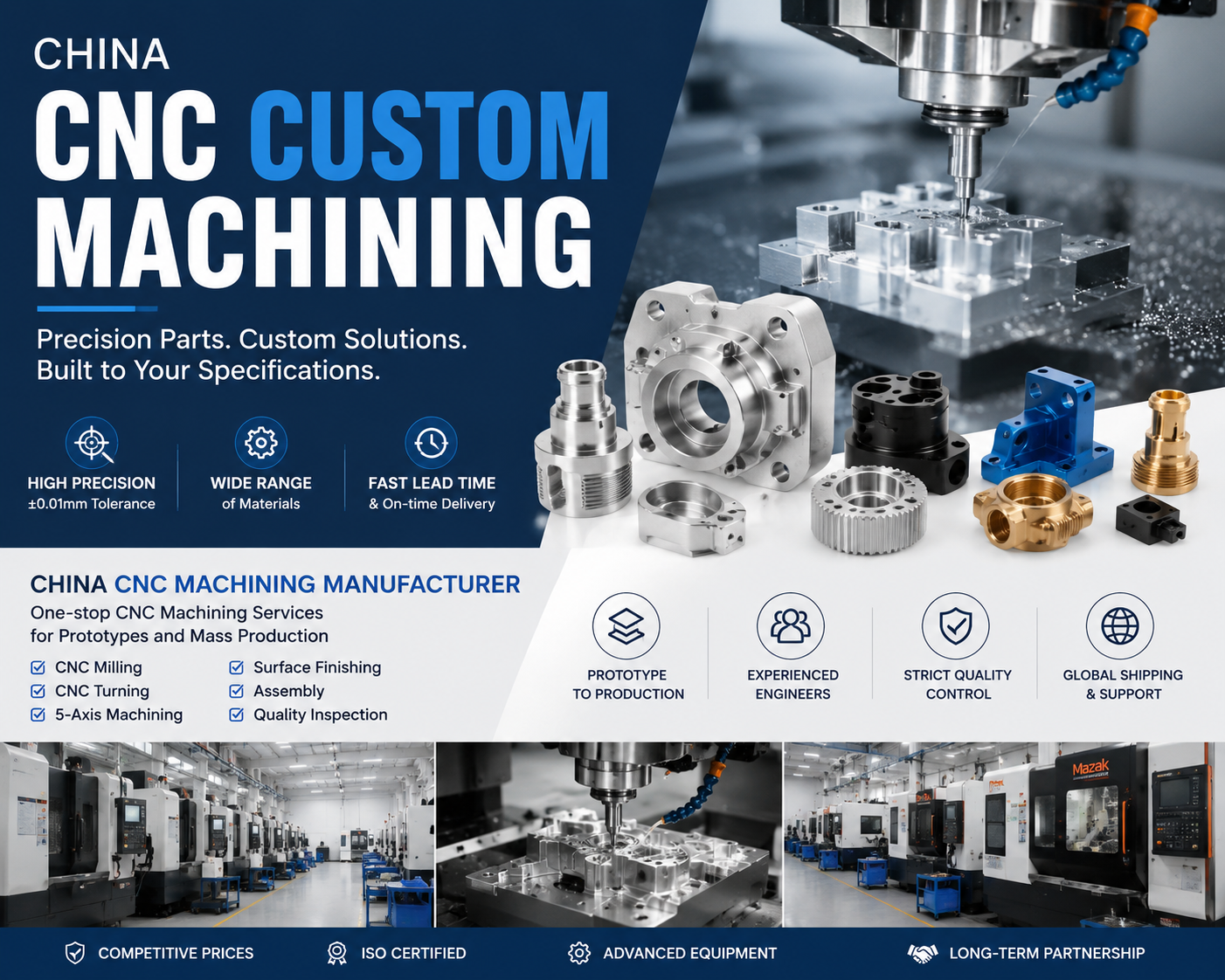
Working with an experienced China CNC machining manufacturer can provide access to advanced machining equipment, diverse materials, prototype development, and scalable production capabilities. However, successful sourcing requires more than simply selecting the lowest quotation. Buyers should evaluate machining technology, engineering expertise, quality control, communication, materials, tolerances, and production capacity before placing an order.
This guide explains how CNC machining works in China, its major advantages, available processes, and the factors businesses should consider when selecting a manufacturing partner.
What Is China CNC Custom Machining?
China CNC custom machining refers to manufacturing parts according to customer-specific drawings, CAD models, dimensions, tolerances, materials, and surface-finish requirements using computer numerical control equipment.
Unlike standard components manufactured in predetermined dimensions, custom CNC parts are created specifically for an application.
A typical machining project may begin with:
- CAD drawings or 3D models
- Material selection
- Tolerance confirmation
- CNC programming
- Prototype machining
- Dimensional inspection
- Surface treatment
- Batch production
- Final quality inspection
CNC technology enables manufacturers to repeatedly produce complicated components while maintaining dimensional consistency.
Why Companies Source CNC Machining from China
China has developed a large precision manufacturing ecosystem covering raw-material suppliers, tooling companies, machining workshops, finishing facilities, and international logistics providers.
Businesses commonly consider China CNC custom machining because it can offer flexible production for prototypes as well as medium- and high-volume manufacturing.
Important advantages include:
- Access to modern CNC equipment
- Competitive manufacturing costs
- Broad material availability
- Rapid prototype production
- Complex component manufacturing
- Multiple finishing options
- Scalable production capacity
- Established international shipping networks
A capable China CNC machining manufacturer may also provide engineering feedback before machining begins, helping identify difficult tolerances, unnecessary complexity, or opportunities to reduce production costs.
CNC Machining Processes Commonly Available
Different components require different manufacturing methods. Manufacturers often operate several types of CNC equipment to accommodate varied geometries.
CNC milling uses rotating cutting tools to remove material from a stationary workpiece. It is commonly used for housings, brackets, plates, mould components, slots, pockets, and complex three-dimensional surfaces.
CNC turning rotates the workpiece while cutting tools remove material. It is particularly suitable for shafts, bushings, pins, threaded components, and other cylindrical parts.
Advanced facilities may also use three-axis, four-axis, or five-axis CNC machining. Five-axis machining allows cutting tools to approach a component from several angles, reducing repositioning and improving efficiency for complex geometries.
Additional capabilities may include drilling, tapping, boring, grinding, EDM, wire cutting, and precision finishing.
Materials Used for Custom CNC Parts
Choosing the correct material influences strength, weight, corrosion resistance, appearance, machinability, and cost.
A professional China CNC machining manufacturer may work with metals and engineering plastics such as:
- Aluminium
- Stainless steel
- Carbon steel
- Tool steel
- Brass
- Copper
- Titanium
- Magnesium
- ABS
- Nylon
- POM
- PEEK
- PTFE
- Polycarbonate
Aluminium is especially popular because it combines low weight, good machinability, corrosion resistance, and useful mechanical properties.
Stainless steel is commonly selected for components requiring strength, durability, heat resistance, or corrosion protection.
Engineering plastics can be appropriate for electrical insulation, lightweight assemblies, chemical-resistant components, and low-friction applications.
Importance of CNC Machining Tolerances
Tolerance defines the permitted variation from a specified dimension. It is one of the most important elements of precision manufacturing.
Very tight tolerances usually require additional machining time, specialised equipment, controlled environments, and more extensive inspection.
Buyers should therefore specify tight tolerances only where they are functionally necessary.
An experienced China CNC custom machining supplier should review drawings before production and confirm whether requested tolerances are realistic for the chosen material, geometry, and machining process.
Clear technical drawings should identify critical dimensions, threads, hole positions, surface finish, flatness, concentricity, and any geometric dimensioning and tolerancing requirements.
Surface Finishing Options for CNC Components
Machining may produce a functional component directly, but many products require additional finishing for appearance or performance.
Common finishing treatments include:
- Anodising
- Powder coating
- Electroplating
- Sandblasting
- Bead blasting
- Polishing
- Brushing
- Passivation
- Black oxide
- Painting
- Heat treatment
For example, anodising is frequently applied to aluminium components to improve corrosion resistance and provide decorative colour options.
The correct surface finish should be discussed with the manufacturer during the quotation stage because finishing can affect dimensions, lead time, appearance, and overall cost.
Prototype CNC Machining Versus Production Machining
CNC manufacturing can support both prototype development and repeated production.
Prototype machining is useful when engineers need functional components for testing dimensions, assembly, strength, or product performance before investing in large production quantities.
Production CNC machining focuses more heavily on repeatability, manufacturing efficiency, fixture optimisation, tool life, inspection procedures, and cycle-time reduction.
| Factor | Prototype Machining | Production Machining |
| Quantity | Low | Medium to high |
| Main goal | Testing and validation | Consistent production |
| Setup | Flexible | Highly optimised |
| Lead time | Usually short | Depends on quantity |
| Cost focus | Speed and flexibility | Cost per component |
A manufacturer capable of supporting both stages can simplify the transition from product development to commercial production.
How to Choose a China CNC Machining Manufacturer
Selecting a machining supplier should involve a structured technical evaluation.
Begin by reviewing whether the manufacturer has experience producing components similar to your requirements. Ask about available CNC machines, achievable tolerances, materials, inspection equipment, and finishing capabilities.
Important evaluation points include:
- Manufacturing experience
- CNC machine capabilities
- Engineering support
- Quality management procedures
- Measuring and inspection equipment
- Material traceability
- Prototype capabilities
- Production capacity
- Packaging methods
- Export experience
- Communication responsiveness
Request sample inspection reports when appropriate.
For technically demanding components, buyers may also consider requesting a prototype before approving full production.
Quality Control in CNC Manufacturing
Quality assurance should occur throughout production rather than only after machining is complete.
Reliable manufacturers typically inspect incoming materials, initial production pieces, machining dimensions, surface appearance, and completed components.
Common inspection tools include calipers, micrometers, height gauges, optical measurement systems, surface roughness testers, and coordinate measuring machines.
First-article inspection can be particularly valuable when producing a new component.
A strong China CNC machining manufacturer should also have clear procedures for identifying, isolating, and correcting non-conforming parts.
Factors Affecting CNC Machining Cost
There is no universal CNC machining price because every custom component has different manufacturing requirements.
Major cost factors include:
- Material type
- Component dimensions
- Geometric complexity
- Required tolerance
- Surface finish
- Machining time
- Number of setups
- Tooling requirements
- Production quantity
- Inspection requirements
Complex shapes and extremely tight tolerances usually increase machining time.
Ordering larger quantities can reduce the cost per component because programming, setup, and fixture costs are distributed across more units.
Providing accurate drawings and realistic tolerances helps manufacturers prepare more reliable quotations.
Design Tips for Lower CNC Machining Costs
Good design-for-manufacturing practices can reduce machining complexity without compromising functionality.
Whenever possible:
- Avoid unnecessarily deep pockets.
- Use standard hole and thread sizes.
- Minimise extremely thin walls.
- Reduce unnecessary tight tolerances.
- Avoid difficult internal sharp corners.
- Standardise similar components.
- Select easily machinable materials when appropriate.
Discussing the design with the machining supplier before finalising production drawings can reveal practical opportunities for reducing cost and improving manufacturability.
Frequently Asked Questions
1. What is China CNC custom machining?
It is the manufacture of customised precision components in China using CNC milling, turning, drilling, and related machining technologies according to customer drawings.
2. What information is required for a CNC quotation?
Manufacturers generally require a 2D drawing or 3D CAD model, material, quantity, tolerances, surface treatment, and special inspection requirements.
3. Can CNC manufacturers produce prototypes?
Yes. CNC machining is widely used for producing functional prototypes before mass production.
4. Which materials can be CNC machined?
Common options include aluminium, stainless steel, steel, brass, copper, titanium, ABS, nylon, POM, PEEK, and other engineering materials.
5. Can a China CNC machining manufacturer produce complex parts?
Yes. Manufacturers equipped with multi-axis machining centres can produce highly complex geometries and precision components.
6. What determines CNC machining prices?
Material, dimensions, complexity, machining time, quantity, tolerances, finishing, and inspection requirements influence pricing.
7. What is five-axis CNC machining?
Five-axis machining allows cutting tools to approach a workpiece from multiple directions, making it suitable for complicated components.
8. Why are tight tolerances more expensive?
They require greater machine accuracy, slower machining strategies, additional measurements, and sometimes specialised equipment.
9. Can CNC parts receive surface treatments?
Yes. Options include anodising, plating, polishing, powder coating, blasting, passivation, and painting.
10. How should CNC part quality be verified?
Quality can be verified through dimensional measurements, first-article inspection, material documentation, inspection reports, and appropriate measuring equipment.