
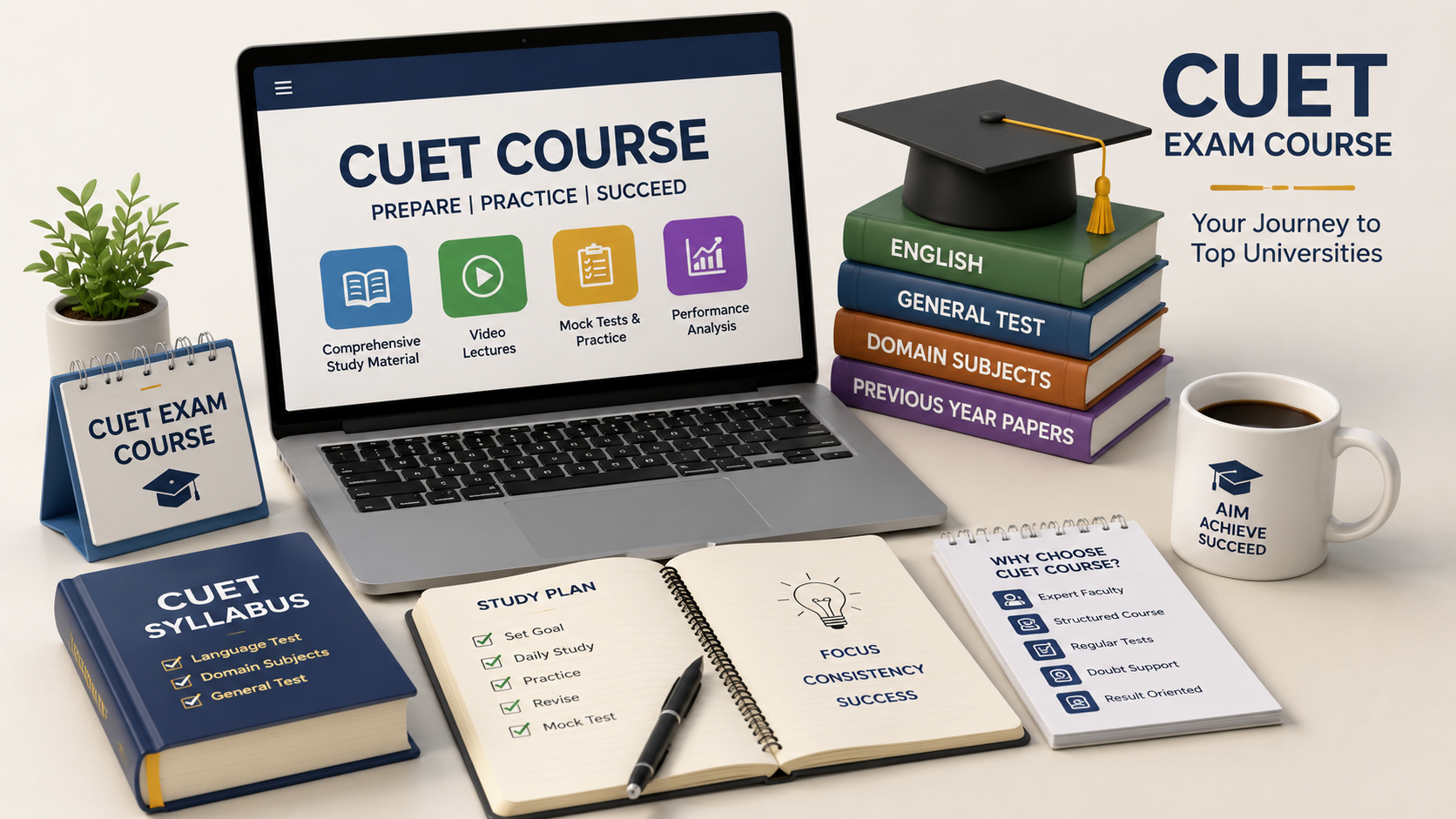
Students need an organised preparation strategy that covers concepts, practice, revision, time management, and exam-oriented problem-solving. This is where a well-planned CUET course can make a meaningful difference.
A comprehensive CUET exam course provides students with structured learning instead of random preparation. It helps them understand the syllabus, strengthen important topics, practise different question types, identify weak areas, and prepare systematically for the actual examination.
Whether you are beginning your preparation early or trying to improve your performance closer to the exam, choosing the right study approach can make preparation more manageable and productive.
What Is a CUET Course?
A CUET course is a structured preparation programme designed to help students prepare for the Common University Entrance Test. Depending on the programme and subjects selected by the student, preparation may include language papers, domain-specific subjects, aptitude-oriented topics, practice questions, mock examinations, and revision sessions.
Unlike unstructured self-study, a course usually follows a planned sequence. Students first understand fundamental concepts, move towards application-based questions, and then practise under examination conditions.
A good programme generally focuses on:
- Clear explanation of important concepts
- Syllabus-oriented study material
- Topic-wise question practice
- Regular revision
- Mock tests and assessments
- Performance analysis
- Doubt-solving support
- Time-management techniques
- Examination strategies
This systematic approach can be especially useful for students managing CUET preparation alongside school or other academic responsibilities.
Why Choose a CUET Exam Course?
Preparing independently is possible, but students often struggle to decide what to study first, how much time to allocate to each subject, and whether their preparation level is sufficient.
A structured CUET exam course provides direction.
Instead of collecting information from multiple books, videos, notes, and websites without a clear sequence, students can follow a defined learning path. This saves time and allows greater attention to actual preparation.
Regular assessments are another major advantage. They help students understand whether they are genuinely improving rather than relying only on the number of hours studied.
The objective should not simply be completing the syllabus. Effective preparation involves learning, practising, analysing mistakes, revising, and improving examination performance.
Key Features of an Effective CUET Course
Not every programme provides the same learning experience. Students should evaluate the quality and structure of a course before enrolling.
A useful CUET course should provide comprehensive syllabus coverage and sufficient practice opportunities. Lessons should explain concepts clearly rather than concentrating entirely on shortcuts.
Mock examinations are equally important because they introduce students to timed problem-solving. Detailed performance analysis can then highlight topics requiring additional attention.
Look for features such as:
- Structured subject-wise preparation
- Experienced faculty or mentors
- Updated study resources
- Topic-wise practice questions
- Full-length mock examinations
- Doubt-resolution facilities
- Recorded or revision classes where available
- Performance tracking
- Personalised improvement strategies
The best choice is the programme that matches your subjects, preparation level, schedule, and preferred learning method.
CUET Course vs Unstructured Self-Study
Both approaches can work, but they offer different experiences.
| Preparation Factor | CUET Course | Unstructured Self-Study |
| Study plan | Structured | Student creates it |
| Guidance | Usually available | Limited |
| Mock tests | Often included | Must be arranged separately |
| Doubt support | Usually available | Depends on resources |
| Progress tracking | Systematic | Self-managed |
| Flexibility | Depends on format | Very high |
| Discipline required | Moderate | High |
Students who are highly disciplined may perform well through self-study. However, those who need guidance, regular assessments, or accountability may find a structured programme more convenient.
How to Prepare Effectively with a CUET Exam Course
Joining a CUET exam course is only the beginning. Students must actively use the resources provided.
Start by understanding your selected subjects and the applicable syllabus. Divide topics according to difficulty and your current level of understanding.
After completing each topic, practise relevant questions instead of immediately moving to the next chapter. This helps determine whether you can apply what you have learned.
Maintain a notebook of mistakes from practice sessions and mock tests. Record conceptual errors, careless mistakes, questions that consumed excessive time, and topics requiring revision.
Reviewing this mistake log regularly can be more valuable than repeatedly solving questions you already understand.
Importance of Mock Tests in CUET Preparation
Mock examinations help transform academic knowledge into examination performance.
Students may understand concepts well but still struggle with speed, accuracy, question selection, or pressure. Regular mock tests help reveal these issues before the actual examination.
After every test, analyse:
- Questions answered incorrectly
- Questions left unanswered
- Time spent on different sections
- Frequently repeated mistakes
- Strong and weak topics
- Accuracy level
- Areas requiring revision
Do not focus only on your score. The purpose of a mock test is also to identify what should be improved before the next attempt.
Creating a Practical CUET Study Routine
Consistency is generally more effective than occasional long study sessions. Create a realistic schedule that can be maintained for several weeks or months.
Divide study time among concept learning, question practice, revision, and mock tests.
A simple preparation cycle can be:
Learn → Practise → Analyse → Revise → Test → Improve
Students should allocate additional time to weaker subjects without completely ignoring their stronger areas.
Revision should also be planned from the beginning rather than postponed until the final weeks.
How to Choose the Right CUET Course
Before selecting a programme, check whether it covers the subjects you actually need. Avoid choosing a course simply because it contains a large number of recorded classes.
Quality, relevance, teaching clarity, practice resources, and assessment systems matter more than content volume.
Consider your preferred learning style as well. Some students benefit from live classroom interaction, while others prefer an online CUET course because it provides greater flexibility.
Compare the curriculum, faculty, mock-test structure, doubt support, study material, course duration, and accessibility before making a decision.
Common CUET Preparation Mistakes to Avoid
Students sometimes spend excessive time collecting study materials while giving insufficient time to actual practice.
Another common mistake is studying favourite subjects repeatedly and postponing weaker areas.
Avoid:
- Ignoring the official syllabus
- Using too many study resources
- Delaying mock tests
- Studying without revision
- Memorising without understanding
- Ignoring previous mistakes
- Following unrealistic schedules
- Comparing progress constantly with other students
Your preparation strategy should be based on measurable improvement rather than simply completing more resources.
Frequently Asked Questions About CUET Course
1. What is a CUET course?
It is a structured preparation programme designed to help students study relevant CUET subjects, practise questions, revise concepts, and take mock examinations.
2. Who should join a CUET exam course?
Students who prefer organised preparation, expert guidance, assessments, and a defined study schedule may benefit from one.
3. Can I prepare for CUET through self-study?
Yes. Disciplined students can prepare independently using appropriate resources and consistent practice.
4. Are mock tests important for CUET preparation?
Yes. They help improve speed, accuracy, time management, and familiarity with examination-style conditions.
5. When should I start CUET preparation?
Starting early provides more time for concept building, practice, revision, and mock tests, but the ideal timeline depends on your current preparation level.
6. Is an online CUET course useful?
It can be useful for students who need flexibility, recorded lessons, online assessments, and the ability to study from different locations.
7. How should I revise for CUET?
Use short notes, important concepts, practice questions, previous mistakes, and regular tests as part of a planned revision cycle.
8. How often should I attempt mock tests?
The frequency should increase as preparation progresses. Every mock should be followed by detailed analysis.
9. How can I improve my CUET accuracy?
Strengthen concepts, read questions carefully, practise regularly, and analyse the reasons behind incorrect answers.
10. What should I check before choosing a CUET exam course?
Check subject coverage, teaching quality, study materials, assessments, doubt support, flexibility, and whether the programme suits your preparation goals.