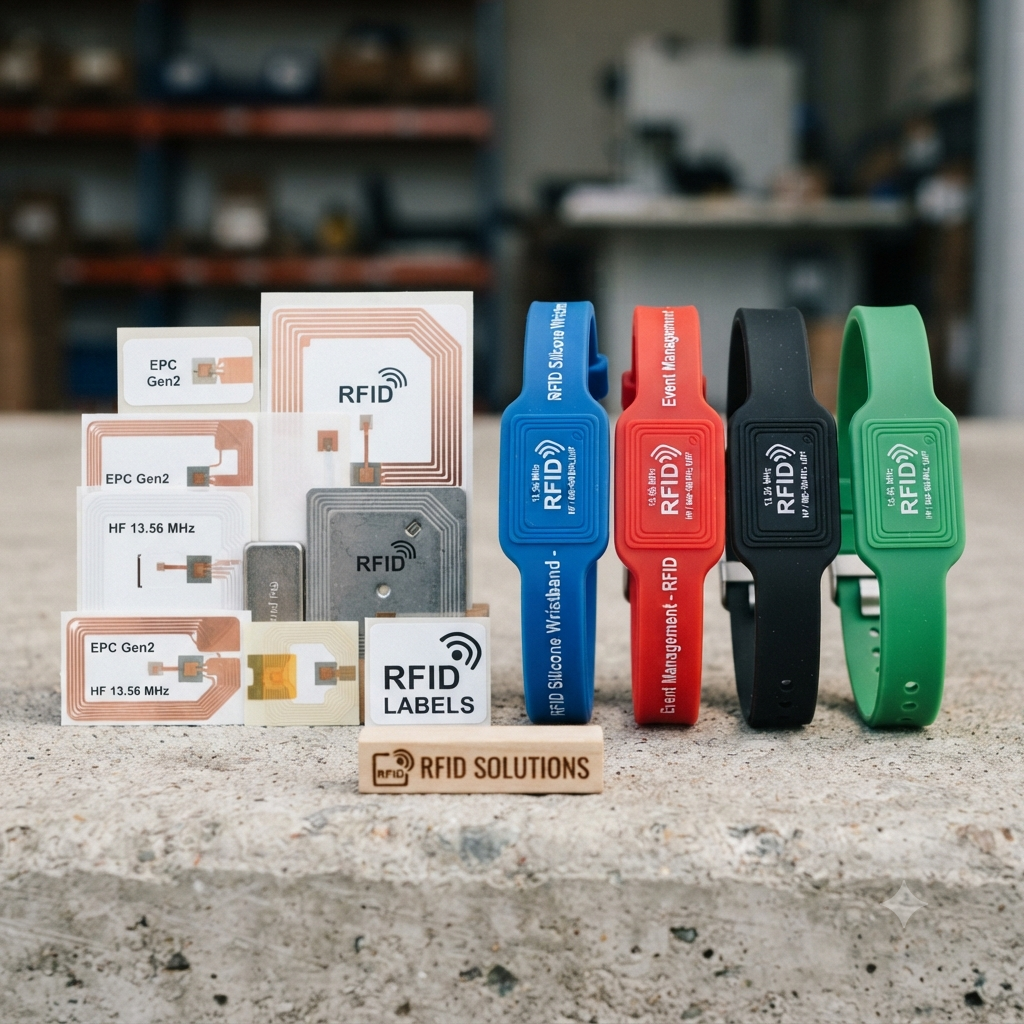
Radio Frequency Identification has changed how businesses identify products, manage assets, control access, and automate everyday operations. Among the most practical RFID solutions available today are RFID labels and RFID silicone wristbands. Although both use RFID technology, they serve different environments and operational needs.
RFID labels are widely used for inventory, logistics, retail, manufacturing, libraries, healthcare, and asset tracking. RFID silicone wristbands, on the other hand, are particularly useful for events, hotels, gyms, swimming pools, amusement parks, hospitals, membership facilities, and access-control systems.
Understanding their differences, capabilities, and applications helps organisations choose an RFID solution that delivers reliable identification while reducing manual processes.
What Are RFID Labels?
RFID labels are smart identification labels containing an RFID chip and antenna. Unlike standard printed barcodes, these labels can communicate information wirelessly when they come within the operating range of a compatible RFID reader.
The exterior of an RFID label may look similar to a conventional adhesive sticker, but its internal RFID inlay makes automatic identification possible.
RFID labels can be attached to:
- Product packaging
- Cartons and pallets
- Books and documents
- Equipment
- Electronic products
- Clothing and footwear
- Containers
- Medical supplies
- Warehouse assets
Depending on the application, businesses can select different label materials, chip types, frequencies, adhesive strengths, memory capacities, printing methods, and dimensions.
One important advantage of RFID labels is that scanning usually does not require direct visual alignment. Multiple tagged products may therefore be identified much faster than products using traditional barcode-based processes.
How RFID Labels Improve Inventory Management
Inventory accuracy is one of the major reasons businesses adopt RFID technology.
Traditional inventory processes often involve employees manually scanning individual barcodes. This can become time-consuming when thousands of products need to be counted.
With RFID labels, businesses can create more automated identification workflows. RFID readers communicate with tags within their supported reading area, allowing multiple items to be detected efficiently.
Typical benefits include:
- Faster inventory counting
- Better stock visibility
- Reduced manual data entry
- Improved product identification
- Easier asset tracking
- More efficient warehouse operations
- Better traceability across supply chains
For example, a warehouse can attach RFID labels to cartons and automatically identify tagged goods when they pass through designated RFID reader points.
The collected information can then be connected with warehouse management, ERP, inventory, or asset-tracking systems.
Important Features of RFID Labels
Different RFID applications require different tag specifications. Selecting an RFID label should therefore involve more than simply choosing its physical size.
Important characteristics include:
- RFID frequency
- Chip and memory capacity
- Read range
- Label dimensions
- Printing compatibility
- Adhesive strength
- Surface compatibility
- Environmental resistance
- Data encoding requirements
- Security features
UHF RFID labels are commonly used where longer reading distances and high-volume identification are important.
HF and NFC-based technologies may be preferred for applications requiring shorter communication distances or user interaction through compatible devices.
Businesses should always test RFID labels on the actual products and surfaces where they will be installed because materials such as metal and liquids can influence RF performance.
What Are RFID Silicone Wristbands?
RFID silicone wristbands combine an RFID chip with a wearable silicone band. They provide a practical way to identify people or provide authorised access without requiring conventional cards, paper tickets, or physical keys.
The RFID component can store or reference a unique identification value that communicates with compatible RFID readers.
These wristbands are commonly used in:
- Resorts
- Hotels
- Water parks
- Swimming pools
- Fitness centres
- Music festivals
- Exhibitions
- Hospitals
- Schools
- Clubs
- Membership organisations
- Corporate events
Because silicone is flexible, durable, and suitable for repeated wear, RFID silicone wristbands are especially useful in environments where users need convenient identification throughout the day.
Why Businesses Choose RFID Silicone Wristbands
One of the strongest advantages of RFID silicone wristbands is convenience.
Visitors do not need to continuously carry access cards or tickets. Their wristband remains easily accessible whenever identification is required.
For example, a hotel guest could potentially use an RFID wristband to access authorised facilities. At an amusement park, the same technology could support visitor identification and controlled entry.
Key benefits can include:
- Comfortable wearable identification
- Quick contactless verification
- Reusable designs
- Water-resistant options
- Custom colours and branding
- Unique RFID identification
- Reduced dependency on physical tickets
- Integration with access-control software
Their durability makes silicone wristbands particularly suitable for swimming pools, spas, resorts, gyms, and outdoor facilities.
RFID Labels vs RFID Silicone Wristbands
| Feature | RFID Labels | RFID Silicone Wristbands |
| Primary purpose | Product and asset identification | Personal identification and access |
| Format | Adhesive or printable label | Wearable silicone band |
| Common users | Retail, logistics, manufacturing | Events, hotels, gyms, resorts |
| Reusability | Often disposable or application-specific | Frequently reusable |
| Custom printing | Yes | Yes |
| Contactless identification | Yes | Yes |
| Inventory tracking | Excellent | Limited |
| Access control | Possible | Excellent |
| Wearable | No | Yes |
| Branding options | Logos, barcodes, serial numbers | Logos, colours and customised designs |
The right solution depends primarily on what needs to be identified.
For tracking products or equipment, RFID labels are generally more suitable. When the objective is identifying people or managing visitor access, RFID silicone wristbands are often the practical choice.
Applications of RFID Labels Across Industries
RFID technology has applications across many industries because identification and traceability are essential to modern operations.
Retailers may use RFID labels to improve stock visibility and merchandise tracking.
Warehouses can use them for cartons, pallets, bins, and assets.
Manufacturers can integrate RFID identification into production processes to monitor components or work-in-progress items.
Libraries may use RFID systems for book identification and circulation processes.
Healthcare organisations can apply RFID technology to equipment, inventory, or authorised asset-management workflows.
Logistics providers may use RFID tags to improve shipment visibility across selected checkpoints.
The important consideration is that the RFID infrastructure—including tags, readers, antennas, middleware, and software—must be designed around the intended operating environment.
Applications of RFID Silicone Wristbands
RFID wristbands are particularly valuable where people need frequent, fast identification.
At water parks, traditional paper tickets may deteriorate when exposed to water, while suitable RFID silicone wristbands can provide more durable identification.
Fitness clubs can use reusable wristbands as membership credentials.
Events can associate unique wristband IDs with registered attendees, allowing authorised entry points to validate participants electronically.
Hotels and resorts can use RFID wristbands as part of integrated guest-management or facility-access systems.
Hospitals may also use appropriately designed identification wristbands within controlled patient or visitor workflows.
These applications demonstrate why RFID silicone wristbands have become a versatile alternative to cards, tickets, and conventional identification methods.
How to Select the Right RFID Product
Before ordering RFID labels or wristbands, businesses should clearly define their technical requirements.
Consider:
- What will be identified?
- What reading distance is required?
- Which RFID frequency does the reader support?
- Will the RFID product be disposable or reusable?
- Will it encounter water, heat, chemicals, or outdoor conditions?
- Does custom printing or branding matter?
- Does the RFID chip require specific memory?
- Will the solution integrate with existing software?
- What surfaces will the label contact?
- What security level is required?
Testing samples before large-scale deployment can help identify compatibility and performance issues early.
Customisation and Branding Opportunities
Both RFID labels and RFID silicone wristbands can support customised designs.
RFID labels may contain company logos, product information, QR codes, barcodes, numbers, colours, and branding elements.
Silicone wristbands can often be manufactured using custom colours, printed logos, embossed branding, identification numbers, or different band dimensions.
Customisation is useful not only for visual branding but also for organising categories of users, products, departments, events, or access levels.
However, visual colour coding should complement—not replace—the electronic permissions configured within the RFID system.
Frequently Asked Questions About RFID Solutions
1. What are RFID labels used for?
RFID labels are commonly used for inventory tracking, logistics, product identification, asset management, manufacturing, and supply-chain operations.
2. What are RFID silicone wristbands used for?
They are mainly used for contactless personal identification, membership systems, events, hotels, resorts, gyms, pools, and controlled access.
3. Can RFID labels be printed?
Yes. Compatible RFID labels can be printed with text, logos, barcodes, serial numbers, and other information using suitable RFID-enabled printers.
4. Are RFID silicone wristbands waterproof?
Many silicone RFID wristbands are designed for wet environments, but the exact resistance rating should always be confirmed with the manufacturer.
5. Can RFID labels be read without direct visibility?
Yes. RFID generally does not require the same line-of-sight scanning used by traditional barcodes.
6. Can multiple RFID labels be detected together?
Compatible RFID systems can identify multiple tags within a reader’s operating area, although performance depends on system configuration and environmental conditions.
7. Are RFID silicone wristbands reusable?
Many versions are reusable, making them suitable for memberships, hotels, gyms, and similar applications.
8. Can company logos be added to RFID wristbands?
Yes. Many manufacturers offer custom colours, logos, numbering, and other branding options.
9. Which RFID frequency should I choose?
The correct frequency depends on required reading distance, operating environment, reader compatibility, and application.
10. Can RFID products integrate with software?
Yes. RFID readers and middleware can be integrated with suitable inventory, ERP, access-control, membership, or custom management platforms.