
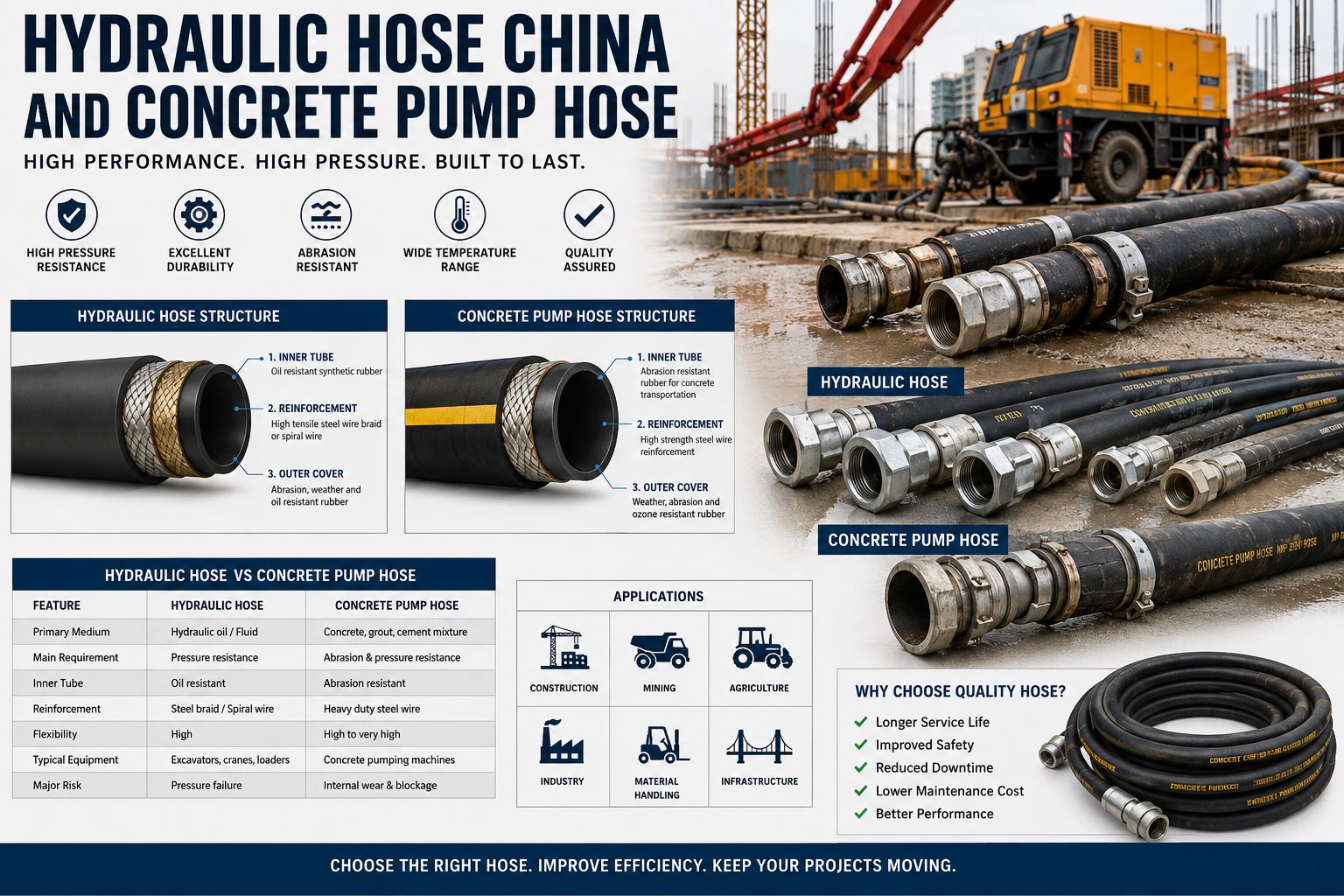
Industrial machinery depends on fluid transfer systems that can operate safely under demanding pressure, temperature, vibration, and working conditions. Hydraulic Hose China products have become widely used across construction, mining, agriculture, manufacturing, transportation, and heavy engineering because manufacturers offer an extensive range of specifications for different hydraulic applications.
At the same time, Concrete Pump Hose is an essential component in modern concrete placement equipment. Unlike a standard hydraulic line, concrete pumping hoses must handle abrasive materials, repeated bending, pressure fluctuations, and demanding construction environments.
Choosing the right hose is therefore not simply a matter of selecting the correct diameter. Pressure capacity, reinforcement, rubber quality, abrasion resistance, fittings, working temperature, flexibility, and application requirements all influence performance and service life.
Understanding Hydraulic Hose China Manufacturing
The Hydraulic Hose China manufacturing sector supplies hoses designed for transferring hydraulic oil and other compatible fluids under pressure. These hoses are commonly installed in excavators, loaders, cranes, agricultural machines, mining equipment, manufacturing systems, and industrial machinery.
A typical hydraulic hose consists of several engineered layers:
- Inner rubber tube compatible with hydraulic fluid
- Reinforcement made from textile braid or steel wire
- Protective outer rubber cover
- Hose fittings or couplings at both ends
The reinforcement determines how much working pressure the hose can safely withstand. High-pressure models may use multiple steel-wire braid layers or spiral-wire reinforcement.
Quality manufacturers also consider oil resistance, ozone resistance, weather resistance, flexibility, impulse performance, and temperature stability when developing industrial hydraulic hoses.
Why Hydraulic Hose Quality Matters
Hydraulic systems operate by transferring pressurised fluid between pumps, valves, cylinders, motors, and other components. A poorly selected hose may lead to leakage, pressure loss, equipment downtime, premature failure, or safety problems.
A reliable Hydraulic Hose China supplier should therefore offer products manufactured according to recognised hose specifications and appropriate quality-control procedures.
Important selection factors include:
- Maximum working pressure
- Minimum burst pressure
- Hose inner diameter
- Operating temperature
- Hydraulic fluid compatibility
- Minimum bending radius
- Reinforcement construction
- External abrasion resistance
- Fitting compatibility
- Application environment
The hose should always have a rated working pressure suitable for the maximum pressure generated by the hydraulic system.
Common Types of Hydraulic Hoses
Different applications require different constructions. Manufacturers supplying Hydraulic Hose China solutions commonly produce several categories.
Steel wire braided hoses are frequently used for medium- and high-pressure hydraulic systems because they provide a useful combination of flexibility and pressure resistance.
Steel wire spiral hoses contain multiple spiral reinforcement layers and are suitable for demanding applications involving very high pressures and pressure impulses.
Textile reinforced hoses may be appropriate for lower-pressure applications where flexibility is especially important.
Thermoplastic hoses are another option for specialised applications requiring lightweight construction, chemical resistance, or compact routing.
The correct type should always be selected according to equipment specifications rather than simply choosing the strongest available hose.
What Is a Concrete Pump Hose?
A Concrete Pump Hose is specifically designed to transport pumped concrete from concrete pumping equipment to the required placement area.
Concrete contains cement, sand, aggregates, water, and sometimes specialised additives. This mixture is considerably more abrasive than typical hydraulic fluids. Consequently, the inner tube of a Concrete Pump Hose needs excellent abrasion resistance.
These hoses are commonly used with:
- Truck-mounted concrete pumps
- Boom pumps
- Trailer pumps
- Stationary concrete pumps
- Construction pipelines
- Concrete distribution systems
Flexible hoses are particularly valuable at the final section of a pumping line because operators can position them accurately when placing concrete.
Important Features of Concrete Pump Hose
A reliable Concrete Pump Hose should combine durability, flexibility, pressure resistance, and abrasion performance.
Its main characteristics normally include:
- Abrasion-resistant inner tube
- Strong reinforcement layers
- Weather-resistant outer cover
- High working-pressure capacity
- Heavy-duty end fittings
- Good bending flexibility
- Resistance to demanding construction environments
Internal wear deserves particular attention. Concrete passing continuously through the hose gradually wears its inner surface, particularly around bends and areas experiencing turbulent flow.
Regular inspection is therefore essential even when the outside of the hose appears undamaged.
Hydraulic Hose vs Concrete Pump Hose
Although both products are reinforced industrial hoses, their operating purposes differ considerably.
| Feature | Hydraulic Hose | Concrete Pump Hose |
| Main medium | Hydraulic oil or compatible fluid | Wet concrete |
| Primary requirement | Pressure resistance | Abrasion and pressure resistance |
| Common equipment | Excavators, cranes, loaders | Concrete pumps |
| Inner tube design | Oil-resistant | Highly abrasion-resistant |
| Reinforcement | Textile, wire braid or spiral | Heavy-duty reinforcement |
| Flexibility | Depends on specification | Important for concrete placement |
A Concrete Pump Hose should never automatically be replaced with an ordinary hydraulic hose simply because the dimensions appear similar. Each hose must be engineered for the material and operating conditions involved.
How to Choose a Hydraulic Hose China Supplier
Selecting the right manufacturer requires more than comparing prices.
Before purchasing Hydraulic Hose China products, buyers should evaluate the manufacturer’s production capabilities, technical documentation, quality management procedures, testing facilities, available fittings, and customisation capabilities.
Ask suppliers for details about:
- Working and burst pressure
- Hose construction
- Temperature range
- Available sizes
- Reinforcement layers
- Applicable standards
- Test reports
- Fitting options
- Minimum order quantity
- Packaging and shipment
- OEM capabilities
Clear technical documentation makes it easier to compare products and reduces the possibility of purchasing unsuitable hoses.
Choosing the Correct Concrete Pump Hose
When purchasing a Concrete Pump Hose, start with the technical requirements of the pumping equipment.
Check the required hose diameter because insufficient diameter can restrict concrete flow, while incorrectly sized components may create connection problems.
Working pressure must also match the pump system. Never rely solely on burst-pressure figures when evaluating a hose because working pressure represents the intended continuous operating limit.
Consider abrasion resistance carefully. High-volume construction projects can place substantial wear on the internal surface.
Other considerations include hose length, end connections, bending radius, concrete composition, operating temperature, frequency of use, and external working conditions.
Hose Inspection and Maintenance
Proper maintenance can improve hose reliability and help identify problems before a serious failure occurs.
Inspect hydraulic hoses regularly for:
- Cracks
- Cuts
- Exposed reinforcement
- Oil leakage
- Loose fittings
- Abrasion
- Flattening
- Kinking
- Unusual deformation
For a Concrete Pump Hose, internal wear should receive particular attention because deterioration may develop internally before becoming obvious externally.
Avoid dragging hoses unnecessarily over sharp or highly abrasive surfaces. Hoses should also be stored away from excessive sunlight, heat, chemicals, and conditions that may deteriorate rubber compounds.
Importance of Correct Hose Fittings
Even a high-quality hose can fail if incorrect fittings are installed.
Hydraulic hose assemblies require compatible fittings, correct crimp dimensions, suitable threads, and professional assembly procedures.
Similarly, a Concrete Pump Hose needs robust end connections capable of handling demanding pumping forces.
Users should avoid mixing incompatible fittings and hoses unless compatibility has been verified by the manufacturer or an appropriately qualified hose specialist.
Correct assembly reduces leakage risks and helps the hose perform according to its intended pressure rating.
Applications Across Major Industries
Hydraulic Hose China solutions are used across numerous industrial sectors, including:
- Construction machinery
- Agricultural equipment
- Mining operations
- Material handling
- Transportation
- Manufacturing plants
- Forestry machinery
- Marine equipment
- Industrial automation
A Concrete Pump Hose, by comparison, primarily serves construction applications such as residential buildings, commercial developments, bridges, foundations, tunnels, industrial structures, and infrastructure projects.
Both hose categories contribute to efficient equipment operation when correctly specified and maintained.
Frequently Asked Questions
1. What is a hydraulic hose used for?
A hydraulic hose transfers pressurised hydraulic fluid between different components of hydraulic machinery.
2. Why are Hydraulic Hose China products widely sourced?
China has a large industrial manufacturing base producing numerous hose specifications, sizes, reinforcement types, fittings, and customised solutions for international markets.
3. What is a Concrete Pump Hose used for?
It transports wet concrete from pumping equipment to the area where the concrete needs to be placed.
4. Can hydraulic hose carry concrete?
Standard hydraulic hose should not be used for pumping concrete unless the manufacturer specifically certifies it for that application.
5. What makes concrete pump hoses abrasion resistant?
They typically use specially formulated inner rubber compounds engineered to withstand continuous contact with abrasive concrete mixtures.
6. How do I select hydraulic hose pressure ratings?
Choose a hose whose rated working pressure meets or exceeds the maximum operating pressure specified for the hydraulic system.
7. What is the difference between braided and spiral hydraulic hoses?
Braided hoses use interwoven reinforcement, while spiral hoses use layers of spirally arranged steel wire and are commonly designed for more demanding high-pressure applications.
8. How often should hoses be inspected?
Inspection frequency depends on operating conditions, equipment recommendations, application severity, and frequency of use. High-demand equipment should be checked regularly.
9. Can damaged hydraulic hoses be repaired?
A damaged pressure hose generally requires proper replacement rather than temporary repairs that could compromise safety.
10. What information should I provide a hose manufacturer?
Provide hose diameter, length, working pressure, temperature range, fluid or material being transferred, fittings, application, required standards, and expected operating conditions.