Its transformation from an emerging intraoral scanning manufacturer to a company offering multiple generations of scanners highlights how quickly digital dentistry is evolving. Today, dental practices can choose between six major Shining 3D models, each targeting a different combination of price, performance, portability, connectivity, and clinical capability.
But having more choices creates a new challenge.
Which Shining 3D model is actually the Best Dental Scanner for your practice?
The answer isn’t simply found by choosing the newest or most expensive model. The right scanner depends on your patient volume, treatment mix, implant workflow, software requirements, and long-term digital strategy.
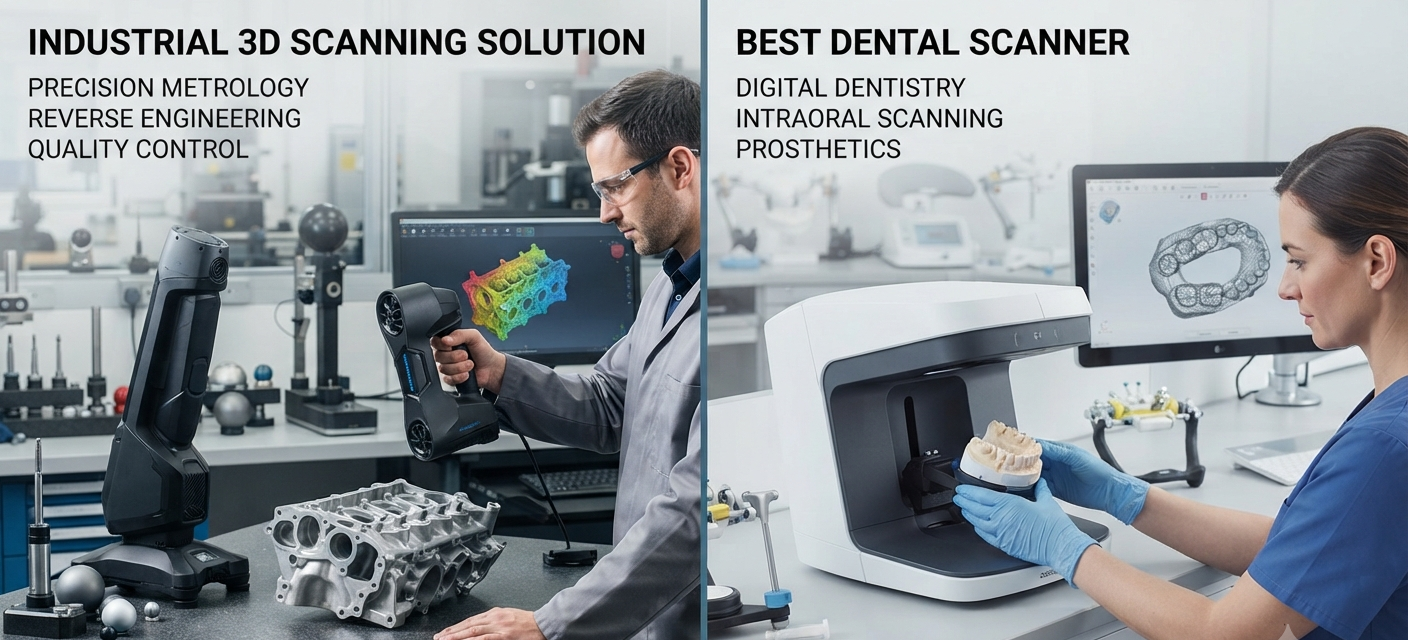
This guide takes a detailed look at the Shining 3D lineup, explains the technology behind each generation, and explores how these scanners fit into the wider world of 3D scanning—including the growing role of the industrial 3d scanner in engineering and manufacturing.
The Rise of Digital 3D Scanning in Dentistry
Dental scanning has changed the traditional impression workflow.
In the conventional approach, a dentist places impression material inside a tray, positions it in the patient’s mouth, waits for the material to set, and then removes the impression. The physical impression must then be transported, stored, and converted into a physical or digital model.
An intraoral scanner takes a fundamentally different approach.
The clinician moves a small optical scanning device across the patient’s teeth and soft tissues. The scanner captures a continuous stream of images, while specialized software processes those images and reconstructs the patient’s anatomy as a digital 3D model.
That model can then be used for:
- Crown and bridge design
- Digital orthodontic planning
- Clear aligner workflows
- Implant restoration
- Prosthodontic treatment
- Digital smile design
- Patient communication
- CAD/CAM manufacturing
- 3D printing
The result is a more connected digital workflow.
However, not every scanner delivers the same experience.
Scanning speed, accuracy, ergonomics, software, artificial intelligence, connectivity, and data management all influence the final outcome.
This is why choosing the Best Dental Scanner requires a more detailed evaluation than simply comparing specifications.
Shining 3D’s Six-Scanner Strategy
Shining 3D’s current intraoral scanner portfolio includes six major models:
- Aoralscan 3
- Aoralscan 3 Wireless
- Aoralscan Lync
- Aoralscan ELF
- Aoralscan Elite
- Aoralscan Elite Wireless
At first glance, the range may look confusing.
However, the lineup becomes easier to understand when divided into two technology platforms.
The first is the Aoralscan 3 generation.
The second is the Elite generation.
This distinction matters because the newer Elite platform represents a significant shift in hardware design, scanning technology, software capabilities, and clinical applications.
Platform One: The Aoralscan 3 Generation
The Aoralscan 3 family includes the wired Aoralscan 3, the Aoralscan 3 Wireless, and the Lync.
These products helped Shining 3D establish its position in the competitive intraoral scanning market.
The platform was designed around several core principles:
- Fast digital scanning
- Open data formats
- Competitive pricing
- Broad software compatibility
- Cloud-based case management
- No mandatory subscription fees
For many dental practices, these features remain valuable.
However, the development of the Elite generation means that the Aoralscan 3 platform is now considered the older technology family.
That does not make these scanners unusable.
It simply means that buyers should understand what they are giving up by choosing previous-generation hardware over newer technology.
Aoralscan 3: The Original Value Proposition
The wired Aoralscan 3 became an important milestone for Shining 3D.
With an approximate price of $10,999 USD, it positioned itself as a competitive option for dental practices that wanted to move from conventional impressions to digital workflows without making an extremely large investment.
The scanner weighs approximately 240g and uses a wired connection.
Its strengths include:
- Fast scanning performance
- AI-assisted soft tissue removal
- Full software suite
- Open file formats
- Unlimited cloud storage
- No subscription fees
- Broad digital workflow compatibility
The scanner’s software ecosystem is one of its most notable strengths.
A scanner is only as useful as the workflow surrounding it. If scan data can be efficiently processed, transferred, designed, and manufactured, the entire clinical experience becomes more efficient.
The main limitations are related to its age.
Compared with newer Shining 3D models, the Aoralscan 3 has:
- A heavier form factor
- Older camera technology
- Smaller scanner tip field of view
- More complicated cable requirements
- Previous-generation hardware
For an existing owner, these limitations may not justify an immediate replacement.
For someone purchasing a new scanner, however, the newer ELF deserves serious consideration.
Aoralscan 3 Wireless: When Cable-Free Scanning Matters
The Aoralscan 3 Wireless was designed to address one of the most common complaints about wired scanners.
The cable.
Wireless scanning allows the clinician to move around the patient without managing a physical connection between the scanner and computer.
The model uses Wi-Fi 6 technology and weighs approximately 330g with its battery.
That makes it significantly heavier than the wired version.
This creates a classic technology trade-off.
More freedom—but more weight.
For some dentists, wireless convenience is worth the additional weight.
For others, the lighter design of a newer wired scanner may be more important.
The Aoralscan 3 Wireless also remains based on the previous-generation scanning platform.
Therefore, buyers need to decide whether wireless functionality is more valuable to them than upgrading to the newer Elite platform.
Aoralscan Lync: The Minimalist Option
The Lync represents a different philosophy.
Not every practice needs a large collection of advanced software features.
Some dentists simply want to capture an accurate digital impression and send the resulting file to a laboratory.
The Lync is designed around this simplified workflow.
Its positioning makes it particularly relevant for budget-conscious practices and selected emerging markets.
The scanner weighs approximately 116g and uses a wired USB-C connection.
Its main limitation is that the software ecosystem is more restricted compared with the full-featured models.
That can be an advantage if you want simplicity.
It can also be a disadvantage if your practice eventually needs advanced digital tools.
The important question is therefore not whether the Lync is capable.
The question is whether the price difference between the Lync and ELF justifies choosing the simpler platform.
If the Lync is significantly cheaper in your region, it may be an attractive option.
If not, the ELF could offer better long-term value.
Platform Two: The Elite Generation
The Elite platform represents the next stage in Shining 3D’s intraoral scanning development.
It includes:
- Aoralscan ELF
- Aoralscan Elite
- Aoralscan Elite Wireless
The platform focuses on several key improvements:
- Newer camera systems
- Updated scanning algorithms
- Improved ergonomics
- Lightweight hardware
- Enhanced software
- Advanced implant workflows
- Integrated photogrammetry on Elite models
The Elite platform is important because it changes the conversation from simply capturing digital impressions to supporting more advanced digital dentistry workflows.
Aoralscan ELF: Lightweight Technology With Broad Appeal
The Aoralscan ELF is perhaps the most interesting model for general dental practices.
It weighs approximately 106g and is designed to deliver the Elite platform’s modern scanning experience in a lightweight package.
Its approximate price is $11,999 USD.
That puts it close to the price range of some previous-generation products while offering newer technology.
The scanner includes:
- Elite-generation scanning technology
- Wired USB-C connection
- Full software ecosystem
- IntelliBite
- Plaque Management Suite
- Unlimited cloud storage
- No subscription fees
- Lightweight plastic construction
The ELF does not include IPG.
That may sound like a disadvantage.
But it can actually be a benefit for practices that don’t need photogrammetry.
Why pay for specialized technology that your practice may rarely use?
For general restorative dentistry, orthodontics, prosthodontics, and everyday digital impressions, the ELF may provide the best balance.
This is why it can reasonably be considered the Best Dental Scanner for many general dental practices.
Why the ELF’s Weight Is Clinically Important
Weight is sometimes treated as a minor specification.
It shouldn’t be.
Intraoral scanning requires the clinician to hold the scanner while navigating around the patient’s mouth.
During a single procedure, this may not be a problem.
Over multiple procedures each day, however, the effect can become noticeable.
A lightweight scanner can potentially improve:
- Operator comfort
- Hand positioning
- Wrist movement
- Scanning endurance
- Overall ergonomics
At approximately 106g, the ELF is designed with this challenge in mind.
For high-volume practices, this could be one of its biggest practical advantages.
Aoralscan Elite: Designed for Full-Arch Implant Workflows
The Aoralscan Elite moves into a different category.
Its defining feature is integrated intraoral photogrammetry.
Full-arch implant workflows require highly accurate spatial information about implant positions.
Traditional workflows may require separate equipment to capture this information.
The Elite attempts to integrate the photogrammetry process directly into the scanner workflow.
This is significant because it could potentially simplify equipment requirements.
The scanner weighs approximately 124g and uses a wired USB-C connection.
It includes:
- Full software ecosystem
- Integrated IPG
- Open digital workflows
- Unlimited cloud storage
- No subscription fees
- Metal construction
The approximately $20,000 USD price point places it firmly above the ELF.
However, price should be considered in relation to workflow.
For a dentist who performs full-arch implant treatments regularly, the value of integrated photogrammetry may outweigh the higher initial investment.
For a dentist who rarely performs implant cases, the ELF may be a more logical purchase.
Aoralscan Elite Wireless: The Flagship Solution
The Elite Wireless represents the highest level of Shining 3D’s current intraoral scanner lineup.
It combines the advanced Elite platform with wireless connectivity.
Its approximate specifications include:
- $23,999 USD price
- 194g with battery
- Wi-Fi 6 wireless connection
- Integrated IPG
- Full software ecosystem
- Enhanced IPG accessories
- Unlimited cloud storage
- No subscription fees
The key advantage is flexibility.
The clinician can move freely while maintaining access to advanced scanning and implant workflows.
The major disadvantage is cost.
If wireless functionality is not critical, the wired Elite offers similar core clinical capabilities at a lower price.
Therefore, the Elite Wireless is best suited to practices that genuinely value wireless operation and regularly perform complex implant procedures.
Shining 3D Intraoral Scanner Comparison
| Model | Technology Platform | Approx. Price | Weight | Connection | IPG | Best Use |
| Aoralscan 3 | Previous | $10,999 | 240g | Wired | No | Entry-level digital workflows |
| Aoralscan 3 Wireless | Previous | $14,000 | 330g | Wireless | No | Affordable wireless scanning |
| Lync | Previous | Regional | 116g | USB-C | No | Basic digital impressions |
| ELF | Current Elite | $11,999 | 106g | USB-C | No | General dental practices |
| Elite | Current Elite | $20,000 | 124g | USB-C | Yes | Full-arch implant workflows |
| Elite Wireless | Current Elite | $23,999 | 194g | Wireless | Yes | Premium wireless implant workflows |
Prices are approximate and may vary depending on region and distributor.
The Software Question: Why It Matters
Many buyers focus heavily on scanner hardware.
However, software can be equally important.
A modern intraoral scanner is not just a camera.
It is the front end of a digital workflow.
The software determines how easily clinicians can:
- Capture scans
- Remove unwanted soft tissue
- Analyze digital impressions
- Create reports
- Manage patients
- Share files
- Plan treatments
- Communicate with laboratories
- Integrate with CAD/CAM systems
This is one area where the difference between models can become important.
A scanner with excellent hardware but limited software may not provide the same overall value as a scanner supported by a broader ecosystem.
When evaluating the Best Dental Scanner, consider the entire digital workflow—not just the scanning handpiece.
Open Architecture and Digital Compatibility
Open digital workflows are becoming increasingly important.
Shining 3D scanners can export common 3D file formats such as:
- STL
- OBJ
- PLY
These formats can support integration with various CAD/CAM and laboratory workflows.
This is particularly important for practices that want flexibility.
A dentist may work with one laboratory today and another laboratory in the future.
Open file compatibility makes it easier to maintain that freedom.
The broader lesson is simple:
The best scanner isn’t just the one that captures good data. It’s the one that lets you use that data efficiently.
Dental 3D Scanning and Industrial 3D Scanning
The growth of intraoral scanners is part of a much larger shift toward 3D digitization.
An industrial 3d scanner can capture physical objects and convert their geometry into digital information.
These systems are widely used for:
- Manufacturing inspection
- Reverse engineering
- Automotive development
- Aerospace engineering
- Product design
- Quality assurance
- Dimensional analysis
Dental scanners operate on the same broad principle of transforming physical geometry into digital data.
But the requirements are very different.
An industrial scanner may be designed to scan:
- Automotive parts
- Mechanical components
- Large structures
- Manufacturing tools
- Prototypes
A dental scanner must operate inside a patient’s mouth.
Therefore, it needs to prioritize:
- Compact size
- Patient comfort
- Lightweight ergonomics
- Fast acquisition
- High detail
- Easy sterilization
- Real-time visualization
- Clinical software
The technology is different, but the objective is similar.
Capture the physical world accurately and turn it into useful digital information.
This shared principle is driving innovation across both industrial and healthcare applications.
Which Shining 3D Scanner Should You Buy?
Choosing the Best Dental Scanner becomes much easier when you start with your clinical needs.
Choose the Aoralscan ELF if:
- You operate a general dental practice.
- You want current-generation technology.
- You value lightweight ergonomics.
- You don’t need integrated photogrammetry.
- You want a comprehensive software ecosystem.
- You want to avoid recurring subscription fees.
Choose the Aoralscan Elite if:
- You perform frequent full-arch implant procedures.
- Integrated photogrammetry is important.
- You are comfortable using a wired connection.
- You want advanced implant workflows.
Choose the Elite Wireless if:
- You perform complex implant cases.
- Wireless scanning is important.
- You want the flagship Shining 3D platform.
- Your budget allows for the additional premium.
Choose the Aoralscan 3 Wireless if:
- Wireless scanning is your primary requirement.
- You want a lower-cost wireless option.
- You are comfortable with previous-generation technology.
Choose the Lync if:
- You primarily need basic digital impressions.
- Your local pricing makes it significantly cheaper.
- You don’t need a full software ecosystem.
Choose the Aoralscan 3 if:
- You want a proven wired platform.
- You find a particularly attractive price.
- You don’t require the latest Elite-generation technology.
https://freeseobacklinks.info/how-3d-technology-is-changing-the-future-of-digital-smile-design/
https://newsgrow.blogspot.com/2026/07/from-flat-photos-to-3d-precision-how.html
https://newsgrow.blogspot.com/2026/07/shining-3d-intraoral-scanner-showdown.html