The architectural metalworking sector is entering a more design-focused and technology-driven phase as construction companies, fabricators, architects, and developers demand metal components that deliver both visual distinction and dependable performance. Forged Elements and Wrought Iron Components are playing an important role in this transition, offering flexible solutions for gates, fencing, balconies, staircases, furniture, landscaping, and customized architectural projects.
Today’s market is moving beyond conventional ornamental metalwork. Precision manufacturing, advanced forming machinery, digital drawings, customized tooling, and improved surface protection are enabling manufacturers to produce complex metal designs with greater consistency.
This development is creating opportunities for designers to preserve the timeless character of forged metal while meeting modern expectations for accuracy, scalability, and project efficiency.
Architectural Metalwork Is Moving Beyond Basic Function
Metal gates, fences, railings, and balustrades were once primarily selected for practical purposes such as security and protection. Modern architecture has changed that perspective.
These structures increasingly form part of a property’s overall visual identity.
An entrance gate can establish the character of a luxury residence. Balcony railings can influence an entire building façade. A decorative staircase can become a central interior feature.
Wrought Iron Components provide architects with individual design elements that can transform otherwise simple structures into detailed architectural installations.
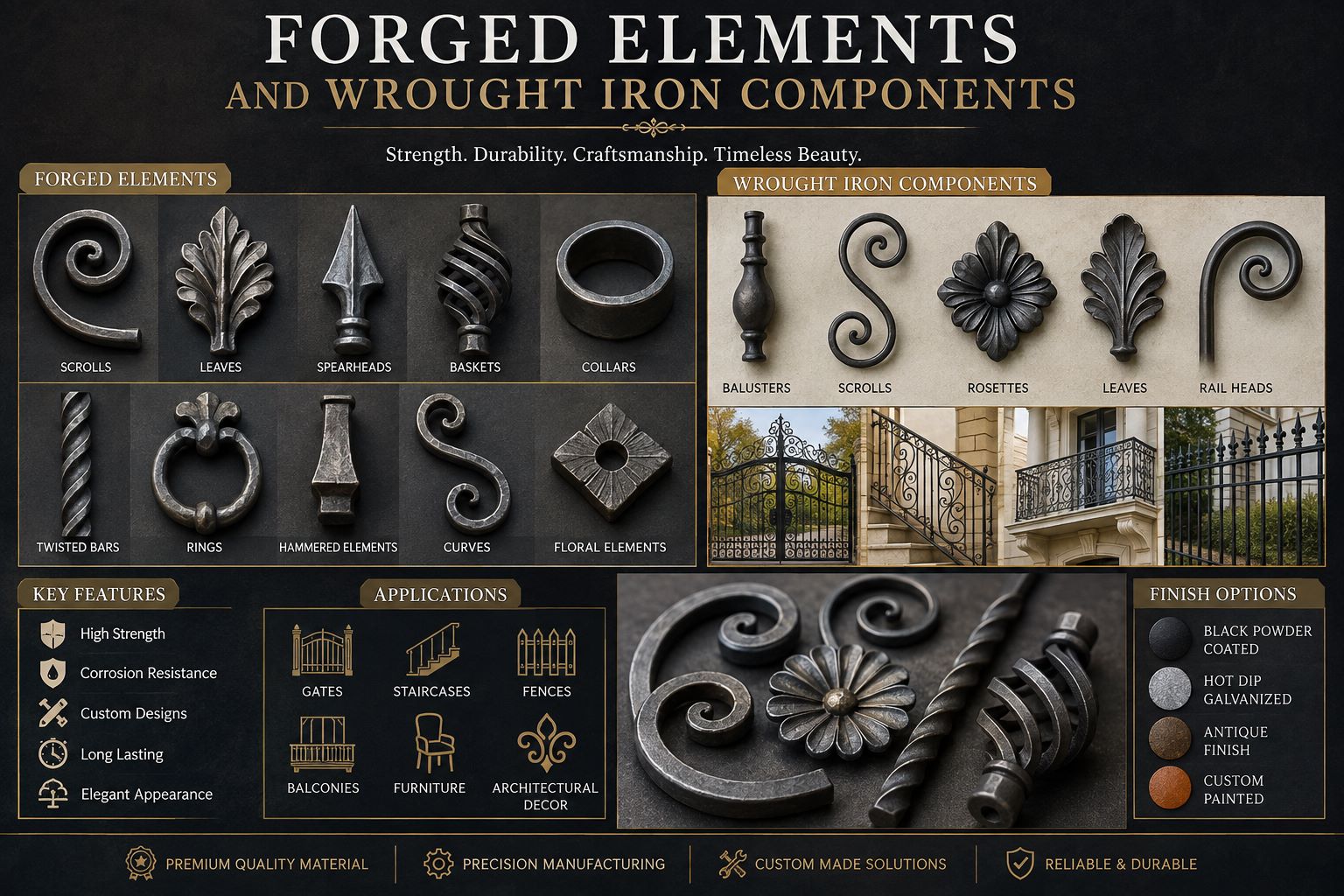
Popular components include scrolls, balusters, baskets, leaves, flowers, collars, rosettes, railheads, and ornamental panels.
Forging Technology Brings Greater Precision to Production
The production of Forged Elements has developed significantly from traditional manual forging.
Forging fundamentally involves shaping metal through controlled compressive force. Metal can be heated and subsequently formed using hammers, presses, dies, rollers, or specialized machinery.
Modern equipment provides manufacturers with better control over dimensions, geometry, and repeatability.
Important production benefits include:
- Accurate component dimensions
- Consistent profiles
- Repeatable decorative patterns
- Efficient production cycles
- Greater manufacturing capacity
- Reduced variation between components
- Improved customization
These benefits become particularly important when architectural projects require large quantities of identical pieces.
Forged Elements Combine Performance with Creative Freedom
The value of Forged Elements extends beyond their appearance.
Properly controlled forging can influence the internal grain flow of metal, contributing to useful mechanical characteristics such as strength and toughness.
This allows forged products to serve both functional and decorative applications.
Common examples include:
- Forged bars
- Decorative rings
- Scrolls
- Collars
- Metal baskets
- Leaves and flowers
- Spearheads
- Gate accessories
- Railheads
- Customized fittings
Manufacturers can produce standard catalog components or develop specialized products for individual projects.
Wrought Iron Components Find New Life in Contemporary Design
Ornamental metalwork is often associated with traditional architecture, but Wrought Iron Components are increasingly adaptable to modern environments.
Complex floral patterns can complement classical properties, while simplified geometric scrolls and clean forged profiles can work with contemporary architecture.
Residential Applications
Luxury villas, apartments, farmhouses, and private residences can incorporate decorative metalwork into gates, balconies, staircases, fencing, windows, and gardens.
Hospitality Applications
Hotels and resorts frequently use ornamental metal details to create distinctive entrances, balconies, outdoor spaces, restaurant partitions, and decorative features.
Commercial Applications
Retail developments, offices, restaurants, event venues, and institutional buildings can incorporate forged designs to strengthen architectural identity.
Understanding What Modern Wrought Iron Really Means
The phrase Wrought Iron Components can sometimes create confusion regarding material composition.
Traditional wrought iron is a historically important iron material characterized by very low carbon content and a fibrous structure resulting from slag inclusions.
However, many modern ornamental components described commercially as wrought iron are manufactured from mild steel.
Mild steel has become a practical alternative because it offers good formability, weldability, availability, strength, and compatibility with multiple finishing technologies.
Buyers working on projects with strict material requirements should always confirm the actual metal grade before purchasing.
Custom Manufacturing Changes the Design Process
Customization is becoming one of the strongest advantages of contemporary metal component manufacturing.
Architects are no longer restricted to selecting decorative pieces from standard catalogs.
Manufacturers can develop customized Forged Elements according to project-specific drawings, dimensions, patterns, and profiles.
Custom Components Can Begin with
- CAD files
- Engineering drawings
- Architectural sketches
- Physical samples
- Reference photographs
- Existing components
Once requirements are established, manufacturers can develop tooling and prototypes before beginning full production.
This process gives designers greater control while reducing the risk of producing large quantities of unsuitable components.
Digital Technology Connects Designers and Manufacturers
Digital design tools are improving collaboration across the architectural metalwork supply chain.
Detailed drawings can specify dimensions, thicknesses, curves, hole positions, profiles, tolerances, and assembly requirements.
For customized Wrought Iron Components, accurate digital documentation helps manufacturers understand exactly what a project requires.
It can also simplify repeat orders because approved specifications can be stored and reproduced when additional components are required.
Forged Elements and Wrought Iron Components: Key Differences
Although frequently used together, their primary roles can differ.
| Comparison | Forged Elements | Wrought Iron Components |
| Primary purpose | Functional or decorative | Mainly decorative |
| Manufacturing focus | Controlled metal deformation | Ornamental forming and fabrication |
| Typical products | Bars, rings, fittings, scrolls | Balusters, leaves, panels, baskets |
| Mechanical performance | Often important | Depends on application |
| Customization | Extensive | Extensive |
| Architecture use | High | Very high |
| Bulk production | Possible | Possible |
The two categories often overlap because many ornamental components are manufactured using forging processes.
Corrosion Protection Becomes Part of Design Planning
Outdoor decorative metalwork must withstand more than mechanical loads.
Humidity, rainfall, industrial pollution, temperature changes, and salt exposure can cause corrosion if ferrous metal is inadequately protected.
Modern manufacturers can provide several finishing options for Forged Elements, including:
- Galvanizing
- Powder coating
- Industrial paint systems
- Electroplating
- Blackening
- Polishing
- Specialized corrosion-resistant coatings
Finishing should be selected according to actual environmental conditions rather than appearance alone.
Quality Control Supports Faster Installation
Consistency can directly influence fabrication productivity.
Consider a project requiring 1,000 identical decorative scrolls. If their dimensions vary significantly, fabricators may need to modify each component manually before welding.
Reliable Wrought Iron Components should therefore be manufactured within agreed dimensional tolerances.
Quality Inspection May Cover
- Material verification
- Component dimensions
- Surface condition
- Pattern consistency
- Straightness
- Forging defects
- Cracks
- Coating quality
- Packaging
Systematic inspection helps ensure components arrive ready for efficient fabrication.
Ready-Made Components Change Workshop Productivity
Ready-made decorative products are also helping metal fabrication workshops optimize labor.
Instead of manually producing every ornament, workshops can source standardized Forged Elements and incorporate them into complete assemblies.
This model can provide:
- Shorter production times
- Greater consistency
- Reduced manual forming
- Easier repeat manufacturing
- Improved scalability
- Wider design selection
- More predictable project planning
Skilled fabricators can then focus on assembly, welding, alignment, finishing, and installation.
International Sourcing Creates New Opportunities
Architectural metal components are increasingly sourced across regional and international markets.
This provides buyers with broader product selections and access to specialized manufacturing capabilities.
However, professional sourcing requires careful supplier evaluation.
Buyers should confirm:
- Material specifications
- Manufacturing capabilities
- Available dimensions
- Tolerances
- Customization options
- Finishing capabilities
- Quality procedures
- Production capacity
- Packaging standards
- Delivery arrangements
Samples are particularly valuable before placing large customized orders.
FAQ About Forged Elements and Wrought Iron Components
What are Forged Elements?
Forged Elements are metal components shaped using compressive forces through hammering, pressing, rolling, or other forging processes.
Where are Forged Elements used?
They are used in architecture, furniture, fencing, machinery, construction, landscaping, gates, railings, and customized fabrication.
What are Wrought Iron Components?
They are ornamental or functional metal components commonly used to create decorative architectural structures.
Is modern wrought iron always genuine wrought iron?
No. Many modern wrought-style components are produced using mild steel.
Why is mild steel popular for ornamental products?
It offers good formability, weldability, availability, practical strength, and compatibility with numerous surface treatments.
Can forged components be customized?
Yes. Dimensions, patterns, shapes, profiles, textures, thicknesses, and finishes can often be customized.
Are these components suitable for exterior installations?
Yes, provided appropriate corrosion protection and maintenance are used.
Which surface treatment should be selected?
The correct treatment depends on material, environment, appearance, lifespan, and maintenance requirements.
Can decorative components be produced in bulk?
Yes. Modern tooling and machinery support consistent production of large quantities.
How should buyers select a supplier?
Buyers should evaluate materials, experience, equipment, customization, samples, quality control, capacity, finishing, packaging, and delivery reliability.
https://gosarkarijobs.com/why-wrought-iron-components-are-redefining-modern-decorative-iron-work/
https://shopnets.com/a-complete-guide-to-wrought-iron-components-for-beautiful-decorative-iron-work/
https://newsgrow.blogspot.com/2026/08/wrought-iron-components-see-renewed.html
https://newsgrow.blogspot.com/2026/08/from-functional-railings-to-statement.html