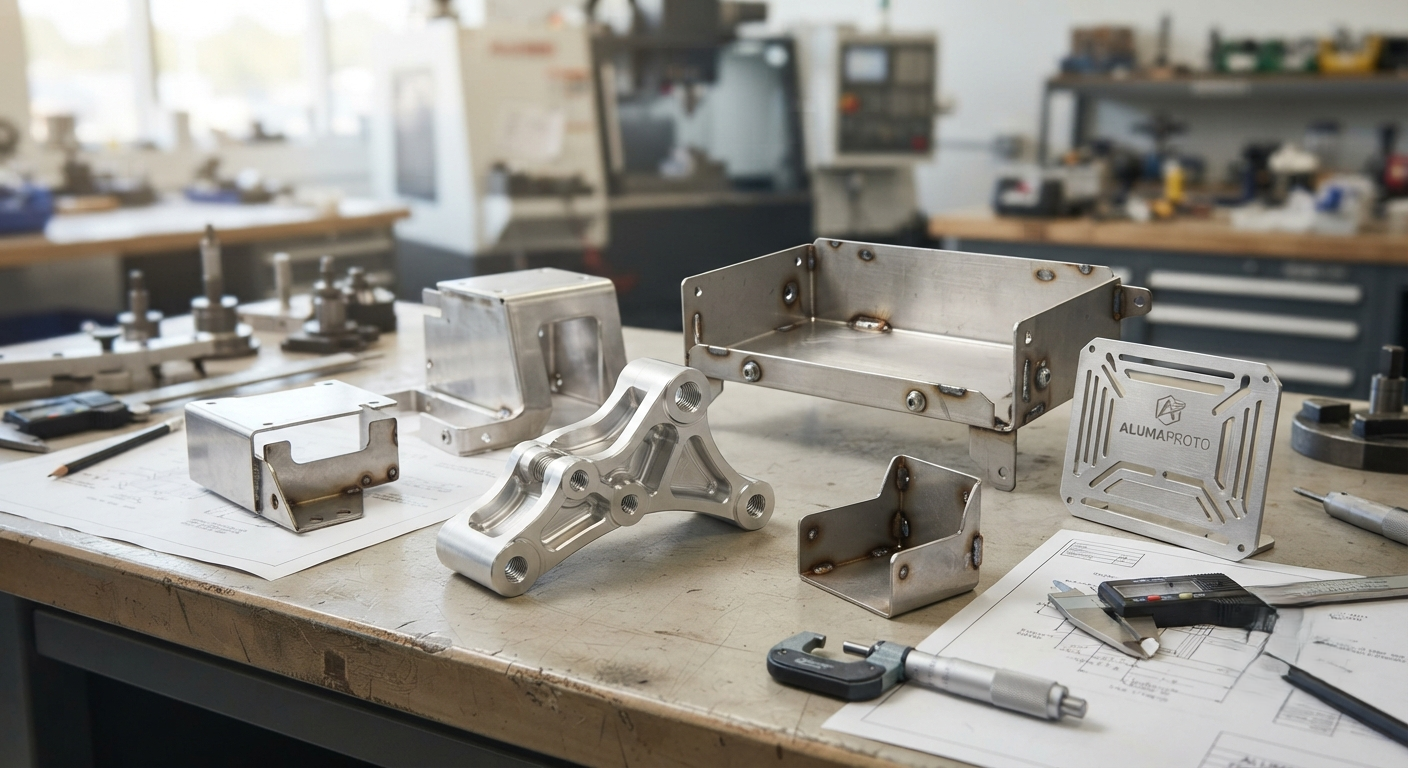
Before investing in tooling or large-scale production, engineers and product developers need to confirm dimensions, performance, assembly, appearance, and material behaviour. This is where aluminum prototype manufacturing and sheet metal prototyping provide significant value.
Both methods allow companies to manufacture realistic parts using production-grade materials without immediately committing to mass manufacturing. They support design validation, engineering testing, low-volume production, and product improvement while helping manufacturers identify costly mistakes at an early stage.
Although aluminum machining and sheet metal fabrication follow different manufacturing processes, both can dramatically reduce development risks when the right technique is selected.
What Is an Aluminum Prototype?
An aluminum prototype is a functional or visual prototype manufactured from aluminium using processes such as CNC machining, milling, turning, extrusion, laser cutting, or fabrication.
Unlike plastic prototypes, aluminium components can closely represent the strength, appearance, thermal properties, and durability of final production parts.
Common aluminium alloys used for prototypes include:
- Aluminum 6061
- Aluminum 6063
- Aluminum 7075
- Aluminum 5052
- Aluminum 2024
The appropriate alloy depends on strength requirements, corrosion resistance, machinability, weight, and the final application.
Aluminum prototypes are widely used for mechanical housings, automotive components, electronic enclosures, aerospace parts, industrial equipment, brackets, heat sinks, and custom engineering products.
Why Aluminum Is Popular for Prototype Manufacturing
Aluminium offers an excellent combination of low weight, strength, machinability, and corrosion resistance.
One major advantage is its ability to create highly accurate components through CNC machining. Modern CNC equipment can manufacture complex geometries while maintaining consistent dimensions across multiple prototype parts.
Other advantages include:
- Excellent strength-to-weight ratio
- Good corrosion resistance
- High thermal conductivity
- Good electrical conductivity
- Excellent machinability
- Attractive surface appearance
- Compatibility with anodising
- Suitable for functional testing
- Easy recycling
An aluminum prototype can therefore provide much more realistic engineering feedback than prototypes made entirely from plastic or resin.
Understanding Sheet Metal Prototyping
Sheet metal prototyping involves manufacturing prototype components from thin metal sheets through cutting, bending, punching, welding, forming, and finishing processes.
Instead of removing material from a solid block, manufacturers manipulate metal sheets into the required geometry.
Typical materials include:
- Aluminium
- Stainless steel
- Mild steel
- Copper
- Brass
- Galvanised steel
Sheet metal prototype manufacturing is commonly used for cabinets, brackets, electrical enclosures, panels, frames, automotive components, covers, housings, and industrial assemblies.
It is especially valuable when the production version of a component will ultimately be manufactured using sheet metal fabrication.
Main Sheet Metal Prototype Manufacturing Processes
A typical sheet metal prototyping project may involve several manufacturing processes.
Laser cutting is commonly used to cut complex profiles from flat metal sheets with high accuracy.
CNC punching can create holes, slots, vents, and repeated shapes efficiently.
Press brake bending transforms flat sheets into three-dimensional components by creating precise bends.
Welding joins separate metal sections when a component cannot be manufactured from a single sheet.
Finishing processes may include powder coating, polishing, brushing, plating, painting, anodising, or surface treatment depending on the required appearance and protection.
Using these processes together enables manufacturers to create highly functional metal prototypes before production tooling is developed.
Aluminum Prototype vs Sheet Metal Prototyping
Although both technologies produce metal prototypes, their manufacturing principles differ considerably.
| Feature | Aluminum Prototype | Sheet Metal Prototyping |
| Starting Material | Solid aluminium block or billet | Flat metal sheet |
| Main Process | CNC machining | Cutting, bending and forming |
| Complex Geometry | Excellent | Moderate to excellent |
| Thin-Wall Components | Possible | Excellent |
| Enclosures | Suitable | Highly suitable |
| Precision Components | Excellent | Very good |
| Material Waste | Higher | Generally lower |
| Functional Testing | Excellent | Excellent |
| Low-Volume Production | Suitable | Highly suitable |
CNC aluminium machining works particularly well for precision mechanical components, while sheet metal prototyping is usually more efficient for panels, brackets, covers, cabinets, and fabricated assemblies.
How Prototyping Reduces Product Development Risks
Prototype manufacturing allows engineers to identify problems before expensive production begins.
A prototype can reveal incorrect dimensions, weak structures, assembly difficulties, interference between components, unsuitable materials, and manufacturing limitations.
For example, an enclosure may look correct in CAD software but become difficult to assemble after bending. Manufacturing a sheet metal prototype allows engineers to test the real component and modify bend locations before production.
Similarly, an aluminum prototype may reveal that a machined housing requires additional clearance for bearings, connectors, fasteners, or electronic components.
Early testing prevents these issues from reaching mass production.
Design Considerations for Aluminum Prototypes
Good design for manufacturing can reduce machining time and prototype costs.
Engineers should consider:
- Avoiding unnecessarily deep cavities.
- Providing realistic internal corner radii.
- Selecting appropriate machining tolerances.
- Reducing unnecessary complex surfaces.
- Selecting the correct aluminium alloy.
- Designing components for easy tool access.
- Specifying surface finishes only where required.
Extremely tight tolerances should only be applied to critical dimensions. Excessively strict tolerances increase machining time and manufacturing cost without necessarily improving product performance.
Important Sheet Metal Design Considerations
Successful sheet metal prototyping requires careful attention to fabrication limitations.
Bend radius is particularly important because metal cannot always be bent sharply without deformation or cracking.
Designers should also consider:
- Material thickness
- Bend allowance
- Hole-to-edge distance
- Hole-to-bend distance
- Minimum flange length
- Welding access
- Fastener positions
- Grain direction
- Surface finishing requirements
Designing around realistic manufacturing limitations helps prototypes transition smoothly into production.
Industries Using Metal Prototype Manufacturing
Metal prototypes are used across numerous industries because they provide realistic mechanical performance.
Common applications include:
- Automotive development
- Aerospace engineering
- Robotics
- Industrial machinery
- Electronics
- Renewable energy equipment
- Medical equipment
- Consumer products
- Telecommunications
- Automation systems
An electronics manufacturer, for example, may use sheet metal prototyping to evaluate an enclosure while simultaneously using CNC machining to manufacture aluminium heat sinks and structural components.
Surface Finishing Options
Surface finishing improves both appearance and performance.
Aluminum prototype components can be anodised to improve corrosion resistance while creating a professional finish. Clear, black, coloured, or hard anodising may be selected depending on the application.
Other finishing options include:
- Bead blasting
- Brushing
- Polishing
- Powder coating
- Painting
- Electroplating
- Chemical conversion coating
For sheet metal components, powder coating is especially popular because it provides a durable, attractive finish suitable for industrial equipment and enclosures.
Moving From Prototype to Production
A successful prototype should provide more than visual confirmation. It should help prepare the product for efficient manufacturing.
After testing the prototype, engineers may optimise dimensions, reduce material usage, simplify assembly, modify tolerances, or redesign difficult manufacturing features.
Once the final design has been approved, production quantities can increase without requiring major changes.
This makes aluminum prototype development and sheet metal prototyping valuable bridges between digital product design and commercial manufacturing.
Frequently Asked Questions
What is an aluminum prototype?
An aluminum prototype is a test or development component manufactured from aluminium to evaluate product design, dimensions, assembly, appearance, and functionality before mass production.
Which aluminium alloy is commonly used for prototypes?
Aluminum 6061 is commonly selected because it provides good machinability, strength, corrosion resistance, and finishing capabilities.
What is sheet metal prototyping?
Sheet metal prototyping is the process of manufacturing low-volume metal components using cutting, bending, forming, welding, and finishing techniques.
Is aluminum suitable for functional prototypes?
Yes. Aluminium is particularly suitable for functional testing because its mechanical and thermal properties can closely represent production components.
Can sheet metal prototypes be produced without expensive tooling?
Yes. Laser cutting, CNC punching, and press brake bending allow many prototype parts to be manufactured without dedicated stamping dies.
What products are suitable for sheet metal prototypes?
Enclosures, brackets, cabinets, covers, panels, frames, chassis, and equipment housings are common applications.
Can aluminum prototypes be anodised?
Yes. Anodising is widely used to improve surface durability, corrosion resistance, and appearance.
Is CNC machining suitable for low-volume production?
Yes. CNC machining is commonly used for prototypes and low-volume production because dedicated moulds or expensive tooling are usually unnecessary.
How does prototyping reduce manufacturing costs?
It helps identify design, assembly, tolerance, and manufacturing problems before companies invest in tooling or large production quantities.
Which method should I choose for my project?
Choose CNC aluminium machining for highly accurate solid components and sheet metal prototyping for fabricated parts such as panels, brackets, covers, and enclosures.